US farmers say $12 billion bailout won't end industry slump
Published in Business News
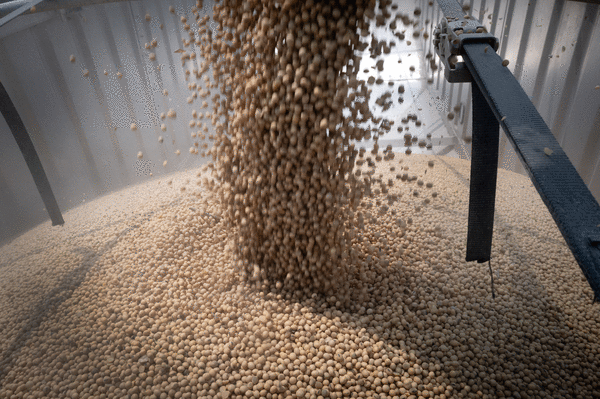
U.S. growers say the Trump administration’s $12 billion aid package brings temporary relief, but is unlikely to kickstart a lasting recovery for the American farm economy.
President Donald Trump on Monday unveiled a package to a key base of support that includes as much as $11 billion in one-time payments to crop farmers who have been hit hard by his tariff regime and low crop prices.
“This is kind of a Band-Aid — we need more markets more than we need aid,” said Missouri farmer Marty Richardson, adding that he feels like 2026 will be just as bad as this year. “We’re already buying seed for next year and fertilizer, and we’re behind the eight ball.”
It’s a familiar sentiment across the Farm Belt, as farmers have been struggling for years with weak exports, falling crop prices and rising costs. The effects of the president’s trade wars, which have squeezed demand and raised costs further, have left the sector in a state of extended uncertainty.
Meryl Kennedy Farr, a rice farmer from Louisiana who sat between the president and Agriculture Secretary Brooke Rollins when the farm aid was announced on Monday, said rice prices are the lowest she has ever seen.
“What we are seeing and facing right now is astronomical, and rice is not the only commodity,” she said, adding that the financial issues are taking a mental health toll on growers. “I’ve had farmers calling me for weeks just almost in tears about what is going to happen.”
Some growers, who are longtime supporters of Trump, are still optimistic about a recovery beginning next year, and farmer sentiment is at the highest level since June on hopes for trade with China. But the fundamentals aren’t pointing to a turnaround anytime soon.
Federal data shows farm bankruptcies on the rise, while income from selling corn, soybeans and wheat crops has declined since 2022. The U.S. Department of Agriculture forecasts net farm income will increase this year, but that is largely driven by government assistance.
Barry Evans, who grows grain sorghum, cotton and wheat in Texas, was seated not far from Trump on Monday. He said timing is of the essence for South Texas farmers who are just several weeks away from planting, and need to make plans and secure bank loans.
“Cotton and wheat all depend on export markets and they are in the tank right now,” he said. “Definitely need this relief.” While he echoed many farmers who say they wished they didn’t need federal aid, Evans said he was grateful for it.
“As a farmer, we can’t control what the markets do. We can’t control what other governments do,” he said. “They don’t all play fair, and so sometimes it’s necessary to have support.”
Many growers were seeking clarity on how much they might get from Trump’s bailout, as the announcement Monday didn’t include crop-specific breakdowns for aid. Analyst and trader Ken Morrison estimated payments could be as much as roughly $50 per acre for farmers of crops such as soybeans, cotton and sorghum.
“That’s substantial and would be enough to matter and help out cash flow,” said Ryan Wagner, a South Dakota grains grower. “As far as whether or not that’s enough to compensate for lost export business and a damaged reputation as a reliable trade partner, that’s another question entirely.”
Stress has been particularly acute among soybean farmers after China, the world’s top importer, avoided buying U.S. supplies this year to gain leverage in trade talks. Though China has resumed purchases following recent diplomatic agreements, its commitment has yet to fully pan out.
The reality is that America’s agricultural dominance is dwindling. Trump’s first trade war resulted in China accelerating a diversion of its supply chain away from the U.S. to places like South America. U.S. farmers have lost crucial market share to competitors, particularly Brazil.
“Economics 101: trade wars, nobody wins,” said Ryan Loy, an agricultural economist at the University of Arkansas. “We can point at politics, but really for many reasons at the end of the day, China goes, ‘They’re cheaper, I’m gonna buy it from them.’”
The difficulty in predicting a recovery in the U.S. farm economy was underscored last month as equipment makers including Deere & Co. gave disappointing outlooks for the year ahead, as farmers continue to hold back on buying tractors, despite Trump’s urging. The president on Monday pressured the companies to drop prices for their machines, blaming them for driving up costs for farmers.
Richardson, who grows corn and soybeans, said that while he is older and established enough to weather the strain, his sons have been squeezed.
“It’s putting the crunch on my boys,” he said. “They’re, you know: ‘I’m not buying a new pickup or not even going to John Deere, so no use for me even thinking about that because it isn’t going to happen.’”
Many believe the U.S. farm economy will continue to be mired in this downturn throughout the coming year.
“This time next year, we’re going to be having much the same conversation about margins for growers, about the potential need for economic support,” said Sam Taylor, a farm inputs analyst at Rabobank. “We could be in a trough for a little bit longer than some people would want.”
©2025 Bloomberg L.P. Visit bloomberg.com. Distributed by Tribune Content Agency, LLC.









Comments