Boeing's certification 'hangover' drags on with new 777X issue
Published in Business News
As Boeing celebrated a successful 2025 with increased profits and higher commercial airplane production, company executives were already focused on the challenges ahead.
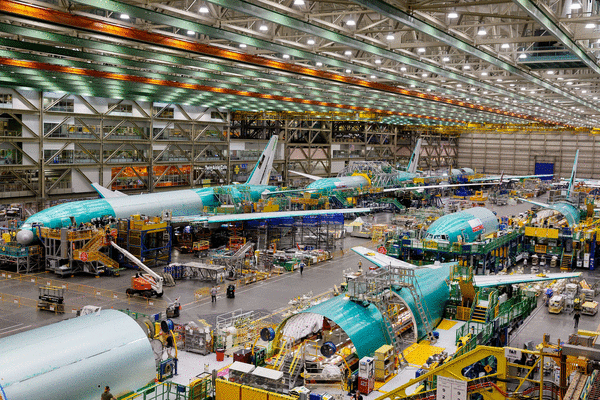
Speaking Tuesday, Boeing CEO Kelly Ortberg told investors the manufacturer planned to again increase 737 Max production this year, and had begun preparing for a fourth Max production line in Everett. Less optimistically, Ortberg said Boeing had identified another issue with its long-delayed 777X, the company’s largest and most fuel-efficient widebody plane.
The new concern, an engine durability issue, should not affect the company’s expected first delivery for the Everett-built 777X in 2027, and Boeing is continuing flight testing for the new plane, Ortberg said.
But the issue marks another hiccup in the manufacturer’s struggle to certify new commercial products. In an interview Tuesday with CNBC, Ortberg called the delayed certification of the 777X, as well as of two Max variants, the largest “hangover” from an otherwise successful 2025.
“We haven’t fully turned the corner, but we’re making real progress getting back to the Boeing everyone expects of us,” Ortberg told investors on a Tuesday earnings call announcing the company’s 2025 financial results. “While I’m proud of what we accomplished in 2025, we also know expectations are rising, and we must continue to elevate that performance.”
Boeing executives said the manufacturer would this year increase production of its Renton-built 737 Max from 42 to 47 planes per month, the second rate increase since a midair fuselage blowout in January 2024 led safety regulators to cap Boeing’s Max output.
Boeing also plans this year to produce some 737 Max 10s, the largest variant of its Max family that has yet to be certified by the Federal Aviation Administration. Company leaders confirmed Tuesday that Boeing has moved to the final phase of flight testing for the Max 10, and reiterated that it expects certification for both the Max 10 and smaller Max 7 this year.
Boeing plans to manufacture the Max 10 in Everett, on a fourth Max line that the company announced in 2023 but has yet to start operating. This month, Boeing posted job openings for the so-called North Line, a sign it is preparing its workforce for the expansion.
On Tuesday, Ortberg said Boeing had completed the tooling for the North Line, and indicated the fourth Max line would be crucial to achieving future rate increases.
“We’re going through the process of training up people,” he said. “That’s really important, as we move past 47 rate, that we have that line up and running.”
Higher deliveries, higher profits
Boeing’s increased commercial deliveries and the sale of its flight navigation unit Jeppesen led the company to a financial turnaround in 2025.
Boeing delivered 600 commercial planes in 2025, its highest annual output since 2018 and a significant increase from the 348 planes delivered in 2024.
Boeing lagged behind its European rival Airbus on the pace of deliveries, but beat its competitor’s order book for the first time in several years. With 1,173 net orders, 2025 marked Boeing’s fifth-highest annual order count ever.
Revenue increased 34%, from $66.5 billion in 2024 to $89.5 billion in 2025.
Boeing reported $2.2 billion in profit, or $2.48 earnings per share, in 2025, compared to an $11.8 billion loss, or $18.36 loss per share, in 2024.
For the last three months of the year, Boeing reported $8.2 billion in profit, or $10.23 earnings per share, a significant shift from a $3.8 billion loss, or $5.46 loss per share, in the same time period in 2024.
Boeing’s 2024 started with a midair fuselage blowout in January, prompting the FAA to cap Max production for more than a year as Boeing created and implemented a manufacturing plan focused on safety and quality. The second half of the year was marked by a nearly two-month Machinists strike that halted production in Boeing’s Puget Sound-area factories and costly fixed-price contracts for some defense programs.
In 2025, the FAA allowed Boeing to increase Max production for the first time since the panel blowout, ramping up from 38 to 42 planes per month, and once again allowed Boeing to help certify its planes were safe to fly, an authority the regulator revoked after two fatal Max crashes in 2018 and 2019.
Boeing also increased production of its 787 widebody plane in North Charleston, S.C., from five per month to eight, and broke ground on a$1 billion site expansion to further increase production rates for the Dreamliner. Ortberg said Tuesday Boeing hopes to reach a monthly production rate of 10 Dreamliners this year.
In the fourth quarter of 2025, revenue from Boeing’s commercial airplanes division more than doubled, from $4.7 billion in the last three months of 2024 to $11.4 billion in the last months of 2025.
In its defense division, Boeing last year won an initial contract to build the U.S. Air Force’s future fighter jet, the F-47. It also faced a three-month strike in its St. Louis defense factories, though the company maintained the work stoppage did not materially affect production or financial results.
In the fourth quarter, Boeing lost $600 million on its KC-46 tanker program, a derivative of the Everett-built 767 freighter that Boeing’s commercial division sends to its defense unit. The charge comes from higher production costs in the Everett facility as well as the supply chain, company leaders said Tuesday.
“It is taking us more resources to make the deliveries,” Ortberg said, adding that Boeing delivered 14 KC-46 tankers in 2025 and plans to deliver 19 in 2026. “We made the conscious decision that we needed to keep resources at a higher level to ensure we make those deliveries on time.”
Revenue from the defense division increased in the fourth quarter, from $5.4 billion in the last three months of 2024 to $7.4 billion in the same time period in 2025.
Boeing’s global services division also saw revenue increase, from $5.1 billion in the fourth quarter of 2024 to $5.2 billion in the same quarter last year.
In the fourth quarter, Boeing finalized a deal to acquire supplier Spirit AeroSystems and completed a sale of its flight navigation unit Jeppesen. The Spirit acquisition increased Boeing’s debt from $53.4 billion to $54.1 billion.
The $10.6 billion Jeppesen sale boosted Boeing’s assets from $23 billion to $29.4 billion. It drove Boeing’s substantial increase in earnings per share quarter over quarter, adding $11.83 earnings per share.
Another 777X concern
The 777X, an upgraded version of Boeing’s 777 twinjet, is meant to offer a larger and more efficient widebody to the market. It is powered by the largest jet engines ever built, and features wings so long they come equipped with foldable wingtips to fit into airports.
The family of planes, including two passenger variants and a freighter, has been delayed for years as Boeing navigated manufacturing defects and heightened regulatory scrutiny.
In October, Boeing took a$4.9 billion charge related to its 777X program, and again delayed its timeline for the first 777-9 to 2027.
Ortberg said at the time the company was “disappointed with the 777X delays,” but “it shouldn’t overshadow the progress we’re making.”
On Tuesday, he said the aircraft and engine “continue to perform well,” but told analysts the company had identified an engine durability issue during a recent inspection.
Boeing is in discussions with engine maker GE Aerospace, Ortberg said, without elaborating. Boeing declined to share any more details about the issue.
A spokesperson for GE confirmed the 777X flight test program is ongoing and that there are no changes to Boeing’s estimated delivery schedule.
“We have an on-wing inspection program in place to support Boeing while we analyze the issue and define the corrective action, guided by our safety and quality systems,” the spokesperson said.
Ortberg added that “demand for the airplane remains strong, and we remain confident the 777X will be the next flagship airplane.”
The company’s two Max variants, the Max 7 and Max 10, have also been delayed in certification, due to an issue with the plane’s engine anti-ice system. Boeing now has a “final set of design changes to permanently address” the issue, Ortberg said Tuesday.
Boeing has about 30 Max 7 and Max 10 planes in its inventory, Chief Financial Officer Jay Malave told investors Tuesday, and expects to build more Max 10s this year. Boeing will deliver those planes after FAA certification, he said.
‘On the right track’ for 2026
In 2025, Boeing spent more money than it generated, reporting a cash outflow of $1.9 billion. Its expenses, particularly related to investments in its 787 production facility in North Charleston and defense factories in St. Louis, exceeded the money it had on-hand from operating cash flow.
But that’s a significant improvement from a year earlier. In 2024, it reported a cash outflow of $14.3 billion.
Last year, it saw positive free cash flow in two quarters, generating $238 million in the third quarter and $375 million in the fourth.
Boeing executives are optimistic the company’s recovery will continue, estimating it could generate between $1 billion and $3 billion in free cash flow in 2026.
Malave, Boeing’s CFO, expects 2026 will follow the same trajectory as 2025, with the first two quarters recording negative cash flow before shifting in the second half of the year. That outlook again includes costs related to Boeing’s facilities in North Charleston and St. Louis, Malave said.
Boeing also expects to make a one-time payment to the Justice Department this year, part of an agreement to resolve a criminal charge stemming from the Max crashes.
In November, the Justice Department secured judicial approval to move forward with a nonprosecution agreement, which would drop the criminal fraud charge while imposing new fines and compliance requirements on the company.
Malave, who joined Boeing in August, reiterated a Boeing goal that started before his time: generate $10 billion in free cash flow. He didn’t put a timeline on the goal, but said “We’re absolutely on the right track” to achieving it.
“I think our potential supports being above” the $10 billion target, he continued, “but first things first.”
©2026 The Seattle Times. Visit seattletimes.com. Distributed by Tribune Content Agency, LLC.










Comments