Affordability angst: How automakers are courting price-shocked buyers
Published in Business News
For 27-year-old Kenneth Slowik, an affordable vehicle is the 1998 Chevrolet GMT truck he bought last month for $900, complete with a broken driver-side door that he taped shut to keep out the cold during the frigid Michigan winter.
The truck runs, he said. That's about it.
"I was looking for something just to transport for work, for me and my wife," said Slowik, who lives in Port Huron near the Canadian border and works as a dishwasher. "I got that out of it, at least until I can get my taxes in and then get a better vehicle."
While Slowik made do crawling out the passenger-side door of his nearly 30-year-old truck, the average sale price of a new full-size pickup hit roughly $66,000 in January, according to Cox Automotive.
Even as consumers and elected officials increasingly call for less expensive options, demand for profit-rich pickups and SUVs has been "incredibly resilient," Cox Automotive executive analyst Erin Keating wrote.
"The expensive stuff sells," said Doug Smith, president of the Missouri Automobile Dealers Association. Adding: "And there’s profit in those cars for the manufacturers, too."
Demand for both high-end and affordable vehicles is a symptom of what experts call a K-shaped economy. While the wealthiest benefit from a booming stock market, lower earners are struggling with inflation and stagnant wages.
The dynamic is pushing middle- and lower-income people away from new vehicles, which on average now cost roughly $50,000, and toward used vehicles. Many are sticking with what they have, hiking the average age of vehicles to nearly 13 years as of 2025.
"Especially on a new vehicle, we're hitting you with a $40,000 price," said Perry Watson IV, president of the National Association of Minority Automobile Dealers. "If you're a dual-income household with two professional working individuals, that's great. But if you're a just-graduated college student carrying student loan debt, that's a challenge.
"We as an industry, along with our partners — the banks and everyone else — need to find a way to make vehicles more affordable," Watson said.
High-income spenders are helping prop up new car sales and the economy as a whole. Excluding commercial vehicles, U.S. sales inched slightly up in 2025 compared to 2024, according to S&P Global Mobility.
Analysts don't expect that to last. S&P Global Mobility forecasts a roughly 2% dip in sales this year, to 15.98 million new vehicles.
"Uneasy consumers — combined with potential OEM price adjustments — translate to low expectations for 2026 US auto sales," S&P auto analyst Stephanie Brinley wrote at the start of the new year.
To manage the natural ups and downs of the economy, U.S. automakers must take a cue from the Chinese and figure out how to make cheap cars, analyst and market researcher Sam Abuelsamid said.
"If you have more affordable vehicles, even in a tighter economy, people are still going to have a need to buy them," said Abuelsamid, vice president of market research and insights for Novi, Michigan-based Telemetry. "And then you can keep people employed (and) keep your factories running."
GM, Ford and Stellantis
The Detroit Three automakers — General Motors Co., Ford Motor Co. and Jeep-maker Stellantis NV — helped fuel the rise of money-making SUVs and pickups in the United States. Now that President Donald Trump's administration is striking rules that limited tailpipe emissions and nudged vehicle makers toward hybrid and electric models, U.S. automakers are renewing their commitment to gas-powered behemoths.
"That to me does not seem like the right strategy," Abuelsamid said. "When you've got a potential down cycle, investing a huge amount of money in expanding production of those vehicles does not to me seem like the right strategy to be able to deal with a down cycle."
"Those are the products that are going to suffer in a down cycle because people won't be able to afford them," he added.
It's hard going back to inexpensive offerings, especially sedans, after U.S. companies ceded the small-car market to foreign automakers such as Toyota Motor Corp. and Honda Motor Co., said Tu Le, managing director of consulting firm Sino Auto Insights.
But automakers are reevaluating their lineups in response to calls for affordability.
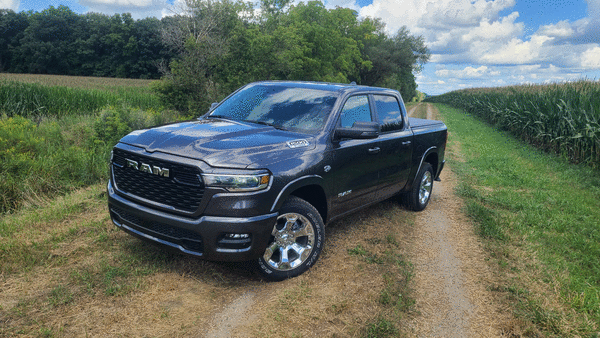
After leaning into luxury with Jeep Grand Wagoneers that can reach surpass $100,000 and Ram full-size pickups that can cost $70,000 or more, Stellantis CEO Antonio Filosa now says the company is considering new offerings in the sub-$40,000 and sub-$30,000 range.
For now, the carmaker's cheapest U.S. model is the Jeep Compass, which starts at $29,355, a price that does not include destination, title and registration fees. The newly-revived Jeep Cherokee starts at $35,000.
On the higher-end, Ford is prioritizing off-road trims like Raptors, V-8-powered F-150s and Lariat models. The Lincoln luxury brand is encouraging Corsair buyers to upgrade to Nautilus SUVs following the discontinuation of the compact crossover.
Currently, Ford's cheapest model is the compact Maverick pickup, which starts at $28,145 plus fees. With production ending of the Ford Escape compact crossover, Ford is promoting the Maverick and Bronco Sport SUV, which starts at $31,845, as alternatives.
Ford says it will have five affordable models under $40,000 by the end of the decade, including the first vehicle on its Universal EV Platform, a midsize truck starting at $30,000, a new gas truck and a new gas and hybrid commercial van.
"What Ford is doing with their universal EV program is directionally correct," Abuelsamid said. "Stellantis, GM and everybody else need to be looking at: How can we do that? How can we get some products into the marketplace that will be more affordable?"
GM is simultaneously cranking out more of its best-selling trucks and SUVs and promoting the Cadillac luxury brand through Formula 1 while doubling down on lower-end models.
"Now, historically what you would have heard from a General Motors presentation is, 'OK, well you made all your money in trucks and SUVs and you gave a little bit of it back at the low end,'" GM Chief Financial Officer Paul Jacobson said during a Chicago Federal Reserve Bank conference this month. "We've been able to create a portfolio where we can make money top to bottom."
GM's No. 4 best-selling model in 2025 was the Chevrolet Trax subcompact SUV, which starts at $21,700 plus fees. The brand's small SUV, the Trailblazer, starts at $23,300, and GM has been teasing the under-$30,000 price tag for its upcoming, limited-release 2027 Bolt electric vehicle.
"The Trax, the Trailblazer and the Bolt all hit in the lower end of the market, where very few players are," Fiorani said. "And Chevrolet has demonstrated the ability to sell large numbers of those vehicles. Consumers are finding it tough to buy a new product and are pushing themselves into the used market. But the low price of the Trax and the Trailblazer are giving new vehicles to hundreds of thousands of (buyers) a year."
When 'affordable' is still too much
Car payments — on top of rent, utilities, medical bills and insurance — are not in 26-year-old Hastings, Michigan, resident Zoe Myers' budget. Myers, a stay-at-home mom, has been dumping money into the 2005 Pontiac Grand Prix she shares with her partner, who works at a Ford supplier in Saranac.
Repairs on her "beater with a heater," she said, are easier to manage than a down payment.
"When it has issues, it's not always an issue after an issue," she said. "You do the issue, and then you wait a little bit. And then there's another issue. Gradually, when you have the funds, you can fix it, instead of paying upfront for something so expensive."
For Slowik, even the industry goal of "affordable" $25,000-$30,000 vehicles is too high.
"That's a lot of money," Slowik said. "More money than I make in a year, that's for sure."
Slowik's plight reflects what's becoming a hard reality for many, Le said: "Vehicles are becoming a luxury item for rich people, unfortunately."
©2026 www.detroitnews.com. Visit at detroitnews.com. Distributed by Tribune Content Agency, LLC.










Comments