Target's 'shrink' back to pre-pandemic levels, but it's not all about theft
Published in Business News
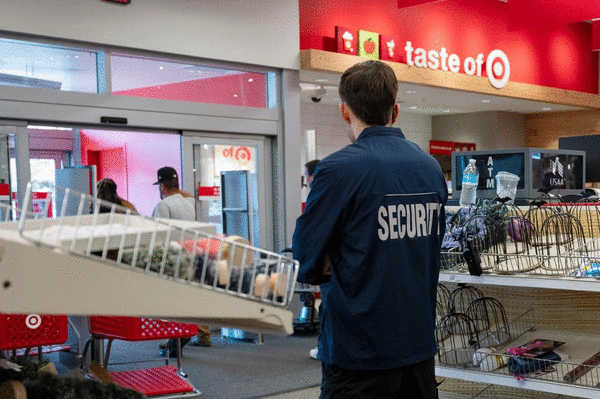
Retailers across the country, including Target, say one metric is finally improving: Shrink is returning to pre-pandemic levels.
That’s good news for the Minneapolis-based retailer’s bottom line. At one point amid the supply chain crisis following the pandemic, executives said they expected shrink, mainly from theft and organized retail crime, to reduce 2022 profits by $600 million.
Shrink — the industry term for lost inventory — is often associated with theft, in part because of industry surveys and retailer-driven narratives about shoplifting.
Target Chief Financial Officer Jim Lee, for example, told the crowd at the company’s annual investors day March 3 that the reduction was “a testament to the great work of our team, along with the industry and community efforts to combat retail theft across the country.”
The recent improvement in shrink levels may have less to do with a dramatic drop in shoplifting and more to do with supply chains stabilizing after the pandemic, analysts say.
Shrink measures the gap between what a company’s store inventory records show and what is tallied when stores actually count their merchandise.
The gap includes stolen items. But the losses also can stem from damaged goods, shipping discrepancies, billing mistakes or simple administrative errors.
“Shrink has been going down for at least the last year across all major retailers, and everybody’s high-fiving. But the most significant contributor is inventory predictability and stability,” said Brand Elverston, an independent retail consultant who formerly helped lead asset protection at Walmart.
The reprieve may be short-lived. Analysts warn tariffs, and the price changes they trigger, could potentially push shrink higher again.
Retailers, including Target, typically conduct inventory counts annually. Any discrepancy that cannot be explained by sales, returns or other adjustments is recorded as shrink.
Theft has dominated much of the conversation, in part because it’s “sexy and gets all the attention,” Elverston said. But the administrative mistakes can be just as responsible.
For example, a store may believe a truck delivered 100 items when it actually delivered 80, immediately creating a discrepancy before products even reach the sales floor.
The retail industry for decades relied on annual shrink estimates from the National Retail Federation (NRF), which surveyed executives about inventory losses and their causes.
But the trade group stopped publishing the long-running report after its 2023 survey, saying the traditional study no longer captured the changing nature of retail losses.
Others questioned the validity of the data, including Elverston, who filled out the survey when he worked for Walmart.
“Before they ceased publishing, for years, that pie chart would always say a little less than 70 percent of every shrink dollar was theft, which is ludicrous,” he said. “It’s all estimates from retailers. It’s not finite data, it’s sophisticated guesses.”
Elverston estimates that losses are likely split evenly between theft and operational breakdowns such as inventory-management errors. It may even skew to the latter for some retailers.
NRF now issues a report titled, “The Impact of Retail Theft & Violence” that surveys more than 50 retail companies on types of theft and preventative measures, such as legislation and cooperation with law enforcement.
It does not provide a dollar amount for product losses like the previous survey.
During the pandemic, retailers faced a different challenge: deeply disrupted supply chains.
Factories shut down, shipping timelines became unpredictable and retailers struggled to keep shelves stocked as shoppers’ demands fluctuated. Many companies responded by ordering extra inventory to hedge against shortages, Elverston said.
When those shipments eventually arrived — sometimes late and in uneven quantities — they affected retailers’ shrink levels, likely because companies recorded higher amounts on their books than what was ultimately delivered.
Over the past several years, companies have worked to regain control by clearing excess goods, improving forecasting and restoring more predictable ordering patterns. As those systems stabilized, shrink rates began to fall.
But many retailers plagued by empty shelves at the height of the pandemic were then left with too much inventory in 2022, potentially inflating their shrink numbers. In May of that year, Target reported its inventory was 43% higher than a year earlier and in June began slashing prices and canceling vendor orders.
“Target was not alone in that challenge,” Elverston said. “Everybody was under inventory management pressure that they had never experienced before. But when inventory levels go up, you exponentially increase your risk for whatever your sources of shrink are.”
Target entered 2026, though, “with healthy underlying margin rates and appropriate inventory levels across our assortment,” said Lee, the retailer’s CFO.
As retailers report improvements in shrink, tariffs could add pressure by creating rapid changes in product costs and shelf prices, Elverston said.
Retailers may try to import goods ahead of tariff increases, temporarily boosting inventory levels. At the same time, frequent price adjustments can complicate inventory systems inside stores.
Those fluctuations can make it harder for employees to track inventory accurately.
But advances in artificial intelligence (AI) could help retailers avoid a widening gap between reported inventory and what is actually on hand, said Dayton Steele, an assistant professor of supply chain and operations at the University of Minnesota’s Carlson School of Management.
AI tools can analyze sales data, shipment records and store inventory levels in real time, flagging discrepancies earlier than traditional annual counts. In theory, that allows retailers to detect potential losses before they accumulate into large shrink totals.
More precise inventory tracking is also becoming a priority across the industry. Retailers have invested in automated systems that scan shipments as they arrive, track items moving through distribution centers and monitor stock levels on store shelves, reducing the chance of human error.
Controlling the supply chain from end-to-end can also help reduce shrink because it creates a standard framework for tracking inventory and perishability of goods, Steele said.
Target said March 3 that it manages its entire fresh food supply chain and has seen improved on-shelf availability coming out of the November-to-January quarter.
©2026 The Minnesota Star Tribune. Visit at startribune.com. Distributed by Tribune Content Agency, LLC.









Comments