CFTC offers first guidance on manipulation in prediction markets
Published in Business News
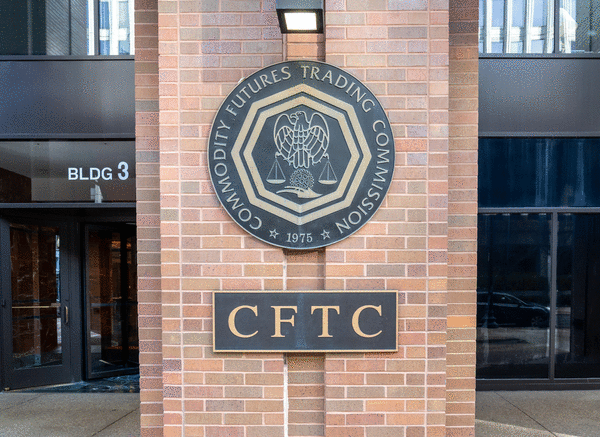
The Commodity Futures Trading Commission issued new guidance for prediction markets, asking exchanges to engage with regulators before opening certain markets that might be vulnerable to manipulation and insider trading.
The document released on Thursday offers one of the first official responses from federal regulators to several of the controversies that have swirled around prediction markets as they have exploded in popularity over the past year.
More established exchanges have recently complained that prediction markets have taken advantage of a longstanding regulatory process that allows them to create new financial contracts without explicit regulatory signoff.
Thursday’s guidance indicates that exchanges will be able to continue to use the so-called self-certification process to introduce new markets. But the CFTC says the companies “are encouraged to consider whether certain categories of event contracts create a heightened potential for manipulation or price distortion,” and to “engage with staff in the early phases of designing such contracts.”
The agency also issued an advance notice of proposed rules that tees up dozens of questions about how it might modify existing rules for prediction markets. That proposal is an early-stage effort to elicit public feedback that can be incorporated into formal regulations.
“This begins the process of new rulemaking grounded in a rational and coherent interpretation of the Commodity Exchange Act, while reassuring the American people that the CFTC will exercise its exclusive jurisdiction over prediction markets,” CFTC Chairman Michael Selig said in a statement on the notice.
The guidance and proposed rules are the latest sign that the agency is trying to bolster its authority over the multi-billion dollar markets in the face of myriad legal questions about novel financial contracts tied to sports and geopolitical events.
During the Biden administration, the CFTC pushed to restrict the expansion of prediction markets into new areas. But Selig, who took the helm of the CFTC in December after being nominated by President Donald Trump, has taken a much different approach and allowed them to rapidly grow.
Donald Trump Jr., the president’s son, is an adviser to the two most prominent prediction market startups, Kalshi and Polymarket, and Trump Media & Technology Group is creating its own prediction market product in partnership with Crypto.com, which operates OG, another prominent sports trading platform.
The exchanges and the CFTC have faced legal challenges from state regulators, who have said that prediction markets tied to sports — one of the fastest growing categories of trading — should answer to state gambling laws. But Selig has indicated that he will side with prediction markets in the ongoing court battles.
“To those who seek to challenge our authority in this space, let me be clear: We will see you in court,” Selig said in a video he posted on X in February.
The nascent industry has recently come under particular scrutiny for contracts tied to the war in Iran, including some that were focused on the removal of Ayatollah Ali Khamenei.
The CFTC said Thursday that it may block contracts tied to assassination, war or terrorism if it determines that an “event contract is contrary to the public interest.” The document, though, did not say that these markets are prohibited outright.
The commission said it was kicking off the rulemaking process in part because the number of exchange applicants has more than doubled over the last year, primarily from companies seeking to operate prediction markets. Many of the applicants plan to focus on sports, an area that has come under scrutiny because of previous sports gambling scandals.
The new guidance suggests that sports contracts can move ahead, but that the exchanges should engage with sports leagues on the oversight of potential insider trading and also work with the leagues on pending investigations.
Crypto.com launched the first sports prediction markets in the final days of 2024, soon after a court ruling paved the way for trading on the 2024 presidential elections.
The company didn’t engage with staff before launching the first contracts on the 2025 Super Bowl. Kalshi followed suit soon after.
Polymarket’s unregulated overseas exchange has long offered sports trading, but last year the company acquired licenses to launch a US-regulated exchange that is currently focused only on trading sports.
Rob Schwartz, a former CFTC general counsel and now a partner at Morgan, Lewis & Bockius, said that the new recommendation that exchanges consult with sports leagues and report on those consultations “shows full awareness of recent public concerns that insiders or other market participants may abuse the unique characteristics of these contracts.”
Crypto.com and Polymarket didn’t respond to a request for comment on the new guidance and proposed rules.
“We’re currently reviewing the CFTC’s proposals,” a spokesperson for Kalshi said. “We looking forward to working with regulators and policymakers on both sides of the aisle to keep these markets fair and safe.”
—With assistance from Nicola M White.
(Updates with comment from Kalshi in the final paragraph.)
©2026 Bloomberg L.P. Visit bloomberg.com. Distributed by Tribune Content Agency, LLC.









Comments