'It's killing everything.' California's truckers are buckling under country's priciest diesel
Published in Business News
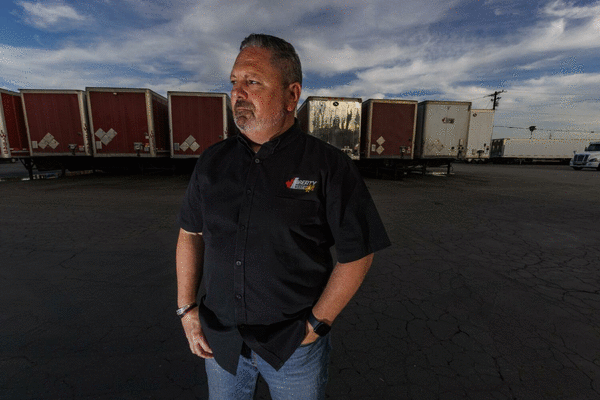
Record diesel prices are crushing California's truckers, forcing them to adjust to avoid losses as they grapple with the most expensive pump prices in the country.
Greg Dubuque's 40 drivers are in a constant diesel-devouring loop. Their big rigs pick up loads of electronics, office furniture and other goods around Los Angeles. They drive close to 1,000 miles through the Mojave Desert and over the Rocky Mountains to Denver. They bring back containers full of everything from pinto beans to home remodeling products.
One tank of gas for his vehicles cost $600 a couple of months ago. Today it costs $1,000. That's a record high and more than 35% above the country's average.
"California sets itself apart from the rest of the country when it comes to pricing," said Dubuque, a third-generation trucker and general manager of Liberty Linehaul West. "Now it's really out of control."
The average price of a gallon of diesel in California got close to $7.75 this week, up 50% from a month ago, according to the American Automobile Assn. The national average of diesel is closer to $5.65 at recent peaks.
The trucking industry was already reeling from a prolonged freight recession, a crackdown on immigrant drivers, and the adverse impacts of tariffs, all of which contributed to a significant increase in bankruptcy filings in the industry.
Now, the price shock from the war with Iran has become yet another headache for the beleaguered industry that hauls 70% of all freight in America.
"It's got a tremendous impact on the industry," said Eric Sauer, the chief executive of California Trucking Assn.
And it is not just truckers being affected. The rising prices of ground and air transportation will eventually be paid for by consumers.
The biggest companies are already passing the extra transportation costs on to consumers. FedEx, United Parcel Service, the U.S. Postal Service and Amazon said they will all start charging an extra fee. Amazon said it would apply a 3.5% charge to merchants for its fulfillment service. USPS will charge an 8% delivery fee for certain packages.
"The longer energy prices remain elevated, the more households will need to confront tradeoffs," said Philip N. Jefferson, vice chairman of the Federal Reserve, at a recent lecture.
This could eventually dampen demand for other products and further hurt the economy, Jefferson noted.
"Families who depend on petroleum products to commute to jobs and school and to heat their homes may need to pull back on more discretionary forms of spending," he said. "That could potentially result in lower spending at restaurants or retailers. It could also result in households carrying elevated levels of debt."
Truckers often rely on fuel surcharges to cover rising fuel costs. It's an industry practice for customers to pay a fuel surcharge, on top of the base freight rate, to offset unexpected fuel price increases. The fee is calculated based on a weekly diesel price index.
Sukhdeep Singh, who owns Merced County-based Cali Brothers Truck Lines, said standard surcharge policies are insufficient when there are wild swings in fuel prices.
"It's killing everything," he said.
Singh's business faced challenges earlier this year when a crackdown on immigrant drivers led to sudden departures, shrinking the available labor pool and leaving 15 of his trucks unused. Despite the diminished fleet, his weekly fuel expenses have surged from $80,000 to $130,000.
Smaller trucking companies are getting hit first.
Major carriers with thousands of trucks have different ways to hedge against price fluctuations that insulate them from temporary volatility. They have long-term shipping contracts and have greater flexibility in surcharges.
Smaller carriers are often paid at a flat rate and have no certainty about whether they will recover the higher fuel costs.
On a recent trip to Denver, one of Dubuque's trucks had to consider returning empty, as the going rate barely covered gas to get back to Los Angeles.
"I wouldn't be able to cover my cost," he said.
He has been instructing drivers to save on fuel by planning their routes, finding truck stops with the best rates, and avoiding California when possible.
"Where we're trying to avoid buying fuel is here in the state of California," he said.
He is also asking his regular customers to pitch in.
Liberty Linhaul West's fleet also works with L.A.'s entertainment and event industries, transporting staging, lighting and other equipment for events such as the Oscars, Grammys and Country Music Awards. He's started calling customers with whom he had flat rates to renegotiate prices.
"We started calling customers, saying, 'Okay, we need some emergency help here,'" Dubuque said.
While he appreciates that the extra fees and restrictions on fuel help build roads and protect the environment in California, he would love to see more support from the state.
"I think the government needs to interact with the oil and fuel world and talk about how they can take this pain away from us, or at least try to lessen this blow," he said.
Without an end to high oil prices or some help from the government, customers can expect the same sticker shock the trucking industry is struggling with.
"Whether you're a grocer, a meatpacking plant, a vegetable grower, that cost has to be factored in, because it doesn't matter who you are, you're faced with it," Dubuque said. "The impact was so hard and so fast, I would think we're going to start seeing just another increase to the cost of goods for people."
©2026 Los Angeles Times. Visit at latimes.com. Distributed by Tribune Content Agency, LLC.










Comments