Jury awards total of $70 million in damages in case against Abbott over infant formula
Published in Business News
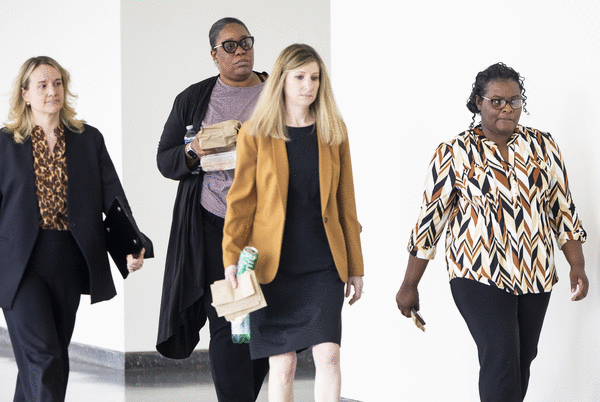
A Cook County jury on Friday decided that Abbott Laboratories should pay $17 million in punitive damages — on top of the $53 million in damages awarded a day earlier — in four cases in which mothers alleged the company’s formula for premature infants caused their babies to become severely ill.
The decision Friday came at the close of a monthlong trial that was the first against Abbott in an Illinois state court over whether its formula for babies born prematurely causes a devastating intestinal disease called necrotizing enterocolitis. NEC is an often-fatal illness in which the lining of the intestine becomes inflamed and dies.
The trial has been closely watched because of its potential implications for both north suburban-based Abbott and families of premature babies nationwide.
Abbott faces more than 1,700 similar lawsuits across the country over its formula for premature infants.
In the cases that were at trial this month, four mothers — Antonia Mendez, Casie Thompson, Kara Sharpe and Eboni Williams — had alleged that the formula was defective, that Abbott failed to adequately warn of its dangers and that Abbott was negligent. Their babies were all born at Chicago area hospitals before 32 weeks gestation between 2012 and 2019 and all developed NEC after consuming Abbott’s Similac Special Care.
Three of the four children underwent surgery as infants, and all four continue to have serious gastrointestinal issues, said Sean Grimsley, an attorney for the mothers and a partner at Olson Grimsley, during the trial.
On Thursday, the jury found Abbott liable on all three counts against it for each child. The jury found that the formula was defective, that Abbott failed to warn about its dangers and that Abbott was negligent.
Also on Thursday, the jury decided to award $15 million each to two of the children, $16 million to the third child and $7 million to the fourth child. Those damages are meant to compensate the children for loss of a normal life, disfigurement, pain and suffering and increased risk of future harm.
The additional $17 million in punitive damages the jury decided on Friday are meant to punish the company and deter it from future wrongful conduct. Attorneys for the mothers had sought $530 million total in punitive damages.
Before the punitive damages were decided Friday, lawyers for the mothers and Abbott offered the jury arguments about why it should and should not issue punitive damages, respectively. In order to award punitive damages, the jury had to find that Abbott conduct was “willful and wanton”
A large award of punitive damages would send Abbott a message, Kenzo Kawanabe, a partner at Olson Grimsley representing the mothers, told the jurors Friday morning.
“This is about our most fragile patients,” Kawanabe said. “This now is about protecting those premature babies that are yet to be born from a company that prioritizes profits over preemies.”
He said that Abbott should have put a warning on its formula label about the risks of NEC.
But Hariklia Karis, a partner with Kirkland & Ellis representing Abbott, told the jury Friday morning that the jury had already sent Abbott a message with the verdict and $53 million in compensatory damages the day before.
“There is no question that Abbott takes your finding seriously,” Karis told the jury. “Abbott cares very much about its products. It cares about its reputation as well. We understand through your verdict and your conclusion, you have determined that not enough was done, perhaps different language on a label, perhaps further marketing, perhaps some different decisions along the way, but please understand the company has heard the message that you have sent.”
She said Abbott had not concealed anything about the risks of NEC, nor shown indifference for the safety of babies. Rather, she argued, Abbott’s Similac Special Care is a necessary product in hospitals across the country, a last resort for feeding babies when mother’s milk and donated breast milk are not available.
Research has shown an association between consumption of cow’s milk-based formula by preterm babies and higher rates of NEC, and that breast milk helps to protect against NEC. But Abbott has long maintained that its formula does not actually cause the illness. Rather, the four preterm babies at the center of the recent trial would have developed the illness because of other conditions, even if they had not had the formula, Karis argued during trial.
Karis said that the consequences of the jury issuing large punitive damages would be “enormous.”
“The consequence of that is to basically say preterm infant formula, because it’s not the same as human milk, cannot exist,” Karis said.
Abbott’s CEO has previously suggested that the company could pull the formula altogether because of the flood of litigation — a move that doctors worry could mean fewer nutritional options for babies born prematurely.
The four cases that went to trial this month are among a number of other similar ones that have also been filed in Cook County Circuit Court. In addition to those cases, hundreds of similar cases have been filed in federal court in Chicago.
So far, cases against Abbott over its preterm formula have only gone to trial two other times beside the one that just concluded in Cook County. Both other trials were in Missouri state court. One of those cases resulted in a $495 million verdict against the company, and the other in a win for Abbott.
Abbott is appealing the $495 million verdict. In the other Missouri state court case, in which Abbott and another manufacturer of preterm infant formula, Mead Johnson Nutrition, were found not liable, a St. Louis judge later granted a motion for a new trial citing “errors and misconduct.” Abbott is also appealing that decision.
©2026 Chicago Tribune. Visit at chicagotribune.com. Distributed by Tribune Content Agency, LLC.



Comments