Boeing's Max deliveries dip even as quarterly numbers pass 2023 levels
Published in Business News
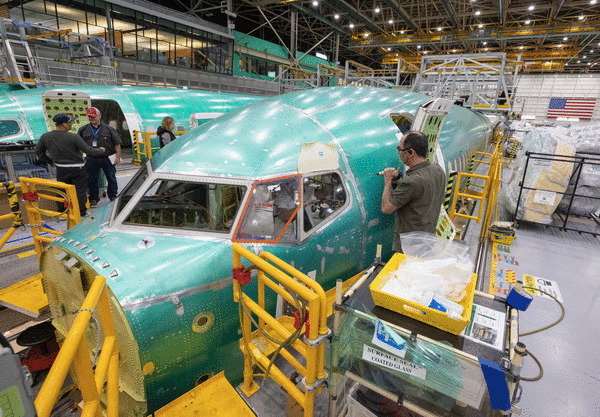
Boeing delivered fewer airplanes in March than the month prior as it dealt with an issue on a small number of 737 Max planes.
Still, the planemaker’s first quarter deliveries rose above 2023 levels, the company said Tuesday.
Boeing delivered 143 airplanes in January, February and March this year, an increase from 130 planes in the same three months last year and just 83 planes in the first quarter of 2024. A midair fuselage blowout in January 2024 significantly slowed 737 Max production in Boeing’s Renton factory as the manufacturer worked to address concerns about its quality and safety practices.
In the first quarter of 2023, before the midair incident and resulting fallout, Boeing also delivered 130 airplanes.
This year, as Boeing had been steadily increasing Max production, the manufacturer warned in March that it had identified small scratches on the wires of some 737 Max planes due to a machining error.
The scratches did not present a safety risk, Boeing said, but the company briefly halted Max deliveries. It resolved the issue by mid-March, Chief Financial Officer Jay Malave told investors at a financial conference last month. Boeing had to rework about 25 planes to fix the issue.
“The impact here is really one of timing,” Malave said, adding that he expected to shift about 10 Max deliveries from the first quarter to the second. “So, fairly limited in the grand scheme of things.”
Boeing did deliver fewer Max planes in March. It delivered 33 Maxes last month, compared to 43 in February and 37 in January, according to numbers shared by the company Tuesday.
Boeing’s overall deliveries also decreased month to month but remained in line with its January count.
In March, Boeing delivered a total of 46 airplanes, a dip from the 51 it delivered in February but equal with the 46 it delivered in January.
It saw an uptick in deliveries of its South Carolina-built 787 Dreamliner, increasing from five in January and three in February to seven in March.
On that program, Boeing continues to face delays related to the airplane’s seats. Safety regulators like the Federal Aviation Administration and European Union Aviation Safety Agency must signoff on new seats and new seat configurations. The slow certification process doesn't affect production but can hold up deliveries as Boeing waits for regulators to approve an airline's decision.
Malave said in March that there have also been “issues here and there” on some interior components for the 787 “from a quality standpoint,” without elaborating on what issues he had seen.
“Quality needs to get better, so that we can improve the delivery,” he said.
Last month, Boeing also delivered three 777 freighters and one 767 freighter. It delivered a second 767 to its defense division for the KC-46 tanker program and one 737 NG to its defense division for the P-8 program.
Boeing’s European rival Airbus delivered more planes in March than its competitor — Airbus delivered 60 planes while Boeing delivered 46.
But Boeing came out on top for the first quarter — Airbus delivered 114 airplanes in the first three months of the year, while Boeing delivered 143.
Boeing booked 33 gross orders in March, including 19 737 Maxes, five 737 NGs and1 737 Max for a Boeing business jet customer. It also booked orders for eight 787 Dreamliners. All those orders are listed for unidentified customers.
It recorded two cancellations for the Max, and, adjusting for accounting principles, moved nine orders out of its backlog and into its reserve.
That resulted in 22 net orders for the month.
From the beginning of January through the end of March, Boeing booked 161 gross orders. Factoring in cancellations and accounting principles, Boeing booked 140 net orders.
Boeing’s commercial airplanes backlog dropped from 6,151 at the end of February to 6,127 at the end of March.
©2026 The Seattle Times. Visit seattletimes.com. Distributed by Tribune Content Agency, LLC.










Comments