Trump's national security strategy veers inward in telling shift
Published in News & Features
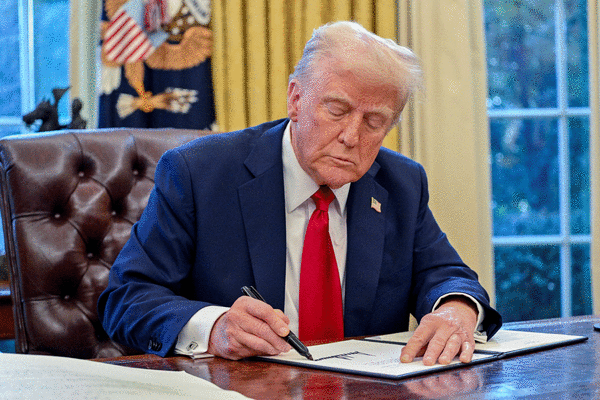
WASHINGTON— President Donald Trump’s new national security strategy codifies the disruptive foreign policies he’s pursued since taking office — including railing against allies as often as traditional foes — but also veers inward with an emphasis on domestic and culture war issues.
Unlike previous national security documents, the one released overnight into Friday highlights the administration’s views about the perils of immigration and the need to re-industrialize the U.S. economy.
It lambastes “American elites,” seeks the “restoration and reinvigoration of American spiritual and cultural health,” uses terms like the “Anglosphere,” and calls for “growing numbers of strong, traditional families that raise healthy children.”
The document emphasizes defense of the U.S. homeland but focuses not on state-level adversaries such as China or Russia, but on unchecked migration and transnational criminal organizations. It also warns of international organizations “driven by outright anti-Americanism” and “transnationalism.”
All those elements highlight how the strategy sets down in writing the most detailed articulation of the norm-shattering foreign policies of Trump’s second term. The document veers away from traditional U.S. priorities such as supporting democracy, instead castigating Europe for its supposed cultural decline.
It features one section — “What Are America’s Available Means to Get What We Want?” — that pushes for exerting “leverage” over countries that want access to the vast U.S. consumer market.
Michael O’Hanlon, defense and strategy chair at the Brookings Institution, called the document a useful tool for understanding which constituencies have the greatest influence within the administration.
“It’s partly an effort for the administration to put pressure on people abroad, to speak to constituencies at home, to prepare for future campaigns of friendly politicians they want to see elected,” he said, calling the document unsurprising. “Nobody expected a touchy-feely, pro-ally report from this administration. Nobody expected Trump to not be Trump.”
While the first Trump administration took a more favorable approach to Europe in its 2017 National Security Strategy that was more than twice as long, the terse 2025 edition challenges the continent for its waning economic influence and burdensome regulation.
References to “cratering birthrates, and loss of national identities and self-confidence,” as well as warnings that Europe itself faces the risk of “civilizational erasure,” will likely cheer far-right forces challenging Europe’s traditional political parties.
“EU and NATO observers will likely see this highly ideological strategy document as confirmation of established concerns about the direction and style of American policy,” said Ian Lesser, a distinguished fellow and head of the German Marshall Fund’s Brussels office. “It also points to European cultural and demographic decline in ways likely to reinforce the views of hard right elements in Europe.”
Reflecting Trump’s repeated praise for Vladimir Putin over the years, Russia is treated not as a major potential threat to the U.S., but as a global power with which the West must restore stability. China, which has traditionally been characterized as a malicious and capable near-peer geopolitical rival, is framed less as an existential threat than as a consequence of long-standing U.S. policy failures.
The strategy also calls for a reallocation of U.S. military assets to the Western Hemisphere, which appears first among geographic regions in the report before Europe or the Middle East, “and away from theaters whose relative import to American national security has declined in recent decades or years.”
The strategy is a faithful expression of Trump’s worldview that ties domestic priorities to “a transactional foreign policy explicitly aimed at advancing them,” said Adam Farrar, a senior geoeconomics analyst at Bloomberg Economics.
It “appears to demote Beijing and the broader Indo-Pacific below the Western Hemisphere in priority and elevates political intervention along ideological lines in Europe — a clear pivot in tone and intent,” he said.
Others were less diplomatic about the document, saying it was a direct challenge to years of consensus between parties. Kori Schake, a former U.S. official in Republican and Democratic administrations, noted the contradiction of its “focus on non-interference in states coupled with such aggressive intrusiveness in European states’ policies.”
“It’s an act of vandalism against the very things that make America strong, safe and prosperous,” said Schake, who is now director of foreign and defense policy studies at the American Enterprise Institute.
(Tony Capaccio and Andrea Palasciano contributed.)
©2025 Bloomberg L.P. Visit bloomberg.com. Distributed by Tribune Content Agency, LLC.






Comments