Automatic draft registration, recruiting tweaks included in NDAA
Published in News & Features
WASHINGTON — Young men are set to be automatically registered for the draft under the compromise version of the fiscal 2026 National Defense Authorization Act unveiled Sunday night.
The automatic draft registration provision was one of several measures included in the bill that broadly aim to make it easier for the military to find young people at a time when the propensity to serve remains low.
The U.S. has not drafted anyone into compulsory military service since 1973, but young men still have to register with the Selective Service System in case there is a draft again in the future. Failing to register is a felony punishable by a fine of up to $250,000 and five years imprisonment, as well as a loss of eligibility for federal jobs and, in most states, state student aid and state jobs.
Under the NDAA provision, the Selective Service System would be able to tap into existing government data, such as Social Security Administration information, to automatically register all 18- to 26-year-old men.
The Selective Service System would also be tasked with notifying men they have been registered, as well as asking them for any missing contact or biographical information and informing them of the process to unregister if they’re not actually required to register.
Some men are exempt from registering if, for example, they have a medical condition that confines them to home or are in the country on a nonimmigrant visa.
The provision would take effect one year after the bill’s passage, which is expected by the end of the month.
Lawmakers tried to set up automatic draft registration in early versions of last year’s NDAA, as well. But the provision was scuttled from the version of the bill that became law after influencers, including rapper Cardi B, spread misinformation on social media that the legislation meant Congress would reinstate the draft.
Supporters of automatic registration argue it’s a commonsense solution to a growing problem: Registration rates are declining even as advertising budgets are increasing. Since the government already knows who needs to register, supporters contend, there is no need to put the burden on young men and punish them for what could be an innocent mistake.
Automatic registration “simply moves the burden of filing the registration paperwork from the individual to the government, where it belongs,” Rep. Chrissy Houlahan, D-Pa., a member of the Armed Services Committee who championed the NDAA provision, said in a statement Monday. “Not only will automating registration save taxpayers money, but it will also make it easier for young men to follow the law and register with the selective service.”
But opponents of automatic registration counter that allowing the Selective Service System to access other government databases is an invasion of privacy that would deny conscientious objectors the ability to refuse to register.
“This extensive data gathering poses a significant risk of weaponization and misuse, particularly with the potential for targeting the most vulnerable such as immigrant and transgender young adults,” the Friends Committee on National Legislation, the lobbying arm of the Quakers, said in a post on its website last month.
Beyond the automatic draft registration, the compromise NDAA would make several other tweaks to the way the military interacts with young people.
For example, the bill proposes to amend requirements for high schools to give access to campus to military recruiters. Under the new language, schools that receive federal funding must give recruiters access “that is equivalent to access provided to such campus to a prospective employer of such students, an institution of higher education, or another recruiter.”
Schools must also allow recruiters to attend at least one career fair or similar event per academic year.
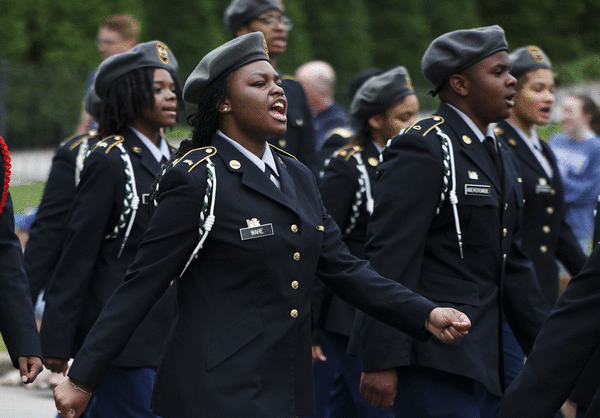
The bill also would increase the number of authorized Junior Reserve Officer Training Corps, or JROTC, units. Right now, the law calls for between 3,400 and 4,000 units in the high school program. Under the NDAA, that will increase to between 3,600 and 4,200 units.
While JROTC is not officially a recruiting program, military officials and lawmakers have increasingly seen it as an opportunity to build interest in military service and interact with young people who are inclined to serve.
Lawmakers advocated both for bulking up JROTC and increasing military recruiters’ access to high schools amid a recent recruiting slump. That slump has already turned around over the last year, but lawmakers are seeking to maintain the recruiting momentum.
_____
©2025 CQ-Roll Call, Inc., All Rights Reserved. Visit cqrollcall.com. Distributed by Tribune Content Agency, LLC.





Comments