NDAA makes exceptions on DC military flight restrictions
Published in News & Features
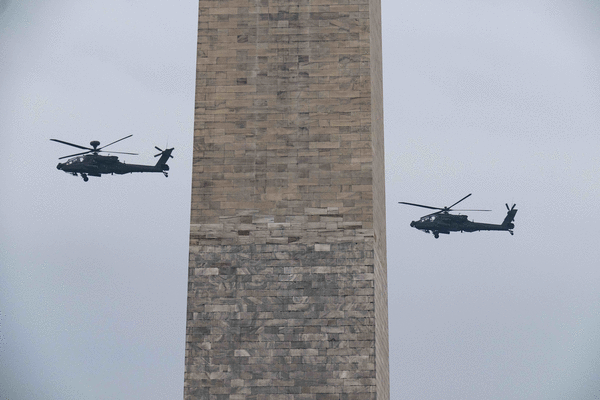
WASHINGTON — The compromise House-Senate fiscal 2026 national defense authorization bill includes requirements and restrictions for military training flights operating in Washington airspace, but stops short of mandating National Transportation Safety Board recommendations included in a bipartisan Senate measure.
The legislation is a response to the fatal midair collision between a commercial flight and a Blackhawk Army helicopter in January. The NDAA provisions would specifically restrict military training helicopters from operating in the “special flight rules area” — a 30-mile roughly circular area surrounding the city — unless the aircraft is actively providing warning of its proximity to nearby aircraft.
But the NDAA language would allow the Defense and Transportation secretaries to waive the proximity transmission requirement in the case of national security interests or if commercial flights are found not to be at risk. They would have to give notice to Congress for waivers that last more than 30 days.
The bill would also require the Defense Department to report to Congress on the number of near misses between military and commercial aircraft over the past year.
The provisions leave room for more exceptions than the measure sponsored by Senate Commerce Chairman Ted Cruz, R-Texas, with ranking member Maria Cantwell, D-Wash., among the 16 co-sponsors, eight from each party. Their bill would implement some NTSB recommendations on D.C.-area flight restrictions and when safety technology must be on.
The panel approved that bill in an en bloc package by voice vote in October.
The NTSB found in its preliminary report on the January crash at Ronald Reagan Washington National Airport that the Army helicopter had its Automatic Dependent Surveillance-Broadcast Out system, a technology that transmits location data quickly to nearby aircraft and air traffic control towers, disabled during the flight.
The helicopter hadn’t transmitted ADS-B-Out data to an FAA ground station for 730 days prior to the accident, although it was not clear if it was malfunctioning or turned off, the report said.
Army Brig. Gen. Matthew Braman told senators in March that Army policy is that ADS-B-Out transmission must be off for certain sensitive operations in matters of national defense, homeland security, intelligence and law enforcement if transmitting would compromise the operation’s security of the mission or pose safety risks to the crew.
Although some of the safety provisions in Cruz and Cantwell’s aviation bill fall outside the NDAA’s jurisdiction, the defense policy bill’s language is still looser on exemptions to military flight requirements.
The aviation safety bill, for example, would require the definition of waived flights to be “narrowly construed” and would specifically prohibit Army training flights and flights transporting federal officials below the rank of Cabinet member to be exempt from the requirements.
The NDAA text narrowly requires position transmissions for only military training flights in the area and doesn’t explicitly define “national security interests.”
The Senate aviation safety bill would also establish an Office of Federal Aviation Administration-DOD Coordination to streamline communication between the agency and the Defense Department — language that’s not included in the NDAA text.
A Senate Commerce Republican spokesperson declined to comment on the NDAA provision.
_____
©2025 CQ-Roll Call, Inc., All Rights Reserved. Visit cqrollcall.com. Distributed by Tribune Content Agency, LLC.






Comments