Thai leader's hard line on Cambodia clash risks irking Trump
Published in News & Features
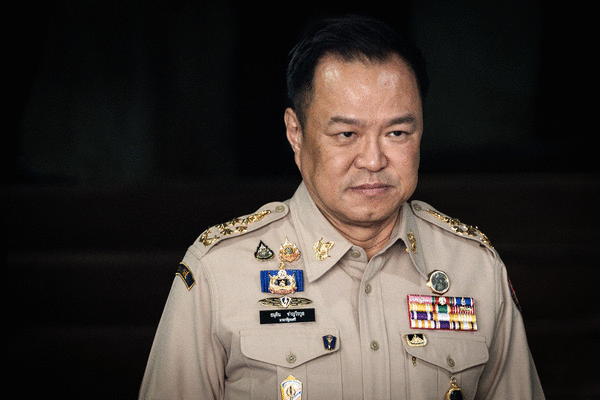
Thai Prime Minister Anutin Charnvirakul is using fresh border skirmishes with Cambodia to tap nationalist sentiment at home before an election. In doing so he’s gambling it won’t unduly irritate U.S. President Donald Trump, who claimed credit for ending a previous outbreak of fighting.
It’s a delicate line to walk for Anutin, who insists the Cambodia dispute is separate from Thailand’s trade negotiations with the U.S. Trump though has linked them previously — in fact, he used the threat of trade penalties to prod Thailand and Cambodia into a ceasefire earlier this year.
At a ceremony in October to formalize an agreement between Thailand and Cambodia to manage their tensions, Trump declared “we did something that a lot of people said couldn’t be done, and we saved maybe millions of lives.” And the Thai-Cambodia issue is one he often cites when declaring how many wars he says he’s ended this year.
Last month, Trump called Thai and Cambodian leaders to urge them to stick to the peace deal after Bangkok unilaterally suspended the accord following a landmine blast that injured several Thai soldiers.
Trump has yet to comment on the latest clash. Secretary of State Marco Rubio released a statement Tuesday strongly urging the “immediate cessation of hostilities, the protection of civilians, and for both sides to return to the de-escalatory measures” outlined in the Oct. 26 pact.
“The latest escalation risks reinforcing concerns in Washington that Bangkok is either unable or unwilling to stabilize the conflict, potentially slowing negotiations or prompting the U.S. to demand stronger security guarantees as a precondition for economic concessions,” said Laura Schwartz, senior Asia analyst at Verisk Maplecroft, a risk intelligence company.
For now, Anutin seems focused more on the potential domestic payoff for sounding tough. He’s only been in power a few months and leads an awkward coalition held together mostly by his promise to dissolve parliament soon with elections expected in March. His government’s focus has been on what he calls a “quick, big win” economic agenda — delivering short-term stimulus to gain popularity.
“Politicians in many Southeast Asian countries need some kind of problem to sustain public support for their regime,” according to Su Mon, Asia-Pacific senior analyst at the Armed Conflict Location & Event Data Project. “Having an external threat always works in creating solidarity between the government and the population.”
The tensions between Thailand and Cambodia along their roughly 800-kilometer (500-mile) border have ebbed and flowed for many years, fueled periodically by nationalist imperatives for their leaders at the time. In the latest outbreak that began on the weekend, Cambodia and Thailand are trading barbs about who is at fault and accusing the other of escalating.
Anutin has strongly backed his military, perhaps learning from the experience of predecessor Paetongtarn Shinawatra. She held a secret call with the Cambodian leadership — seemingly bypassing the military — and the leaking of the contents of the call led directly to her ouster. Army Chief of Staff General Chaiyapruek Duangprapat has spoken of the goal “to render the Cambodia militarily ineffective for a long time — for the safety of our children and grandchildren.”
Su Mon said Anutin’s actions give the military more freedom when it comes to the border issue. “It’s very important for any Thai government to have a good relationship with the Thai military.”
It’s also arguably important for Thailand to have a good relationship with the U.S., its biggest export market at $63.33 billion in 2024.
“Trump’s personal investment in brokering the ceasefire means that renewed violence will inevitably shape U.S. perceptions of Thailand’s reliability as a negotiating partner,” said Schwartz from Verisk Maplecroft.
For now Anutin is shrugging off that risk.
“This is a matter between Thailand and its neighbor,” he told reporters on Monday. When asked if he had any concerns over U.S. trade talks, he replied: “no concern.”
The tensions also come as Thailand deals with some of the worst flooding in the south in decades and as the government faces criticism for a slow and uneven response. The floods hit at the start of the peak tourism season, and the government estimates economic losses from the deluge could be as much as 500 billion baht.
Anutin’s stance against Cambodia is backed by a degree of public support. A poll in August found more than half of respondents said Thailand shouldn’t be associated with Cambodia, and an even bigger majority believed the “interference by super powers” was for their own vested interests.
He also has perhaps surprising backing from business groups, some of whom face a collective $3.1 billion hit from border-trade disruptions, as well as U.S. tariffs. The Thai Chamber of Commerce said in a written statement this week that “the security of the nation and the lives of its people must take priority over economic considerations.”
Still, Thailand’s economy showed less resilience to global trade volatility compared to other key emerging markets analyzed by Verisk Maplecroft. The country already faces sluggish economic growth and slowing tourism arrivals, with this year’s expansion slowing to 2.1% and annual visitor numbers dropping for the first time since Covid. While exports grew for the 16th straight month in October, some shipments may be driven more by the rerouting of goods to the U.S. from China.
Cambodian Senate President and former Prime Minister Hun Sen this week accused Anutin of using attacks on his country to gain votes in the upcoming elections. But Hun Sen and his son, current Prime Minister Hun Manet, may also stand to benefit from the escalation.
Cambodia’s relatively new prime minister “has a military background and is a West Point graduate, and is careful to defend any perceived challenge to Cambodia’s sovereignty from its neighbors,” said Tom Pepinsky, a professor at Cornell University who studies political and economic systems in Southeast Asia.
--------
—With assistance from Eric Martin and Michelle Jamrisko.
©2025 Bloomberg L.P. Visit bloomberg.com. Distributed by Tribune Content Agency, LLC.






Comments