Venezuelan ex-general claims Rodríguez siblings run Maduro's criminal regime
Published in News & Features
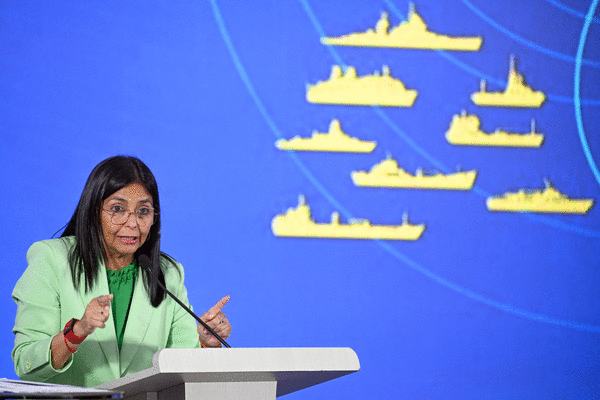
Former Venezuelan Gen. Cliver Antonio Alcalá Cordones, currently serving a 21-year prison sentence in the United States, claims in a letter to President Donald Trump that Nicolás Maduro’s regime is effectively run not by the strongman himself but by two of his closest allies: siblings Jorge and Delcy Rodríguez.
Alcalá, who pleaded guilty last year to supplying weapons and protection to Colombian guerrillas, says the Rodríguez siblings are the true masterminds behind the notorious criminal network known as the Cartel de los Soles.
“Delcy Rodríguez is the current vice president of the country, and her brother Jorge Rodríguez is the current president of the National Assembly of Venezuela,” Alcalá writes in the letter, published by the Dallas Express. “They are the real controllers of Nicolás Maduro and Diosdado Cabello. The regime’s survival in power is largely due to these two individuals.”
The letter comes as reports suggest the Rodríguez siblings are attempting to promote themselves as more acceptable alternatives to Maduro in the eyes of the Trump administration. Maduro himself is wanted by the U.S. Department of Justice on drug trafficking charges, with a record-breaking $50 million reward for information leading to his capture.
Alcalá’s letter is the second issued this month by a former high-ranking forrmer general offering to disclose the inner workings of Venezuela’s regime. Last week, Hugo Carvajal Barrios, a former three-star general, sent a letter from a U.S. federal prison alleging the Venezuelan government’s involvement in narcotics trafficking, organized crime and intelligence operations in the United States.
In his letter, Alcalá frames himself as a cooperative intelligence source, citing his 34-year military career and his experience commanding operations such as the 2011 takeover of Tocorón prison in Aragua, which left 16 inmates dead. He claims that the raid revealed the roots of the Tren de Aragua criminal group, which he says still operates under Maduro’s direction.
The former general details what he calls the deliberate criminalization of state institutions, particularly Venezuela’s prisons. After retiring in 2013, following Maduro’s ascent, he says he observed a growing symbiosis between political leaders and criminal networks.
According to Alcalá, prison officials were instructed to manipulate inmate votes in elections, facilitate crimes outside detention, and serve as conduits for government illicit activities.
He specifically implicates former Sports Minister Antonio “Potro” Álvarez in coordinating with prison leaders and criminal groups.
“With his political consolidation, the prison-based criminal structures were strengthened under [Maduro’s] control,” Alcalá writes. “Instructions were even given to control inmates’ votes in elections, while criminals came and went to commit crimes, and prisons functioned as depots for weapons and other illegal elements.”
Alcalá also claims the Rodríguez siblings manipulate Venezuela’s electoral system. He names General Carlos Quintero, vice president of the National Electoral Council, as the operative overseeing electoral fraud through electronic voting systems, which he says operate largely under the siblings’ control.
Beyond domestic affairs, Alcalá claims Maduro has cultivated long-term ties with Iran, including the Islamic Revolutionary Guard Corps and Hezbollah, personally managing the sensitive relationships. He also claims the Venezuelan leader has boasted of influence over U.S. legislators.
Drug trafficking and illegal mining, he says, are central to the regime’s operations. The Arco Minero del Orinoco, a strategic mining region, is identified as a hub for gold, diamond and mineral extraction, with proceeds laundered through the Cartel de los Soles. Alcalá claims Maduro’s son has personally overseen those activities.
“Gold and diamonds served as key commodities in the money-laundering mechanism of the drug trafficking carried out by what is now known as the Cartel de los Soles,” he writes.
Alcalá traces his personal opposition to Maduro to the death of Hugo Chávez, describing the Venezuelan president as a “criminal gang leader.” He recounts multiple attempts to restore democracy, including periods of exile in Colombia, which he says put him at personal risk. Despite his imprisonment, he says he is offering cooperation to U.S. authorities to safeguard both nations.
If verified, Alcalá’s claims would challenge longstanding U.S. assumptions about Venezuela’s leadership. The Cartel de los Soles—a term describing a network of military officers involved in narcotics trafficking—has long symbolized Venezuela’s institutional corruption. Alcalá’s letter goes further, asserting operational control by key political figures and detailing the integration of criminal, political, and electoral power under Maduro.
In closing, Alcalá appeals directly to Trump and the American public, emphasizing that Maduro’s regime threatens U.S. national security. He pledges to testify about all matters within his knowledge and reaffirms his commitment to restoring democracy in Venezuela.
©2025 Miami Herald. Visit at miamiherald.com. Distributed by Tribune Content Agency, LLC.





Comments