NC Gov. Josh Stein reverses cuts to Medicaid, but says it'll run out of money
Published in News & Features
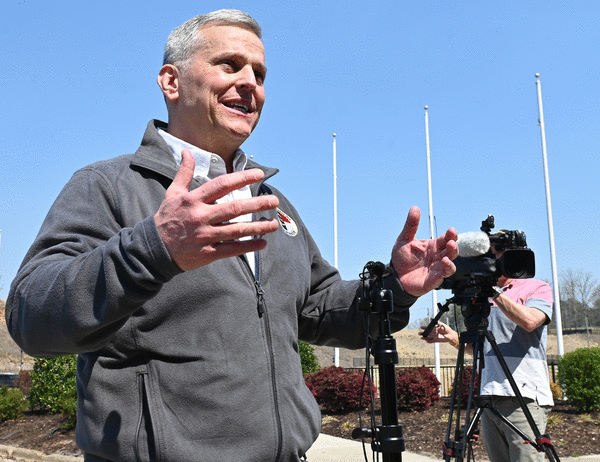
RALEIGH, N.C. — Gov. Josh Stein on Wednesday announced that he would reverse cuts his administration made to Medicaid provider payment rates, saying months of legislative inaction left the program underfunded and led to a wave of lawsuits from patients and providers.
For months, Stein said, the state’s health and human services department had “warned” lawmakers that Medicaid was running out of money and that, without additional funding, substantial cuts would be enacted on Oct. 1. Lawmakers agreed more funding is needed but have failed to reach a deal, leading to the reductions of 3% to 10% that have strained providers and families, he said.
The cuts drew rebuke from Republican lawmakers, who control both chambers. GOP leaders said the cuts could have been delayed while negotiations continued and accused the administration of acting too quickly and for political reasons.
Stein, a Democrat, has countered that DHHS had already postponed cuts once and that waiting further would force deeper reductions later.
And on Wednesday he said the GOP’s “failure forced these cuts, which are causing real and damaging impacts on people’s health and well-being. Their failure is irresponsible and callous, and it’s infuriating, because all of this was absolutely unnecessary.”
“All they had to do was their most basic and important job — pass a budget,” Stein said during a news conference at the Executive Mansion, surrounded by providers and others, including North Carolina Healthcare Association President Josh Dobson, a Republican former lawmaker who represents hospitals.
North Carolina remains the only state in the country without a budget, which was due at the end of June.
Lawsuits against the Medicaid cuts
Stein said providers and affected families then turned to the courts. The department is facing several lawsuits over the cuts, including one challenging the 10% reduction to services for children with autism.
Two cases have already been decided in favor of patients, and three more cases have also been filed “with even more waiting in the wings,” Stein said.
“DHHS can read the writing on the wall,” Stein said. As a result, the department “is restoring all provider rates to where they were on Sept. 30 before the cuts took place,” he said at the news conference.
“That’s what’s changed,” Stein said. “Here’s what has not changed. Medicaid still does not have enough money to get through the rest of the budget year, and that is even (more) clear now that we’re nearly six months into this fiscal year and we can see how Medicaid spending is actually tracking.”
Stein said Medicaid will run out of funding in the spring, “which will be absolutely devastating, not only to Medicaid patients, but to the entirety of our health care system.” He called on lawmakers to come back to Raleigh and “do your job.”
More than 3 million people in North Carolina rely on Medicaid. DHHS Secretary Devdutta Sangvai said if Medicaid is not fully funded, “services could be eliminated. Providers could be left waiting for payments that may never come. Clinics and practices, especially those in rural areas where so many residents rely on Medicaid, could be forced to lay off staff and stop serving patients or simply close their doors all together.”
Sangvai told reporters after the news conference that projections show Medicaid running out of money by April, and possibly March.
As for whether the damage from the cuts could be reversed, Sangvai said the “anecdotal evidence” shows providers had only begun planning reductions to take effect at the end of the year, so “we’re hopeful that anything they had planned is now reversible.” He said the cuts are being reversed retroactive to Sept. 30, which will allow DHHS to reprocess claims submitted since Oct. 1.
Stein said he spoke Tuesday with several senators — including Senate leader Phil Berger — and with House Speaker Destin Hall to inform them of the reversal.
“I encouraged them to come to the table and fund this, and I’m hopeful that they will. I wish I had complete certainty that they would, but I hope they will. I think they will,” he said.
‘Politically motivated’
Republican leaders have backed raising Medicaid funding to about $690 million, but the House and Senate have been unable to reach agreement.
Senate leaders want to include funding for a children’s hospital negotiated in 2023; House leaders have questioned that funding and tied it to broader budget talks. Both chambers passed Medicaid funding bills in October but have not taken up the other’s version.
In attendance Wednesday was Republican Sen. Jim Burgin, who chairs the committees on health and human services appropriations and on health care. Burgin said he was disappointed in Stein’s tone.
“I’ve already told the governor’s staff to share with him that I was disappointed in the comments. I’d hoped what he was going to say was that he was restoring the rates and that he would work with us on getting this fixed,” he said. “I think it was too partisan and too political.”
Burgin said he has been at the legislature for four budgets and had never seen Medicaid rates reduced.
“Tell me when we have not taken care of Medicaid? We’ve never done this before,” he said.
He said in similar situations when Kody Kinsley, who retired last year, was DHHS secretary, “we worked with it and dealt with it. This is a process.” Burgin often attended events with Kinsley and was viewed as a key player in building bipartisan support for Medicaid expansion in 2023.
Burgin said he had just spoken with Sangvai. “I’ve become close friends, and I appreciate him, and I’m going to work with him,” he said.
In early November, Stein called for a special session to shore up Medicaid funding, but lawmakers declined to return, saying he had not met constitutional requirements because the General Assembly was already in session.
Lawmakers at the end this year have held a series of short, one- to two-day sessions, often near the end of each month, to address unfinished business. Those sessions have not produced a budget or a deal on Medicaid funding, though the October session resulted in a new congressional map favoring Republicans.
©2025 The News & Observer. Visit at newsobserver.com. Distributed at Tribune Content Agency, LLC.





Comments