'Happy for the early Christmas gift': Illinois State Sen. Emil Jones III reaches deferred prosecution agreement in bribery case
Published in News & Features
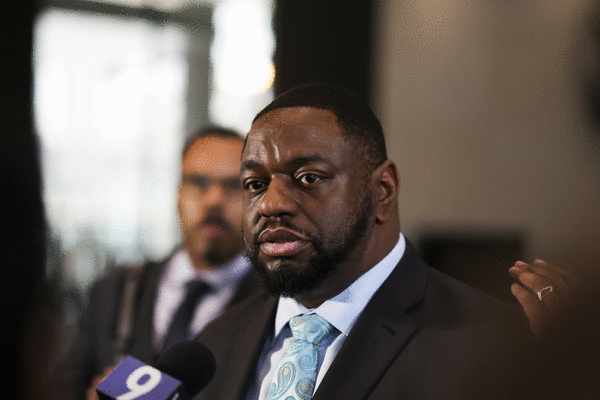
CHICAGO — A month before his scheduled retrial on bribery charges, state Sen. Emil Jones III has agreed to enter into a deferred prosecution deal that will leave him with no conviction as long as he admits to certain illegal conduct and pays a fine.
The agreement with the U.S. attorney’s office was announced at a hearing Thursday before U.S. District Judge Andrea Wood and scuttles a trial that had been set for Jan. 12.
Under the terms of the deal, Jones agreed to pay a fine of $6,800, stay out of legal trouble, and make admissions about his meetings with FBI mole Omar Maani and false statements he later made to the FBI about how much Maani paid Jones’ intern.
If Jones lives up to his end of the bargain, the charges against him will be dropped in December 2026.
Dressed in a brown suit, Jones stood at the lectern in court Thursday and told the judge he was satisfied with the work of his attorneys. When the judge asked if he wished to enter into the agreement, he answered, “Absolutely” in a deep voice.
Jones, who’d entered court walking with a limp, later asked to sit down due to a sprained ankle. Asked by reporters on his way out of court how he felt, Jones smiled and said: “Happy for the early Christmas gift, and I’ll see you all in 12 months.”
A U.S. attorney’s office spokesperson declined to comment.
Jones, 47, a Chicago Democrat and son of former Senate President Emil Jones Jr., was charged in 2022 with agreeing to take bribes from Maani, an executive of a red-light camera company, in exchange for Jones’ protection in Springfield against legislation that would hurt the company’s bottom line.
His first trial in April ended in a mistrial after the jury failed to reach a unanimous decision on all counts.
The deal to avoid a felony conviction means Jones’ political career, which had been on life support, is now very much alive. Although he was stripped of his committee chairmanship after being charged and some leaders — including Gov. JB Pritzker — said he should resign, Jones not only remained in the Senate but was reelected that November to a term that ends in January 2027.
Now, Jones is seeking a fifth term in office and is on the ballot for the March Democratic primary with two other candidates, campaign records show.
Meanwhile, Jones’ deal with the government marked the second high-profile public corruption case in recent months to end in a deferred prosecution agreement after a jury deadlocked.
In October, former AT&T Illinois President Paul La Schiazza entered into a strikingly similar deal after a mistrial on charges involving a scheme to bribe then-House Speaker Michael Madigan. La Schiazza had also been set for retrial in January.
For Jones, his deal with the government comes more than six years after FBI agents confronted him at his Roseland neighborhood home as part of a sweeping investigation into bribery schemes involving red-light cameras, liquor licenses and other graft across the west and southwest suburbs.
At the heart of the probe was Maani, co-founder of SafeSpeed LLC, who agreed to work undercover for federal investigators after being confronted with evidence he was paying off officials in Oak Lawn in exchange for political support to add SafeSpeed cameras at additional intersections.
Maani, who was also granted a deferred prosecution agreement by the U.S. attorney’s office for his extensive cooperation, was the star witness at Jones’ trial, testifying for the first time in public about his prolific turn as an FBI mole. That cooperation also netted the convictions of former Crestwood Mayor Louis Presta, ex-Oakbrook Terrace Mayor Anthony Ragucci, and Jeffrey Tobolski, the former mayor of McCook and Cook County commissioner.
According to the charges, Jones agreed to accept $5,000 in campaign funding from Maani in exchange for Jones agreeing not to file a bill calling for a statewide study of red-light cameras. Jones also offered to “protect” the company from his friend, then-state Rep. David McSweeney, who had filed bills of his own calling for an all-out ban of red-light cameras, according to prosecutors.
Evidence at the trial showed Maani also allegedly agreed to hire Jones’ district office intern at SafeSpeed.
At the heart of the case were a series of undercover videos made by Maani as he sat down at steakhouses in Oak Brook and Chicago with Jones as well as then-state Sen. Martin Sandoval, the powerful and corrupt head of the Senate Transportation Committee who was taking cash payments from Maani in exchange for being SafeSpeed’s protector in the General Assembly.
One video, from a meeting between Jones and Maani in July 2019 at Steak 48 on North Dearborn Street, showed Jones digging into his favorite wagyu filet as Maani brought up Jones’ upcoming fundraiser at Sox Park.
“How much money you want me to come up with?” Maani asked. “You tell me a number.”
Jones initially demurred, telling Maani no one had ever asked him that before. But Maani explained he was different, that he always wanted to meet expectations.
“You’re already meeting expectations, Omar,” Jones said, cutting into his steak while a hidden camera sat somewhere on the table across from him. “You’re a good guy. I like you all’s company a lot.”
Then Jones dropped the number: “If you can raise me five grand, that’d be good.”
“Done,” Maani replied quickly.
Maani repeatedly stressed that he needed to keep their relationship a secret and that any donations would have to be hidden so the source would not be publicly known. “Especially in this day and age, keep it quiet. Is that cool?” he said.
“Yeah that’s fine,” Jones replied.
“We’re gonna know each other for a very long time, building our relationship and I will be there for you every time,” Maani said.
At his trial, Jones made the risky decision to testify in his own defense, telling the jury his namesake father, who spent nearly 40 years in the General Assembly before retiring in 2008, inspired him to go into politics.
“Ever since I was a child, I always wanted to be a state senator like my father and I decided to run,” Jones testified, leaving out that his father had retired abruptly after winning the primary and pitched his son as his replacement to favorable Democratic committeemen.
He also told the jury that Maani reminded him of “a used car salesman” and that he never asked him directly for any money, only possible support for a fundraiser.
“Had an answer for everything,” Jones testified. “He talked a lot. He repeated himself over and over again.”
_____
©2025 Chicago Tribune. Visit chicagotribune.com. Distributed by Tribune Content Agency, LLC.





Comments