As Florida offshore drilling looms, birds less protected from spills under Trump
Published in News & Features
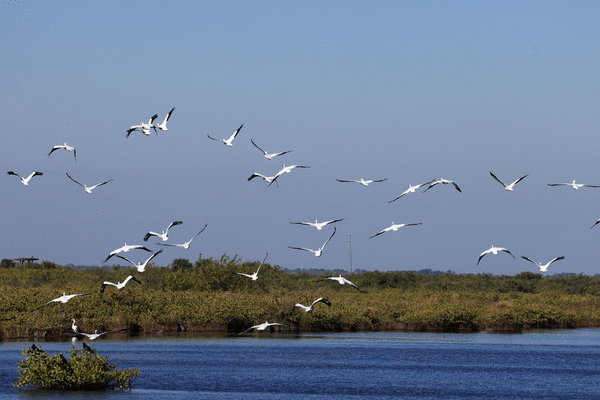
TAMPA, Fla. — Richard Baker remembers the feathers: bright white and striking.
Just 20 days earlier, the Deepwater Horizon oil rig had exploded, killing 11 people and igniting one of the worst environmental disasters in modern history. A pelican and a Northern gannet were the first two birds plucked by wildlife rescuers from the oily waters near the disaster zone. Once-regal feathers had been doused with dark, sticky oil.
After days of cleaning and rehabilitation, the avian duo was released into Pelican Island National Wildlife Refuge on Florida’s east coast. Baker recalls the oil-free feathers as a vivid streak in the sky as the birds flew away.
“It was very impressive to me that we could do this,” said Baker, who as a local Audubon society leader released the pelican and gannet alongside federal veterinarians. “The birds seemed thankful for us.”
But not all birds were as lucky. By some estimates, more than a million were killed by the spill.
Their deaths added up to an enormous fine for BP: $100 million of its whopping $4 billion penalty was for killing birds protected by one of the nation’s oldest environmental laws, the Migratory Bird Treaty Act.
But now, the Trump administration has weakened that law’s protections, just as it proposes bringing oil drilling closer to Florida’s coasts. The result: Gulf Coast birds could be more vulnerable than ever to the offshore oil industry.
“We cannot let this happen again,” Baker said. “It was awful.”
The Migratory Bird Treaty Act passed in 1918 — a time when species were disappearing because of demand for feathers in fashion and hunting for sport. It prohibits the unauthorized harming of birds.
Regulators have used the law to penalize oil companies after spills, including Exxon after the 1989 spill in Valdez, Alaska, as well as BP. Members of more than 100 species were hurt by the Deepwater Horizon disaster, including black skimmers, brown pelicans, laughing gulls and terns.
But regulators don’t just use the law after the worst happens on a rig. The act also requires oil companies to get federal permits for the birds they will unintentionally hurt and kill through normal, day-to-day operations.
Scientists estimate hundreds of thousands of birds are burned, poisoned by oil or otherwise killed each year near drilling rigs in the Gulf of Mexico. The birds will strike equipment, for example, after being attracted to lights or the prospect of human food.
The law’s power, said Tara Zuardo, a senior advocate at the Center for Biological Diversity, comes from its emphasis on prevention: The permit process encourages companies to improve practices and reduce bird deaths.
But earlier this year, the Trump administration announced it would change the way the federal government interprets the law so that oil companies won’t be penalized for birds they harm unintentionally.
The change was a victory for the oil industry, which says bird protections remain strong.
“Our industry is committed to safe, responsible energy development in the Gulf of America and has taken significant steps to protect wildlife,” said the American Petroleum Institute, an industry lobbying group, in an emailed statement. “Operators are already subject to robust federal laws and oversight that hold companies accountable and ensure strong environmental protections remain in place.”
The administration is taking the opposite approach to renewable wind energy.
In July, the U.S. Department of Interior announced the agency would review bird death rates from wind energy projects to determine whether those deaths violate the Migratory Bird Treaty Act, running counter to its softened stance on the law for the oil industry.
Zuardo said it’s unlikely the administration’s watering down of the law would hold up in court, pointing to a 2020 legal decision.
“But at the same time, what matters here is enforcement,” she added, noting that the administration could try to weaken actions against fossil fuel companies.
This isn’t the first time the administration has taken this position on the bedrock bird protection law — it launched a similar rollback during President Donald Trump’s first term. But this time, the move is coinciding with the federal government’s proposed expansion of offshore drilling into waters closer to Florida, despite heavy opposition from the state’s Republican U.S. Senators, all its members of Congress and Gov. Ron DeSantis.
Opposing offshore oil drilling has long been a point of bipartisan agreement in a state with an economy that depends on tourism and pristine beaches. Florida officials like DeSantis have also said offshore rigs would hamper military training efforts for bases in the Panhandle.
Ann Paul, president of the Tampa Audubon Society, remembers the images of birds covered in oil, and the ones who died after swallowing oil-slicked fish after the 2010 Deepwater Horizon spill. She worries about rigs inching closer as wildlife protections wane.
“Are we willing to risk that along the coast of Florida?” she said. “What we need to be doing is increasing enforcement of this law — instead of diluting it.”
--------------
©2025 Tampa Bay Times. Visit at tampabay.com. Distributed by Tribune Content Agency, LLC.




Comments