Chicago Mayor Brandon Johnson's organizer roots at fore as he courts progressives in budget fight
Published in News & Features
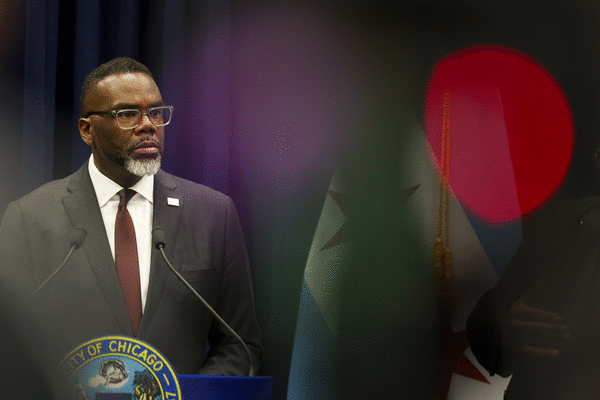
CHICAGO — The trenches are dug in Chicago’s slow-moving budget battle. And as he seeks to gain ground with a government shutdown weeks away, Mayor Brandon Johnson keeps lobbing the same ordnance: harsh words.
Last week, opponents of his plan to implement a corporate head tax were “cowards.” He tagged them with a pair of new epithets Wednesday.
“They are immoral. They are wicked,” Johnson said during a City Hall news conference, a remark a spokesperson later said was aimed not at aldermen opposed to his budget, but at mostly anonymous wealthy Chicagoans bankrolling a pushback campaign.
The mayor is far from the only one firing shots. Those groups opposed to his budget have spent tens of thousands of dollars on ads blasting his spending plan, and specifically the controversial head tax at its center.
“Chicagoans deserve honesty and transparency and real solutions that make our neighborhood safer,” one ad from a dark money group opposed to the head tax says. “Not a slush fund that puts politics over people.”
Aldermen in the opposition have harried the mayor with daily news conferences and jabs.
“I don’t think he understands the foundational issues of governing, much less how to do a budget and what’s really in there,” Ald. Scott Waguespack, 32nd, a leader of that pushback, told the Tribune.
Other organizations allied with the mayor have spent big too, even depicting Johnson’s aldermanic opponents as marionettes controlled by billionaire hands.
It’s essentially a public relations campaign aimed from both sides at the hearts and minds of Chicago residents, a war of words waged on TV, online and in the pages of papers. Such campaigns are a routine part of politics, but this budget year they are taking place as aldermen decry a lack of meaningful private negotiations where the real work to craft a municipal budget often takes place.
Johnson remains stuck short of the 25 votes he would need to break a tie and pass a budget. Similarly, the aldermen trying to pass their own plan remain far shy of the 34 votes they would need to overcome the veto Johnson has promised if they hike garbage fees as they have proposed. The two sides remain deadlocked as the city races closer each day to the end-of-year budget deadline.
The mayor has barely budged on his head tax push, though he altered the proposal last week to target companies with more than 500 Chicago employees monthly, at $33 per job. A majority group of aldermen has rejected the proposal, in a committee vote and petitions.
The static back-and-forth has kept City Hall’s focus squarely on the head tax, right where Johnson wants it.
He has pitched the tax as the key component of negotiations and a critical test in which aldermen will either support “working people” or the “ultrawealthy.” And he has carefully cast himself as a foil to his opponents, a move that reaffirms his progressive bona fides with a reelection campaign set to start in mere months.
Earlier this month, Mayor Johnson sounded a lot more like activist Johnson in a private huddle with the Progressive Caucus.
Johnson addressed the bloc made up of his closest ideological allies in the council for over 20 minutes and sought to remind them of where they came from. The Chicago Teachers Union organizer-turned-mayor stressed that this budget was not his, but a product of the progressive movement after over a decade of organizing to reach “our moment,” according to two sources familiar with the caucus meeting.
He repeated that he needs all 19 progressives to unite on his spending plan, sources said. It was a revealing window into how Johnson’s team continued to view these negotiations through the lens of being with his leftist coalition or against it.
But right now, caucus members Aldermen Desmon Yancy, Ruth Cruz, Ronnie Mosley, Andre Vasquez and Matt Martin have all expressed concerns with the overall budget to varying degrees. And the moderate-led council opposition is looking to pounce.
For his part, the mayor says the alternative budget so far backed by a council majority is no budget at all because it relies on unfounded assumptions that make it unbalanced. The groups opposing the head tax aren’t motivated by public interest, but by “the bottom line, how they can get richer,” the mayor again argued Wednesday.
Those opponents have scheduled a series of council meetings for this week as they attempt to pass their version over Johnson’s objections.
Johnson has repeatedly identified as backers of the attempted aldermanic end run the groups One Future Illinois, led by former Rahm Emanuel campaign manager Michael Ruemmler, and Common Ground Collective, led by Chuck Swirsky, once chief adviser to former Chicago Public Schools CEO Pedro Martinez.
The mayor has taken particular aim at investor Michael Sacks, a close Emanuel adviser who is one of around 90 donors to contribute $10 million to the latter group. Meanwhile, the groups and their allies have helped aldermen opposing Johnson organize news conferences and publicize analysis to undercut the mayor’s efforts.
They have also purchased dozens of social media ads, both slamming the Johnson budget’s supporters and praising its critics. Altogether, the two groups have spent around $100,000 on Facebook ads, according to the social media platform. They have also run TV ads.
Asked about the mayor’s criticism and the ad buys, Swirsky said Johnson and his allies are trying to bully their way to a budget.
“Everyone knows you have to stand up to a bully,” he said.
On the other side, the Atlanta-based Black Voters Matter Fund has spent around $80,000 on Facebook ads to back up Johnson’s head tax push. That effort to pass Johnson’s tax is further backed by a fleet of local progressive groups.
Facing backlash, at one point last month the group suspended an ad campaign depicting several aldermen as puppets and clarified in a post, “The ad was never meant to attack any elected official personally. … We are always willing to adjust our messaging.” Since then, the organization has put new ads up.
Though both opponents and proponents of the head tax have pointed to employment data as evidence it would either hurt or have no effect on local jobs, experts have said the data is inconclusive.
The Institute for the Public Good, a think tank whose leadership has ties to Johnson, has also shared data on federal tax rates for corporations, arguing that changes in rates don’t impede economic activity and that companies are benefiting from historic levels of tax breaks under Trump. There is less analysis on the impact of municipal-level head taxes, however, as few places have tested them out in the U.S.
Denver and Mountain View, California, both have a version of the head tax; the latter is home to Google headquarters. Seattle’s head tax — implemented then quickly repealed — was replaced by its “JumpStart” tax on payroll expenses, which faced fierce opposition from Amazon.
The CTU launched a barrage of robocalls last week, charging specific aldermen with cutting millions from neighborhood schools after they officially introduced their alternate budget without the head tax. The tweaked counterproposal retains Johnson’s record $1 billion tax increment financing surplus for CPS, however.
“If you believe (they) should stand with Chicago families instead of protecting big corporations, please … let them know you want them to tax ultrawealthy corporations,” the message said.
A coalition of unions and progressive community groups even held a rally earlier this month outside the office building of GCM Grosvenor in a bid to target Sacks, who led fundraising for the 2024 Democratic National Convention.
“How dare we protect CEOs who are living in mansions and having expensive meals when you have seniors standing in lines, begging for groceries,” close Johnson ally Ald. William Hall, 6th, told the crowd.
At the end of the protest, police detained several demonstrators dressed as Santa Claus as they blocked a Michigan Avenue intersection.
Johnson’s side has argued the tax revenue would go into a “lock box” to support existing community safety efforts, such as summer jobs for teens and neighborhood violence intervention work. Opponents have slammed that idea that the money truly funds such services as, in the words of Ald. Matt O’Shea, 19th, “a gimmick.”
Several attack ads from Johnson allies have zeroed in on Progressive Caucus aldermen who have shown a willingness to break from the mayor, including Yancy, Vasquez and Martin.
Vasquez, 40th, who was depicted as a puppet in front of the likes of Trump and Elon Musk in a Black Voters Matter Fund ad, told the Tribune Wednesday he has “no problem” with a head tax, but has concerns about the revenue estimates from the mayor’s team. He accused Johnson’s administration of withholding the data needed to explore changes to the mayor’s plan: “They’re asking us to help them cook when they won’t show us the ingredients,” he said.
According to Johnson spokesperson Cassio Mendoza, the projected $82 million haul from the tax is based on the number of 500-plus employee companies the administration estimates operate in Chicago using census data, city business licenses and data from the old Chicago head tax rescinded by Emanuel. Johnson’s administration has repeatedly said it cannot share a list of the companies it expects to be taxed, citing rules around sharing tax information.
But the North Side alderman, who called Johnson’s head tax focus “insincere, disingenuous and a cynical way to try to pass a budget,” is instead troubled by Johnson’s plan to cut a planned $260 million advanced pension payment down to $140 million and borrow $166 million to pay for firefighter back pay and $283 million for police settlements. The borrowing will carry $42 million in interest costs.
Martin, 47th, who joined Vasquez to vote against Johnson’s budget last year, also cited the borrowing and shrunken advance payment as “key shortcomings.”
“I don’t get the impression that those concerns are really understood by as many people who should know about them and be concerned,” he told the Tribune.
To pressure Yancy, 5th, Johnson supporters dialed up a flurry of urgent texts from former colleagues during Yancy’s time as a leftist labor organizer. In one response, Yancy retorted he had similar data concerns, “all while this administration has failed to build relationships with allies to pass his agenda.”
“The problems with this budget are more related to a lack of Goodwill and preparing a budget than anything,” he wrote.
The ads and rhetoric from Johnson and his allies have also driven away aldermen in the council’s ideological middle. Ald. Pat Dowell, 3rd, whom Johnson picked to lead the Finance Committee, noted the jabs tied to her backing of the alternative proposal.
She has been falsely accused of supporting a property tax increase, “trying to take meals away from seniors” and wanting to cut youth summer jobs, she said.
“No one likes the attacks when they are not true,” Dowell said. “Many of the priorities that the mayor has, I also share, but we have to figure out how to fund those.”
For his part, Johnson earlier this month couched his budget defense in deeply personal terms.
“If you’ve never gone hungry, you wouldn’t know why I had that urgency,” a hoarse Johnson said about his budget proposal during a City Hall news conference. “If you’ve never opened up your refrigerator and there’s nothing in it — poverty sucks … and we have alders that are more interested in defending these big corporations than families like mine who went without food and electricity and could not afford rent and mortgage.”
Cruz, 30th, a freshman progressive, said she doesn’t question the pain behind the mayor’s plea. But the Northwest Side alderman said her hesitation on which side she’ll take on the budget fight doesn’t mean she’s siding with billionaires either.
“I know what it is to be poor and hungry as well,” Cruz, an immigrant from Mexico, told the Tribune last week as she said a budget needs to include the full advance pension payment to get her vote. “I think we get caught up on saying what is progressive, what is not progressive. Progressive is being fiscally responsible.”
_____
(Tribune reporter A.D. Quig contributed.)
_____
©2025 Chicago Tribune. Visit chicagotribune.com. Distributed by Tribune Content Agency, LLC.



Comments