Slow release of Epstein files triggers victim outcry, legal threats from Congress
Published in News & Features
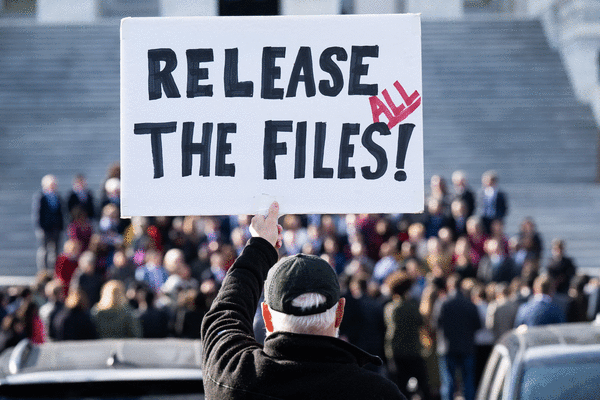
The top Democrat in the Senate threatened legal action against the Trump administration Monday over its slow and incomplete rollout of the so-called Epstein files. The Department of Justice has so far failed to release any additional new documents from its investigation into the deceased sex trafficker Jeffrey Epstein.
Senate Minority Leader Chuck Schumer of New York introduced a resolution Monday that would direct the Senate to initiate legal action against the Trump administration for “illegally refusing to release the complete Epstein files and heavily redacting the files that are released.”
A group of Epstein’s victims also issued a letter Monday criticizing the Justice Department for failing to disclose more documents and for failing to redact the names of victims in some files while releasing others “riddled with abnormal and extreme redactions with no explanation.”
The law allows the department to withhold the release of documents that would impede active investigations and to redact material to protect the identity of victims.
The department was required to release all of its files by last Friday, according to the Epstein Files Transparency Act, a bipartisan piece of legislation that was signed into law by President Donald Trump in November.
Epstein’s victims — believed by DOJ to number roughly 1,000 women — have long sought more accountability for Epstein’s powerful friends and accomplices and greater transparency from a department that kept them in the dark about a sweetheart deal Epstein negotiated in 2007 that allowed him to escape harsh punishment for sexually abusing girls in South Florida.
The department’s initial release of files Friday — which consisted largely of photographs and heavily redacted documents — did little to satisfy victims, or the members of Congress who mandated that the files be released.
After its initial release Friday, the department subsequently removed some of the files, including a photograph that showed photos of both Trump and former President Bill Clinton from one of Epstein’s homes.
That photo, and several others, were subsequently put back online.
The department defended its removal of the photos in a fact sheet posted on X, the social media network formerly known as Twitter, saying that it has “received incoming from individuals alleging to be victims and their lawyers, requesting that certain information be removed.”
The files released Friday contained numerous photographs of Clinton, many from a trip to Africa that Clinton and Epstein took on Epstein’s plane in 2002.
On Monday, a spokesman for Clinton called for the Justice Department to release all the files it has containing Clinton and said the release of the files so far suggests that “someone or something is being protected.”
There were, however, some revelations from the material.
The files showed, for example, that Epstein’s homes were littered with photos of naked young women, many of them clearly young girls, as well as the sex toys and outfits that victims have long accused Epstein of forcing them to use.
And they included an FBI form from 1996 showing that a woman — Epstein victim Maria Farmer — had complained that Epstein had stolen naked pictures of her 12- and 16-year-old sisters that she had taken as part of her artistic work, confirming that Epstein’s sex crimes were on the FBI’s radar for a decade before the FBI investigated his alleged crimes in South Florida.
The department also later released files from grand jury investigations into Epstein in South Florida in 2007 and New York in 2019; and into his ex-girlfriend and accomplice Ghislaine Maxwell in New York in 2020.
As the Miami Herald documented in its 2018 ‘Perversion of Justice’ investigation, Epstein reached a remarkably lenient deal with federal prosecutors in South Florida in 2007 that allowed him to plead guilty to two state prostitution charges, one involving a minor, and serve 13 months in the Palm Beach County Jail, where he was allowed to leave regularly to work from a nearby office space in which he continued to abuse girls.
The newly released files showed that two FBI agents and one of Epstein’s victims testified before a grand jury in West Palm Beach in 2007, but Epstein was never indicted.
Also included in the files was the transcript of a 2019 DOJ interview with Alex Acosta, who was the U.S. Attorney for the Southern District of Florida who signed off on the plea deal reached with Epstein.
The DOJ investigators scrutinized Acosta’s decision in approving the deal and asked about missing binders of evidence and 11 months’ worth of missing e-mails from his account during the timeframe in which the deal was negotiated.
Epstein was charged again by the Southern District of New York in July 2019 and died in federal custody one month later in what has been ruled a suicide.
Maxwell was charged a year later for her role in recruiting and grooming girls for Epstein’s abuse and convicted of sex trafficking in 2021. She is currently serving a 20-year prison sentence, but is reportedly seeking a pardon.
_____
©2025 Miami Herald. Visit at miamiherald.com. Distributed by Tribune Content Agency, LLC.




Comments