State deletes most references to Hope Florida from Medicaid contract
Published in News & Features
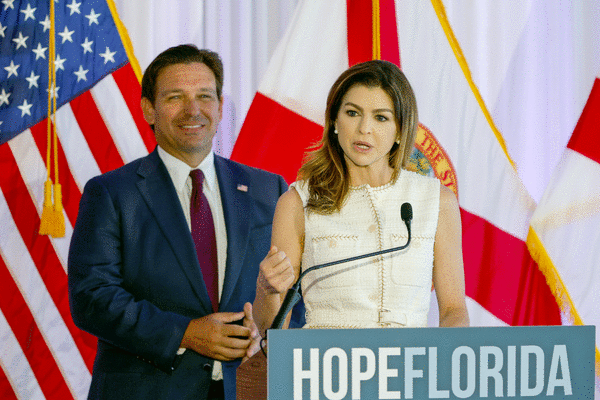
TALLAHASSEE, Fla. — Hope Florida won’t be providing loneliness services anymore.
The state has scrubbed nearly 80% of the references to Hope Florida — the controversial DeSantis administration effort to move residents off government assistance that became mired in political scandal — in its Medicaid managed care contract.
The original contract had come under heavy scrutiny from lawmakers during the regular legislative session six months ago.
The latest changes were made quietly and without notice in October, as part of an amended contract with all the state’s managed care plan vendors by the Agency for Health Care Administration, which administers the state’s $143 billion Medicaid program.
At first glance, it appears that the state is trying to scale back Hope Florida’s involvement in the Medicaid program – the largest contract administered by the state, affecting some 4.2 million Floridians who otherwise would not have health insurance. The earlier version of the contract delineated a role for Hope Florida, a pet project of First Lady Casey DeSantis, in providing a number of specific services to Medicaid recipients, including “loneliness services.”
But a closer review of the amended contract by the Orlando Sentinel indicates the words “Hope Florida” were deleted or replaced with more generic terms like “program navigator” while the substance of the contract remains the same. That raises questions of whether the changes diminish Hope Florida’s actual role, or only obscure it.
“It looks like they’re trying to downplay the apparent role Hope Florida has in this plan” said Rep. Alex Andrade, the Pensacola Republican who has been sharply critical of the Hope Florida effort.
“It’s unclear whether there is any substance to the changes in the contract or if they are winding down its function. That in itself is odd,” Andrade said. “It certainly seems misleading. The actual net effect is hard to tell.”
Asked to explain the changes, AHCA spokeswoman Mallory McManus said, “Hope Florida remains in the contract.” She did not respond to a request for public records related to the amended contract.
Andrade also reached out to AHCA for an explanation of the changes but received no answers.
The changes were made as scrutiny of the Hope Florida program and its nonprofit support foundation intensified over the course of the year, ultimately leading to an ongoing Leon County grand jury investigation. Hope Florida’s structure and goals have always been murky — it relied on state employees but was not a formal state department, and claims about its success in moving Floridians off welfare and Medicaid have been difficult to substantiate.
That investigation was apparently sparked after lawmakers raised concerns about the legality of a mysterious $10 million donation to Hope Florida that was part of the state’s $67 million settlement agreement with Medicaid provider Centene over allegations it had overcharged for prescription drugs.
The donation was then funneled to two dark-money groups that in turn gave millions to a political committee set up by Attorney General James Uthmeier, who was chief of staff for Gov. Ron DeSantis at the time, to help defeat a ballot amendment to legalize marijuana.
The scandal has plagued the DeSantis administration and appears to have derailed plans for the First Lady to replace her husband as governor.
AHCA’s goal to make Hope Florida an integral part of the state’s Medicaid program was included in the Centene settlement agreement signed in September of 2024, but it did not become widely known until members of Andrade’s health committee started grilling AHCA officials about it last April.
Hope Florida was mentioned 34 times in the original 620-page contract, which had an entire section devoted to prioritizing the program. Medicaid vendors would face sanctions, corrective action and even liquidation if they did not comply.
The amended version signed in October mentions Hope Florida only seven times and changes the section title from “Prioritizing Hope Florida” to “Prioritizing Self-sufficiency.”
One of the Medicaid managed care vendors is Sunshine State Health Plan Inc., a wholly owned subsidiary of Centene.
House members raised concerns about the legality of forcing Medicaid vendors to prioritize Hope Florida in their treatment plans, and to refer their clients to Hope Florida for nonmedical services like housing support and job training. They questioned the qualifications of Hope Florida “navigators” — state employees who were to help guide those on government assistance — to provide those services, especially something called “loneliness services.”
“Why did they think that Hope Florida navigators or state employees were qualified to provide expanded benefits?” Andrade asked. “That’s the part that frustrated me.”
Andrade asked AHCA officials at the time if Hope Florida was a recognized vendor for the state, only to be told they “contemplated using Hope Florida” to provide those expanded services.
When asked during committee hearings in April to define loneliness services, AHCA Secretary Shevaun Harris told Andrade he should ask the health plan provider what it meant.
Lawmakers also questioned whether sharing client information with Hope Florida would potentially violate patient confidentiality and if giving preferential treatment to vendors who “graduate” the most clients off of Medicaid contradicts state law.
Much of the contract’s original language remains intact in the amended version, including punitive measures to vendors that don’t refer clients to Hope Florida.
But it deletes any references to “loneliness services.”
----------
©2025 Orlando Sentinel. Visit at orlandosentinel.com. Distributed by Tribune Content Agency, LLC.





Comments