'The honeymoon is over': Inside Wes Moore's rift with Maryland Democrats
Published in News & Features
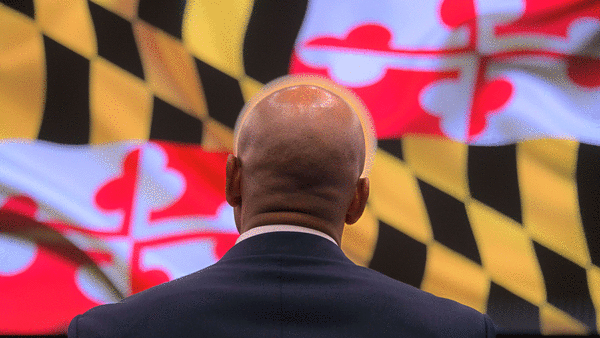
BALTIMORE — Democratic lawmakers in Annapolis say their relationship with Gov. Wes Moore is on ice — a revelation that comes just weeks before the 2026 legislative session in which lawmakers aim to close Maryland’s $1.4 billion budget deficit and lower energy costs among a host of other pressing issues.
The Baltimore Sun spoke to several members of the Maryland House and Senate who said the relationship is tense between them and the governor. They cited moments where lawmakers felt Moore had slighted them or was uncooperative in ensuring Democrats could enact their legislative agenda.
The fallout, lawmakers said, culminated when the General Assembly overrode 19 of 29 bills on Dec. 16 that Moore vetoed in the 2025 legislative session. Moore’s redistricting push has also left some members feeling as though he’s put the desires of national Democratic leadership over Marylanders’ opposition to eliminating the state’s lone Republican congressional seat.
“The honeymoon is over,” said Del. C.T. Wilson about the Democratic governor’s relationship with party leaders in the General Assembly.
“There was a honeymoon phase when he was new and things were kind of going the right way,” Wilson, who chairs the House Economic Matters Committee, said in a phone interview with The Baltimore Sun.
Now, Wilson added, some House Democrats feel Moore hasn’t built and nurtured the relationships required to ask that the General Assembly execute lofty policy demands.
“The complaint is that he’s not politicking,” Wilson, who later added that he remains in regular communication with Moore and his staff, said. “Me and my colleagues may want more attention, more of a conversation. And I think the governor is still learning (how to handle) the egos of the elected. And I told him many, many times (that) most of the people that I serve with (also) envision themselves being governor, president, congressman or senator one day. They have egos too.”
The tension was on display on Dec. 18 when Senate President Bill Ferguson accused Moore’s redistricting commission of approving redrawing Maryland’s congressional maps before the commission’s members had even met.
A few days earlier, Democrats in the House also harbored hard feelings toward Moore when they gathered for a special session to override the bills he previously vetoed.
Del. Emily Shetty, chair of the House Democratic Caucus, told The Sun that while she played no direct role in it, there “were tensions, particularly around the veto overrides.” The vetoes included bills that sought to: create a commission to study the effects of slavery in Maryland and recommend restitution to descendants of people once enslaved in the state, study the impact of building data centers in the state and fund climate change studies. The General Assembly on Dec. 16 then overrode 19 of those vetoes during a special session.
“I know that those conversations were difficult and that there has been some ill will generated potentially around those,” Shetty said in a phone interview with The Sun.
A senior House Democrat, who requested anonymity to be frank about private matters , was more blunt. Democrats who’ve served longer terms have often felt that vetoes were punitive measures, particularly under former Republican Gov. Larry Hogan, this Democrat said. Those instincts haven’t subsided, the senior House Democrat added.
“People’s feelings may still be in tangles from what happened,” the senior House Democrat said. “But genuinely, I do believe — because I was involved very deeply with this. I lost some relationships in this entire ordeal — that people forgot that we are on the same team.”
The senior House Democrat added that Moore has the right to veto bills he doesn’t agree with, but some lawmakers treat legislation “like their children,” but a veto doesn’t make it personal.
“So are there some colleagues of mine who are probably absolutely walking around upset? I know there are, for sure,” this senior House Democrat said.
As far as Moore is concerned, he’s “very eager” to work with Maryland’s General Assembly.
“I respect the legislative branch as I respect the judicial branch, as they should respect the executive branch. We all have our roles and our responsibilities,” Moore said in a wide-ranging interview on Dec. 18 with Armstrong Williams, co-owner of The Baltimore Sun.
But he also accused the Maryland legislature of being sluggish at attaining policy wins.
“I am very much a do it now kind of leader, and we want to make sure that we do not miss this moment,” he said. “I feel like we have to be a state that goes from no and slow to yes and now.”
Moore didn’t immediately respond to requests for comment.
To Republicans, the rift between Moore and Democrats isn’t surprising. House Minority Whip Jesse Pippy noted that Moore entered Maryland politics as an “outsider” and has had his work cut out for him, winning over Annapolis politicians who Pippy feels are “very much stuck in their ways.” Compounded on that, Pippy added, are reports suggesting Moore may run for president in 2028.
“The governor may have some national ambitions, maybe have some other ideas of what he wants to do,” Pippy told The Sun. “If that’s not in alignment with what the powers in Annapolis want, he’s certainly going to run into issues.”
Pippy added that a lack of cohesion on policy goals has also contributed to the animosity between Moore and some Annapolis Democrats. He described the veto overrides as “pretty unusual” and predicted that the stark differences in legislative goals will play out during the session.
“I think a lot of that comes from the fact that their policy goals are not always on the same page,” Pippy said, adding that redistricting is a strong example.
Some House Democrats believe the governor will work with the legislature.
Sen. Karen Lewis Young told The Sun she received a call from someone she identified as Moore’s senior staffer who deals with energy policy, before Moore vetoed her bill that aimed to analyze the impact of building data centers across Maryland. She was disappointed in Moore’s decision but the veto the House and Senate.
“He called me to tell me that the governor was vetoing the bill, so at least I found out by telephone before I read it in the newspaper,” Lewis Young said of Moore’s staffer. “I thought that was courteous, and I was told what everybody else was told that it was a financial decision because there were too many studies that were too costly.”
Lewis Young added that Moore is also accessible, noting that she had a 15-minute private conversation with him last week ahead of an event in her district.
“The governor didn’t say anything negative about that veto or any other veto decision. So there’s him taking a leadership role in deescalating the temperature,” Lewis Young said.
Sen. Jim Rosapepe, vice chair of the Senate Budget and Taxation Committee, also sang Moore’s praises, arguing that relations with the governor are “as good or better than they were under (former Republican Gov. Larry) Hogan or under (former Democratic Gov. Martin) O’Malley.”
Rosapepe added that Moore often reaches out to him, seeking advice on policy issues. And when Moore’s current chief of staff, Lester Davis, began his role, Rosapepe appreciated that Davis personally called him to introduce himself.
“I said, ‘Lester, you’re the first governor’s chief of staff who has ever called me on their own initiative just to (ask) what can they do to help,'” Rosapepe recalled their conversation. “That clearly comes from Wes Moore.”
Democratic leaders would rather members address their issues behind closed doors.
“When this all started there was no need to have disagreements with our governor in public,” the senior House Democrat said. “If you felt that he vetoed the bill that you supported, alright, you now have a constitutional obligation to veto override. But if you look at some of the articles, there was just a lot of back and forth in the press.”
Democrats are better off putting “egos aside here and focus on bringing forward that essential collaboration that is critical to being able to tackle the challenges that we’re facing right now,” Del. Joe Vogel, a Montgomery County Democrat, said in a phone interview with The Sun.
“I choose to focus on areas where we can find that common ground,” he said.
_____
(Mennatalla Ibrahim contributed to this story.)
_____
©2025 The Baltimore Sun. Visit at baltimoresun.com. Distributed by Tribune Content Agency, LLC.






Comments