Second Trump term, new CA strategy; 5 key High-Speed Rail developments from 2025
Published in News & Features
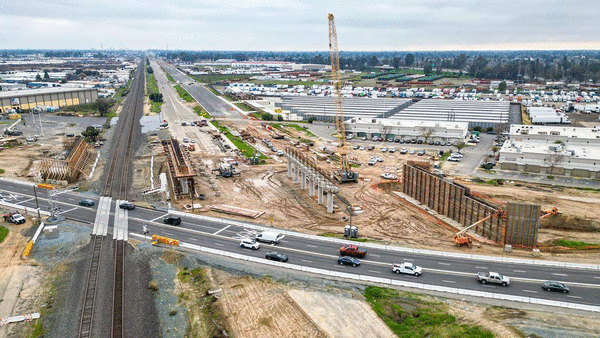
The California High-Speed Rail Authority entered 2025 knowing its federal dollars were at risk as President Donald Trump took office for the second time.
The agency finished the year with $4 billion gone from its federal purse. But it also has a state promise of $1 billion per year through 2045, and new strategies that could help push the historically slow-moving, increasingly expensive project forward faster and with fewer costs.
The train was originally envisioned as a Los Angeles-to-San Francisco line that would cost up to $33 billion and be operational by 2020. But the project has been plagued by delays and cost increases in the 17 years since California voters first approved $9.95 billion in bonds for its construction.
The main focus today is the completion of a 172-mile Bakersfield-to-Merced railway by 2032, and fully-funded construction is underway on 119 miles between Shafter and Madera.
But the strategy the rail authority unveiled in 2025 could mean the train’s construction shifts toward the Bay Area in the upcoming years.
Here are the five key developments that shaped California’s high-speed rail project in 2025.
Battling the Trump administration for $4 billion
Trump vowed to investigate California’s high-speed rail project shortly after he took office in January.
He sent U.S. Transportation Secretary Sean Duffy to California in February to announce a “compliance review” of the project’s federal funding.
In June, Duffy released a 310-page report with the results of his department’s audit of high-speed rail. The audit concluded that the Trump administration should pull $4 billion of its unspent federal money on the grounds that the rail authority had “no viable path” toward completing the Central Valley segment by 2033.
The federal government in July announced it would officially be rescinding the $4 billion, triggering a lawsuit from California. But the state ended up withdrawing its lawsuit near the end of 2025.
CA Legislature’s $20B commitment to high-speed rail
Henry Perea, a rail authority board member from Fresno, told The Bee in June that the state fully expected the Trump administration to target the project’s federal money in 2025.
“Our preparation has been making a decision to pivot more towards the state,” he said.
In May, Gov. Gavin Newsom proposed an annual allocation of $1 billion for high-speed rail through 2045 from the state’s Cap-and-Trade program (now called Cap-and-Invest). The program generates public dollars from companies that buy credits at state auctions to offset their greenhouse gas emissions.
State lawmakers passed Newsom’s proposal at the end of the 2025 legislative session.
The state’s $20 billion commitment to the project will allow the rail authority to complete the 172-mile Central Valley route even without the $4 billion rescinded by the Trump administration, the agency has said.
The state’s commitment is key to the rest of its plan to speed up construction — and expand work past the Central Valley — because it provides potential private investors a $20 billion guarantee, the rail authority said.
CA High-Speed Rail says tracks coming in 2026
Ian Choudri, CEO of the rail authority, announced during an April visit to Fresno that the agency will be laying the project’s first tracks in the Central Valley next year.
“We are purchasing rail materials this year, we are laying tracks next year,” Choudri said then. “I don’t see any point where we have to say, ‘Oh, we can’t do it.’”
In September, the agency began seeking bids from U.S. manufacturers to provide $507 million-worth of necessary materials. Choudri has said buying track materials — including rail, concrete ties, electric poles and ballast — straight from manufacturers instead of contractors will reduce costs.
In early December, the agency began seeking proposals from contractors who will perform $3.5 billion-worth of track construction on the 119 miles between Madera and Shafter.
CA High-Speed Rail’s plan to speed work, cut costs
The rail authority in August released a report with the results of a project reassessment launched by Choudri shortly after he took lead of the agency in 2024.
The objective, he has said, was to quicken the pace and reduce the costs of construction.
Besides buying materials from manufacturers and securing a strong state financial commitment, the report pitched a list of actions the Legislature could take to help the project avoid the delays and cost increases it has historically dealt with.
The rail authority says a sales tax exemption would decrease the project’s overall costs on in-state materials and equipment purchases, and could also help build the train faster by removing some financial barriers.
The agency also asked the state to pass a bill that would streamline local permitting and make it easier for the rail authority to remove utilities in the train’s right of way. The bill met heavy resistance from local governments and utilities and ultimately failed during the 2025 legislative session.
Choudri also wants the state to establish courts or appoint judges dedicated to handling its eminent domain cases, which have been spread out across the state and slowed the securing of the train’s right-of-way.
“We are not asking for any exceptions,” Choudri told The Bee. “We are asking for a special court and few judges that are available only for our program. So if we were to process cases, those are handled in an expeditious way, instead of letting it bigger, like what happened in the past.”
Controverisal High-Speed Rail option would delay Merced station
The report released in August worried local Central Valley leaders as it presented options for expanding construction past the region.
Some of those options pitched delaying construction to Merced so the rail authority can first build to Gilroy, where it expects higher revenues and a better chance of attracting private dollars.
In the months that followed the report’s release, Merced elected officials traveled to Sacramento to advocate that their region remain within the train’s initial segment.
“Keeping Merced in the early operating segment is 100% a hill to die on for us,” Merced Mayor Matthew Serratto told The Bee.
But Choudri confirmed to The Bee during a November visit to Fresno that he will be asking state lawmakers to change SB 198, a state law that requires the rail authority to first complete a Merced-to-Bakersfield segment and only allows $500 million in spending outside that focus.
The rail authority has begun the prequalification process for a partnership with the private sector that Choudri expects to be finalized by mid-2026. He said the private sector can use its own money to build the train faster, but investors will likely want to be allowed to build toward Gilroy.
Choudri said changing SB 198 does not mean the train will skip Merced.
“We can get it done,” he said, “but everything needs to be sequenced in the right order.”
©2025 The Fresno Bee. Visit at fresnobee.com. Distributed by Tribune Content Agency, LLC.






Comments