Amid news of Maduro's capture, Venezuela grapples with the wreckage he left behind
Published in News & Features
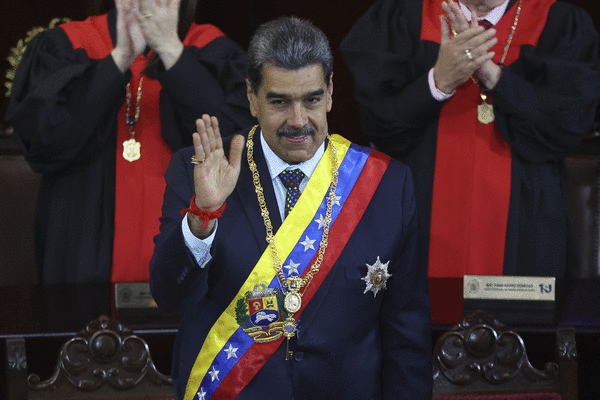
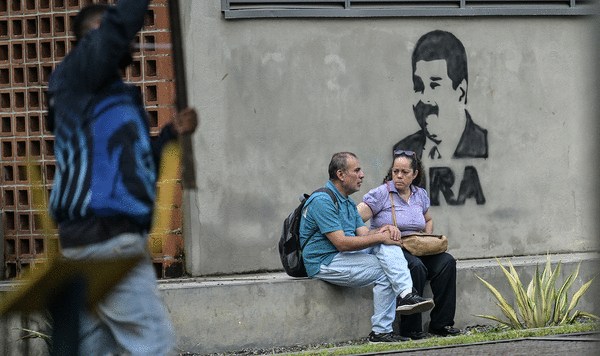
When Nicolás Maduro assumed Venezuela’s presidency in 2013, the country was already deeply unsettled after years of political polarization under Hugo Chávez, marked by shrinking freedoms and violent crackdowns on dissent.
But as it turned out, Venezuelans had seen nothing yet.
Following Chávez’s death, Venezuela entered one of the most dramatic political, economic and humanitarian collapses in modern history. Maduro inherited a nation strained by falling oil production and entrenched corruption, but his administration’s response — defined by economic mismanagement, rigid ideological controls and deepening authoritarianism — sharply accelerated the country’s unraveling.
Over the past decade, Venezuela’s economy has contracted by roughly 80%, the largest peacetime collapse ever recorded in the Western Hemisphere. Hyperinflation surged into the millions of percent, wiping out savings and wages. Food and medicine became scarce, triggering widespread hunger, preventable deaths and the rise of a barter-based informal economy. Although inflation has since eased, deep structural weaknesses — massive debt, crumbling infrastructure and near-total dependence on oil — remain firmly embedded.
Politically, Maduro consolidated power through loyalist networks within the military, intelligence services, criminal enterprises and civilian paramilitary groups known as colectivos. Opposition parties faced arrests, exile, disqualification and the systematic dismantling of democratic institutions. Elections were riddled with irregularities, media censorship intensified, and civil-society groups operated under constant threat. The disputed 2024 presidential election ignited nationwide protests and a sweeping government crackdown.
Humanitarian conditions pushed more than seven million Venezuelans to flee, creating one of the world’s largest displacement crises. Those who remain endure unreliable electricity, collapsing public services, high crime and chronic shortages in hospitals and schools.
Internationally, Maduro’s government grew increasingly isolated, relying on support from Russia, China, Iran and Cuba while facing extensive U.S. and European sanctions.
Now, with Maduro captured by the United States and flown out of the country, Venezuelans are left wondering whether his sudden disappearance could mark the end of a socialist regime that ruled for more than two decades, turning a nation that once enjoyed the highest standard of living in Latin America into one of the poorest.
While the answer remains unclear, analysts broadly agree that Venezuela requires a dramatic political shift to close a grim chapter that hollowed out democratic institutions, criminalized dissent and presided over an economic collapse that plunged millions into poverty and forced one of the largest migration waves in the world.
A collapse years in the making
Venezuela’s decline can be traced in part to the economic and political controls imposed during Chávez’s self-styled Bolivarian Revolution. But much of the responsibility lies with the corruption and repression that intensified under Maduro, who proved a more ruthless strongman than his predecessor.
Maduro’s presidency began with a razor-thin and contested victory. After Chávez’s death in 2013, the former bus driver narrowly defeated opposition leader Henrique Capriles with 50.6% of the vote amid accusations of fraud — a disputed start that foreshadowed a decade of crisis.
Venezuela’s oil-dependent economy — responsible for more than 80% of export revenue — was already fragile, despite the country holding the world’s largest proven crude reserves. When global oil prices collapsed in 2014, the government responded with denial, rigid price controls and unchecked money printing.
Shortages worsened. Inflation reached 69% — alarming at the time but modest in hindsight — and the first major wave of protests erupted. More than 40 people were killed as security forces and colectivos cracked down.
In 2015, voters handed the opposition a sweeping legislative victory. Rather than accept the result, Maduro turned to the loyalist Supreme Court, which systematically stripped the National Assembly of its powers, accelerating the erosion of democratic checks and balances.
From authoritarian drift to full dictatorship
Between 2016 and 2018 Venezuela plunged into its steepest descent. A constitutionally permitted recall referendum against Maduro was abruptly halted. The Supreme Court declared the National Assembly in contempt and assumed its powers, triggering a constitutional crisis.
The economy imploded. Hyperinflation surged from 800% in 2016 to 1.35 million percent in 2018. Salaries evaporated, savings became worthless and oil production fell to four-decade lows.
Maduro responded by tightening control. He convened a new Constituent Assembly loyal exclusively to him, sidelining the elected legislature. Months of nationwide protests followed; more than 120 people were killed by security forces.
The 2018 presidential election cemented Venezuela’s pariah status. Boycotted by the opposition and widely condemned as fraudulent, the vote handed Maduro a new term with record-low turnout. The United States, the European Union and most of Latin America refused to recognize the result, prompting further sanctions.
Human rights groups documented escalating abuses. Amnesty International and local organizations reported thousands of extrajudicial killings, many attributed to feared special police units known as FAES. The International Criminal Court later opened an investigation into possible crimes against humanity.
The Guaidó gamble
In early 2019, Maduro appeared vulnerable. Juan Guaidó, head of the opposition-led National Assembly, invoked constitutional provisions to declare himself interim president. More than 50 countries, including the United States, recognized him.
Mass protests followed, but the regime held. The military remained loyal, Cuba’s intelligence apparatus shielded Maduro, and Russia, Iran and China provided financial and diplomatic backing.
U.S. sanctions intensified, targeting the state oil company PDVSA. The economy deteriorated further: nationwide blackouts plunged cities into darkness, hospitals ran out of supplies and poverty reached 96 percent by 2021. The COVID-19 pandemic devastated an already shattered healthcare system.
By 2022, Guaidó’s momentum had collapsed. Limited dollarization produced modest stabilization, but inequality soared and the political stalemate persisted.
A disputed election, a nation on edge
Ahead of the 2024 election, Maduro moved to neutralize credible challengers. María Corina Machado, the opposition’s primary winner, was barred from running. Edmundo González Urrutia, a retired diplomat, became the opposition’s substitute candidate.
The July vote became one of the clearest cases of electoral manipulation in recent Latin American history. Official results gave Maduro 51 percent, but independent tallies, leaked data and assessments from the Carter Center, the United Nations and the Organization of American States suggested González likely won by a wide margin.
Protests erupted nationwide. Security forces launched Operation Tun Tun, a sweeping crackdown that left at least 24 people dead and more than 2,000 arrested. González fled to Spain; Machado went into hiding. The Supreme Court upheld Maduro’s victory.
Maduro began his third term amid widespread international nonrecognition and escalating repression. Civil-society groups recorded one arbitrary detention every 32 hours in 2025. Hundreds of political prisoners remain in facilities notorious for torture.
While the economy shows faint signs of stabilization — with growth projected at about 0.5% — most Venezuelans see no relief. Basic goods remain costly or scarce, inflation continues to erode wages, and public services remain dysfunctional.
A dangerous new phase
Internationally, Maduro leaned heavily on Russia, China, Iran and Cuba. He then faced his most serious external threat in years: the return of Donald Trump to the White House.
In August, the United States increased its reward for Maduro’s capture to $50 million, accusing his government of ties to drug cartels and the criminal group Tren de Aragua. Tensions escalated in October after reports of a covert U.S. attempt to seize him.
On Nov. 24, the Trump administration took its most drastic step yet, designating Maduro’s government a foreign terrorist organization — a move that expanded Washington’s authority to freeze assets, intensify sanctions and potentially justify future military action.
Maduro accused the United States of plotting an invasion to seize Venezuela’s oil reserves. The government-controlled parliament denounced U.S. “aggression,” while state media amplified warnings of looming foreign threats.
The U.S. designation’s effects were immediate: tightening financial markets, concerns over humanitarian supply chains and rising public anxiety.
Venezuela’s humanitarian crisis persists, with more than 6.8 million migrants across the hemisphere, poverty still above 50 percent, widespread child malnutrition and a barely functioning healthcare system. The country’s GDP, once among Latin America’s largest, now resembles that of a small Central American nation.
Most analysts agree that without a political transition — negotiated or otherwise — recovery is unlikely. While Maduro blamed a U.S. “economic war,” independent experts point instead to systemic corruption, authoritarian rule and chronic mismanagement as the true drivers of Venezuela’s collapse.
©2026 Miami Herald. Visit miamiherald.com. Distributed by Tribune Content Agency, LLC.



Comments