Trump snatches Maduro but leaves his regime in charge for now
Published in News & Features
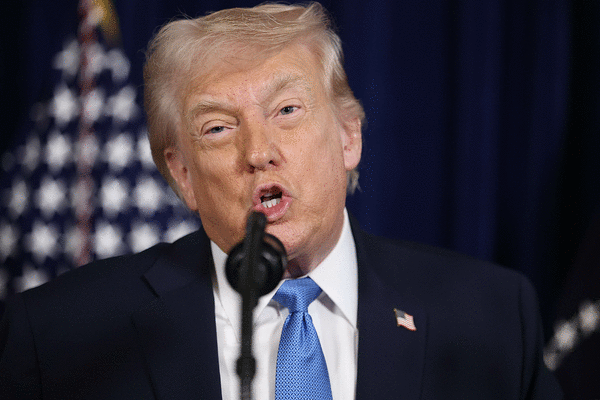
Hours after President Donald Trump stunned the world by saying the U.S. plans to “run” Venezuela, uncertainty over what that means and who is in charge loomed over the South American nation.
Ousted Venezuelan President Nicolás Maduro was an indicted prisoner on a flight bound for New York by the time his Vice President Delcy Rodríguez — who Trump said would partner with Washington to “make Venezuela great again” — denounced the intervention as “barbaric” and a “kidnapping.”
Adding to the confusion was that the White House offered few details about what running an oil-producing nation of about 30 million people would entail. A U.S. official said Secretary of State Marco Rubio — who has spent his career criticizing Maduro and his predecessor, Hugo Chavez — would take the leading administration role.
For now, there’s no plan spelled out to have American troops or administrators in Venezuela. But Trump signaled he’s keenly focused on the country’s petroleum, saying the U.S. would have a “presence in Venezuela as it pertains to oil.” That could mean a greater role for Chevron Corp., which still operates in Venezuela under waivers from sanctions, as well as for other major American oil companies.
Trump’s resistance to keeping American boots on the ground and his dismissal of Venezuela’s opposition leader Maria Corina Machado as a “nice woman” not ready to take power suggest he decided on giving Rodríguez and other Maduro loyalists a second chance over full-blown regime change. Maduro, meanwhile, is now in U.S. custody in a detention center in New York City.
Trump is “essentially trying to control the vice president and people around her through carrots and sticks to get the outcomes the United States wants,” said Matthew Kroenig, vice president and senior director of the Atlantic Council’s Scowcroft Center for Strategy and Security. “We’ll see if it works.”
Trump appeared to confirm that approach with his remarks later in the day to the New York Post, when he said that U.S. troops on the ground would not be necessary as long as Rodríguez “does what we want.”
That strategy is a huge gamble — particularly for a president who campaigned in 2016 on ending America’s “forever wars” but has since used the U.S. military to strike targets in Iran, Yemen, Nigeria and the Caribbean Sea.
Venezuela has suffered through decades of mismanagement that eroded the country’s oil infrastructure, sparked prolonged bouts of hyperinflation and saw millions of economic and political migrants flee for neighboring countries and the U.S. A total collapse of the government sparked by the early morning U.S. strike risks causing even more turmoil.
Rodríguez, considered by many to be the most powerful person in the country after Maduro, gave mixed messages in her public comments on Saturday. She called for the ousted president’s return, but she also said Venezuela could still have “respectful relationships,” perhaps offering a path to a detente with the U.S. if she can consolidate power and the two sides cooperate. Venezuela’s Supreme Court late Saturday granted Rodríguez all presidential powers in an acting capacity.
Rubio said Sunday that the U.S. would watch her actions more than her rhetoric.
“We are going to make an assessment of what they do, not what they say publicly in the interim, not what we know, what they’ve done in the past in many cases, but what they do moving forward,” he said on CBS’s "Face the Nation." “So we’re going to find out.”
Trump warned of a potential second wave of American attacks if that cooperation isn’t forthcoming.
“All political and military figures in Venezuela should understand what happened to Maduro can happen to them, and it will happen to them” if they weren’t “fair” to the Venezuelan people, he said.
In the short term — and barring a breakdown of governance — the administration’s move could offer it the opportunity to help revive Venezuela’s decaying oil industry, something that Trump seemed particularly focused on when he announced Maduro’s capture.
“We’re going to have our very large United States oil companies, the biggest anywhere in the world, go in, spend billions of dollars, fix the badly broken infrastructure, the oil infrastructure, and start making money for the country,” Trump said. In the same news conference, he said, “We’re going to make sure that that country is run properly.”
A multiyear recovery of Venezuelan oil production could entail a 4% decline in global oil prices over time, according to an analysis by Bloomberg Economics. That would help the U.S. president address the affordability concerns voters have, but energy analysts added that it could take years for Venezuela’s oil industry — plagued by mismanagement, corruption and sanctions — to recover.
“Both upside and downside scenarios have significant implications for Venezuela’s outlook, debt markets, global oil supply, and the U.S. standing in the region and the world,” Bloomberg Economics analyst Jimena Zuniga wrote.
Following the Trump news conference, a U.S. official laid out some priorities for the coming days, saying that administration officials will engage diplomatically with those remaining in the Venezuelan government, as well as with oil executives on expanding output. The official said the U.S. military will remain ready and the oil embargo will remain in effect. U.S. strikes on suspected drug vessels will continue.
Yet the uncertainty over what really happens next hung over Caracas as it settled into its first night without Maduro in more than a decade, with many of his regime’s loyal backers still in the country.
That reality, and Rodríguez’s long history with Maduro, are “why I’m a bit skeptical this can work out long term,” said Ryan Berg, director of the Americas Program and head of the Future of Venezuela Initiative at the Center for Strategic and International Studies in Washington.
All day long, Venezuelans lined up outside grocery stores and gas stations amid worries about the nation’s future.
While Trump sought to project optimism, the military maneuver recalled past U.S. efforts at regime change that yielded mixed results. For now, hawkish Republicans appear to have rallied to Trump’s side while more isolationish supporters have balked. A top worry will be whether the U.S. gets bogged down.
“A bigger concern really would be that this all falls apart here, that there isn’t an effort to make sure there’s a successful handoff,” said Matt Terrill, managing partner at Firehouse Strategies.
Iraq, Afghanistan
Under President George W. Bush the U.S. invaded two countries, Afghanistan after the Sept. 11, 2001 attacks and Iraq, to depose Saddam Hussein, in 2003. Both conflicts and the insurgencies they spawned mired the U.S. in bloody and costly occupations for years. Frustration over those deployments and the messy Afghanistan withdrawal helped propel Trump to the presidency twice.
It’s now a legacy he — and perhaps Rubio, a potential 2028 presidential candidate — risks taking on.
“This is, to paraphrase Winston Churchill, not the beginning of the end, but the end of the beginning,” CSIS’s Berg wrote on Saturday. “Venezuela will enter a long transition with even greater U.S. involvement in shaping the government to come.”
_____
(With assistance from Hadriana Lowenkron, Myles Miller, Natalia Drozdiak and Shamim Adam.)
_____
©2026 Bloomberg L.P. Visit bloomberg.com. Distributed by Tribune Content Agency, LLC.




Comments