What does Maduro's capture mean for Venezuelans in the U.S.? We answer your questions
Published in News & Features
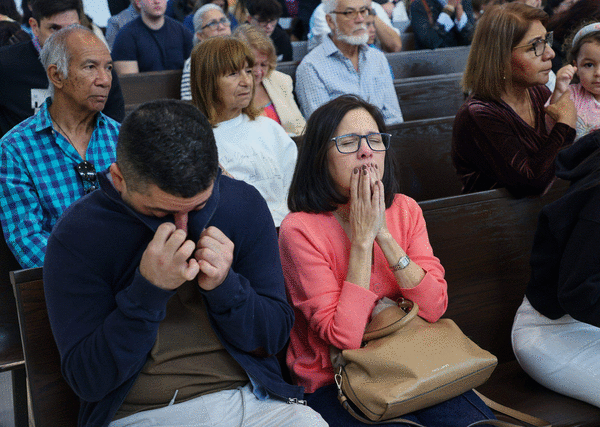
During a national television appearance on Sunday morning, Department of Homeland Security Secretary Kristi Noem said that the hundreds of thousands of Venezuelan immigrants in the U.S. who lost deportation protections under the Trump administration have the opportunity to apply for refugee status.
“We need to make sure that our programs actually mean something, and that we’re following the law,” Noem said during a Sunday morning appearance on Fox News.
In the wake of the United States’s capture of Venezuela strongman Nicolás Maduro, the remarks generated confusion among Venezuelan immigrants. But even before the U.S. government carried out the dramatic military operation Saturday, Venezuelan immigrants were already living in vast uncertainty as high-profile targets of President Donald Trump’s mass deportation agenda.
The Trump administration has stripped over 600,000 Venezuelans of their work permits and deportation protections under Temporary Protected Status. He has also invoked an 18th Century law, the Alien Enemies Act, to deport Venezuelans to a notorious prison in El Salvador; ended a parole program that legally brought over 117,000 Venezuelans to the United States, and arrested asylum seekers at their court hearings.
What’s next for Venezuelan immigrants in the United States? Here are answers for some key questions:
Homeland Security Secretary Kristi Noem said “every individual that was under TPS has the opportunity to apply for refugee status.” What does that mean?
In a word: unclear.
Under federal law, individuals must be located outside the United States to become part of the U.S. Refugee Program. They must also be referred by someone else for their applications to be considered.
President Trump’s administration set a historically low cap of 7,500 refugees nationally for fiscal year 2026, down from 125,000 in fiscal year 2026 under President Joe Biden. Trump also directed most of the 2026 admissions to be allocated mostly to Afrikaners from South Africa.
The Department of Homeland Security rejected any interpretation that Noem’s comments mean that the over half-a-million Venezuelans that lost TPS would now be considered for refugee admissions.
“This is not what Secretary Noem said. President Trump is bringing stability to Venezuela and bringing to justice an illegitimate Narco Terrorist dictator who stole from his own people,” the agency said on social media. “Secretary Noem ended Temporary Protected Status for more than 500,000 Venezuelans, and now they can go home to a country they love.”
Many former TPS recipients from Venezuela have pending asylum cases. And if a former TPS recipient had not applied for asylum, they still have some time, because having TPS status stops the clock on the requirement to file for asylum within a year of arriving to the United States as long as the one-year-clock has not expired.
But the Trump administration has made it harder for immigrants to apply for asylum, even asking immigration judges to close people’s cases in court and then arresting them after their hearing.
“She made [the remarks] in the narrowest possible way. Anyone can apply for anything but there are no plans to grant them asylum,” said David Bier, director of Immigration Studies at the Cato Institute.
The administration stripped over 600,000 Venezuelans of protections and work permits under Temporary Protected Status. What happens to them now?
For now, nothing changes.
The Trump administration stripped hundreds of thousands of Venezuelans from their immigration relief under TPS, which is granted to people already in the United States who came from countries in turmoil. The administration said that conditions like healthcare and crime had improved in Venezuela, making it possible for Venezuelans to return home. But they noted that regardless of conditions, Venezuela’s TPS designation was not in the best interest of the United States.
For many former TPS holders, their only remaining pathway to stay in the United States is seeking asylum. But some experts think that it will be harder now for Venezuelan immigrants to claim asylum based on a claim of political persecution.
“They have no status and the administration will argue that now that Maduro is gone, their persecution claims are invalid,” Bier said.
What will happen to U.S. deportation flights to Venezuela?
The United States unilaterally suspended deportation flights to the South American country in mid-December, according to Venezuela’s government.
Between February and November 2025, the U.S. conducted 73 deportation flights to Venezuela, sending back 13,656 of its nationals, according to Human Rights First, which tracks removal flights.
But as tensions with Venezuela escalated, the Venezuelan government announced that the U.S. had suspended the flights in mid-December. That could soon change as part of any negotiations between Washington and Caracas.
“Expect an increase in deportation flights to Venezuela as a condition that the U.S. will require Delcy Rodriguez to meet,” said Jason Marczak, vice president and senior director of the Atlantic Council, in reference to Maduro’s vice president, who now appears to be in charge. “These regular deportation flights have been one of the few points of cooperation with Venezuela over the course of the last year.”
The U.S. used the Alien Enemies Act earlier this year to deport to El Salvador hundreds of Venezuelans accused of being gang members. Could the administration try to invoke the act again?
In March 2025 Trump invoked the Alien Enemies Act against alleged members of the Venezuelan gang Tren de Aragua, saying they were trying to invade the United States. He sent about 250 Venezuelans to CECOT, a notorious prison in El Salvador. Public records later showed most of the men deported did not have criminal records in the U.S. and they were later sent back to Venezuela.
The Washington Post has reported that Stephen Miller, White House senior advisor to Trump, has said that “a strong reaction from Caracas could provide the pretext to invoke the Alien Enemies Act to quickly deport hundreds of thousands of Venezuelan immigrants from the United States.”
However, to invoke the Alien Enemies Act the United States would have to declare war against Venezuela. After the U.S. attack on Caracas, Trump and other officials have emphasized that no further military operations are planned. However, Trump did say the United States is “ready to stage a second and much larger attack.” although he mentioned it won’t likely be needed. And Congress has not voted on or approved a declaration of war.
“They could try to invoke the Alien Enemies Act, but they are simultaneously arguing that we aren’t at war with Venezuela, so legally and politically, it wouldn’t make sense,” Bier said.
©2026 Miami Herald. Visit at miamiherald.com. Distributed by Tribune Content Agency, LLC.




Comments