Idaho Gov. Brad Little says he won't support repeal of Medicaid expansion
Published in News & Features
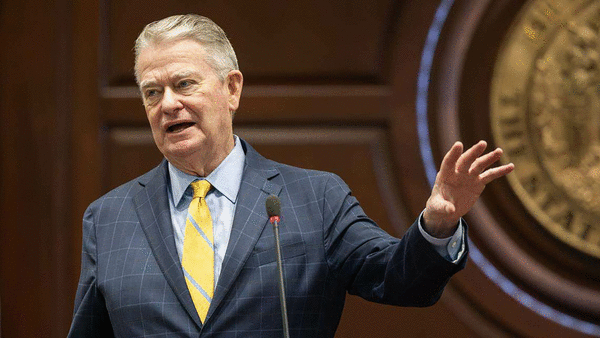
BOISE, Idaho — In recent months, Idaho lawmakers and state leaders have expressed angst over a projected state budget deficit of hundreds of millions of dollars. They have deliberated how to close the gap. Cut spending by slashing state programs? Reverse tax cuts enacted in the 2025 legislative session?
During a sometimes-tense discussion Thursday, Idaho Gov. Brad Little and legislative leaders offered a preview of what Idahoans can expect in the 2026 legislative session, set to begin Monday.
Here are five things to watch:
1. A fight over Medicaid expansion
A panel of Idaho lawmakers in December recommended that the Legislature repeal the state’s voter-enacted Medicaid expansion program, which provides health care coverage to about 90,000 lower-income Idaho residents.
Members of the Legislature’s interim “DOGE” committee, modeled after Elon Musk’s so-called Department of Government Efficiency, said a repeal was needed amid the state’s budget deficit. They shared anecdotes suggesting that people were gaming the system and fraudulently receiving health care benefits.
On Thursday, Little told reporters at a news conference that he was not open to repealing Medicaid expansion.
“We’ve got a lot of stuff to do with Medicaid,” but repeal isn’t on the table, he said.
He stopped short of saying he would veto a proposal to repeal the expansion program. “I don’t commit on bills until I see them on my desk,” he said. But he warned that there would be “all kinds of unintended consequences” of repealing Medicaid expansion.
Discussion over the fate of Medicaid expansion dominated the 2025 session. Initial bills proposed cutting the program entirely, but lawmakers instead voted on a compromise to implement a “managed care” model to reduce costs.
The federal government pays 90% of the costs of Idaho’s Medicaid expansion, which as of early 2025 provided access to care for about 90,000 lower-income Idaho residents who earn too much to qualify for standard Medicaid but not enough for private insurance discounts. (About 385,000 Idaho residents were enrolled in Medicaid as of fiscal year 2024.)
But amid rising health care costs, Idaho’s share of the burden has significantly exceeded lawmakers’ expectations: from $32 million in projected costs in 2018 to $110 million in fiscal year 2026, said Rep. John Vander Woude, R-Nampa, on the House floor in February.
On Thursday, House Speaker Mike Moyle, a Republican, called the program a “behemoth” that risked siphoning money away from other government priorities.
Medicaid Expansion passed in 2018 as a ballot initiative with more than 60% support from Idaho residents, and Little previously expressed reservations about cutting a program that “was passed overwhelmingly by the public.”
2. Disagreement over the state’s economic health
Little and lawmakers from both sides of the aisle painted diverging pictures of the state’s budget and economic prospects.
In December, Lt. Gov. Scott Bedke said the state’s approximately $14 billion budget was “upside-down” after lawmakers slashed income taxes during the 2025 session. Idaho faces a projected deficit of over $500 million in fiscal year 2027, he said. The state’s general fund budget was about $5.2 billion for fiscal year 2025.
But on Thursday, Little touted the record growth in residents’ employment and personal incomes — though he, Moyle and GOP Senate Pro Tem Kelly Anthon, also noted that farmers and ranchers are tightening their belts amid low commodity prices.
Anthon said he had a “very positive outlook” for the state, and Moyle sought to minimize the impact of cuts lawmakers would need to make to state programs to balance the budget, as Idaho’s constitution requires.
“We’re in a really interesting situation this year, where we’re going to have the opportunity to go in and possibly reduce some government spending, which I totally support,” he told reporters. “At the same time, we’re going to get tax relief.”
But “if you look at overall what’s going on in the state, we are in amazing shape,” he said. “We don’t have a problem.”
Democratic leaders took a darker view. House Minority Leader Ilana Rubel said the state was “in a hole” and pushed back on the suggested that cutting government spending was the answer.
“We don’t have a spending problem. There is no fat to cut,” she said, citing low pay and high turnover among government employees. “Any cuts at this point are excruciating.”
Instead, said Senate Minority Leader Melissa Wintrow, the state needed to reverse some of the tax cuts it has enacted in recent years.
“We haven’t had a conservative approach to budgeting,” she said. “We’ve had an attitude of ‘cut, cut, cut’ instead of, ‘How much revenue is really needed in a growing economy?’ and ‘How much many services really would help Idahoans?’”
3. New proposals to balance the budget
Little didn’t specify where that money would come from, but in December, his team suggested it would be open to dipping into the state’s $1.4 billion in “rainy-day” funds to help close the gap.
Bedke in December called such a move “prudent,” and Emily Callihan, a spokesperson for Little, told The Idaho Statesman that the use of the funds “remains an option” that the governor may recommend to balance the budget.
4. More tax cuts?
During his January 2025 State of the State address, Little called for tax cuts that could reduce the state’s general fund by about $100 million. Lawmakers pushed through cuts that reduced the fund by more than four times that amount. Democratic lawmakers blame the state’s budget shortfalls on that decision.
Early in the 2026 legislative session, lawmakers must also decide whether to conform with the tax breaks offered in federal tax code. Idaho typically aligns its state tax code closely with the federal one, but doing so this year could cost the state hundreds of millions of dollars of lost revenue at a time when it can’t take the hit, an Idaho think tank warned in November.
“I think it’s so unfortunate now that we’re in this situation, that we have to be so stressed about how to conform because of what it’s going to do to break our own bank,” Wintrow said.
As lawmakers this session work to balance the budget, could even more tax cuts be on the way?
Little said he “would not be shocked” to see such a proposal come across his desk, though he did not provide additional details.
5. Questions about education funding
Amid the state’s revenue shortfall, Little in August ordered state agencies other than public schools to cut spending by 3%.
Will he keep exempting funding for kindergarten through 12th grades?
“It’s going to be pretty close,” Little told reporters.
In 2025, he signed House Bill 93, which allotted $50 million for $5,000 grants to students who don’t attend public schools. Students with disabilities could receive up to $7,500 annually. The grants would come in the form of refundable tax credits.
Public-school advocates have warned that the program is “just the beginning,” and that the budget for such grants would only increase — siphoning money away from public schools. But this year, at least, Little said “there’s not any new money” for any such increases.
“We are trying to do all we can to make the budget balance,” he said. “I’m fairly confident that my legislative partners will agree that there is no new money.”
(Carolyn Komatsoulis contributed.)
©2026 The Idaho Statesman. Visit idahostatesman.com. Distributed by Tribune Content Agency, LLC.




Comments