EPA opposes Colorado plan to close coal-fired power plants
Published in News & Features
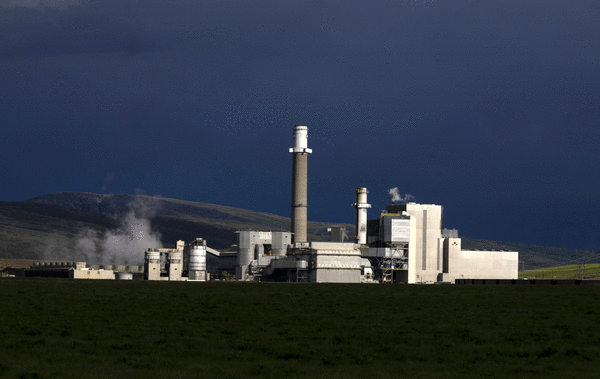
DENVER — The Environmental Protection Agency on Friday determined Colorado cannot order the closure of coal-fired power plants under the Clean Air Act, and, therefore, the agency will deny the state’s plan to reduce the haze that clouds views at Rocky Mountain National Park and other federal lands.
The move is part of the Trump administration’s push to make sure no federal regulations stand in the way of restoring the coal industry and powering the electric grid with the fossil fuel, which pollutes the air with carbon dioxide, sulfur dioxide, soot and other chemicals that contribute to climate change and harm human health.
Those coal emissions also help create a haze that dims visibility for people experiencing the outdoors, something that is important to Colorado’s economy and state identity. Colorado is required to find ways to reduce that haze under the Clean Air Act. To do so, the state had proposed shuttering coal plants — a move that would also help meet its goal to eliminate almost all greenhouse gas emissions by 2050.
The EPA signaled in July that it would at least partially deny Colorado’s plan to reduce haze, but on Friday, it kicked the entire strategy back to the state for a rewrite. If Colorado declines to write a new plan, then the EPA could impose one on the state.
Cyrus Western, administrator for EPA Region 8, which includes Colorado, said the state cannot shut down coal-fired power plants without consent from the utilities that run them, and, therefore, the mandate does not comply with the Clean Air Act.
Because Colorado Springs Utilities wants to exclude its Ray D. Nixon Power Plant in Fountain from the state’s closure plans, the EPA rejected Colorado’s entire plan, he said.
The plants are vital to supplying reliable and affordable electricity, and Colorado can still meet its requirements to reduce haze while keeping them open, Western said.
“You do not have to shut these down to ensure the people in Colorado have clean air,” he said.
Michael Ogletree, senior director of state air quality programs at the Colorado Department of Public Health and Environment, said in an emailed statement that the EPA’s decision will negatively impact Colorado’s environment and the “majestic national parks and wilderness areas the program was designed to safeguard.”
The state’s Air Pollution Control Division will review the EPA’s decision and consider its next step, he said, noting that the state had not failed to meet its regional haze requirements.
“Regardless of EPA’s decision, Colorado will continue to lead,” Ogletree said. “Coal plant retirement dates remain in state regulation, and many facilities have already closed or are on track to retire voluntarily because cleaner energy is more affordable and makes economic sense for consumers. Colorado has demonstrated that it is possible to protect public health, reduce pollution, and maintain a reliable energy system at the same time.”
Environmentalists disagreed with Western’s assessment that Colorado can improve its mountain views while continuing to burn coal.
Jeremy Nichols, a senior advocate with the Center for Biological Diversity, said the EPA is mistaken in its decision because Colorado had submitted a “landmark proposal” that would have benefited the state’s open spaces, air quality and residents who need to breathe clean air. He said Western “is going to lie through his teeth and deny science.”
“It’s beyond crooked how brazen they are in doing the bidding of the coal industry,” Nichols said. “Obviously, a war has been declared against Colorado by the Trump administration and this is another continuation of it.”
Most utilities in the state have plans in place to retire their coal-burning plants and to transition to cleaner power sources such as solar, wind, batteries and natural gas.
However, Colorado Springs Utilities told the Trump administration earlier this year that it needs to keep the Nixon plant open past its 2029 retirement date because its management is having difficulties finding resources for the transition to renewable energy.
Xcel Energy last year received permission from the state to keep one coal-burning plant open longer because it needs to repair another, larger plant that is scheduled to close in 2030.
The EPA will assist Colorado in creating a regional haze plan that fulfills all statutory requirements, an EPA news release said.
Western said it was Colorado’s business if it wants to mandate coal plant closures through state law, but the federal government would not allow the state to use the Clean Air Act as an option for doing so.
The Trump administration is intent on keeping the state’s coal plants burning through other means.
On Dec. 30, U.S. Energy Secretary Chris Wright issued an emergency order to keep an aging coal-fired power plant in Craig operating even though it is broken, out of operation and was scheduled to be retired at the end of 2025. The order left Tri-State Generation and Transmission Association in a bind as it tries to figure out how to comply with the order and restart a broken, 45-year-old plant.
Environmentalists and park conservationists oppose the EPA’s plan to support the coal industry.
Ulla Reeves, the National Park Conservation Association’s clean air program director, previously told The Denver Post that the agency is undercutting Colorado’s progress to clean its air.
“Colorado had one of the strongest plans that we’ve seen in the entire country,” Reeves said. “This is really turning that progress backwards. It’s extremely concerning what the EPA is doing here and undercutting the state’s authority.”
_____
©2026 MediaNews Group, Inc. Visit at denverpost.com. Distributed by Tribune Content Agency, LLC.






Comments