Parents stand watch for ICE outside Minnesota schools
Published in News & Features
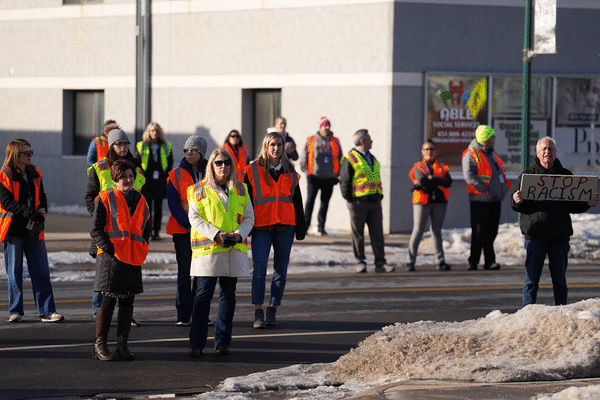
MINNEAPOLIS — Parents, neighbors and school staffers are ramping up mobilization efforts to stand guard outside schools as thousands of federal immigration agents descend on the Twin Cities.
While parent-teacher organizations have organized watches outside schools during pick-up and drop-off times for months, the ICE killing of Renee Nicole Good in Minneapolis Wednesday, Jan. 7 and the clash that day between U.S. Border Patrol agents and protesters outside Roosevelt High School has prompted more parents to guard schools.
“What kind of joy is there if a child has to be afraid that some of his friends are going to be abducted,” said Michael Martini, a St. Paul grandfather who on Thursday began to stand watch outside Central High School in the Lexington-Hamline neighborhood.
On Friday, he stood at the street corner again.
In Minneapolis, a parents group affiliated with TakeAction Minnesota, Minneapolis Families for Public Schools, now has 35 school sanctuary teams looking for ICE agents during student pickups and drop-offs. The group is also coordinating transportation and grocery delivery for immigrant families.
Natasha Dockter, vice president of the teacher chapter of the Minneapolis Federation of Educators, implored people to join in, “get a whistle, wear it at all times and get plugged into the rapid-response network in your neighborhood.”
Parents with Minneapolis Families for Public Schools and the teachers union demanded Friday that ICE leave schools, echoing similar calls from Gov. Tim Walz and other local leaders.
Citing “an abundance of caution,” Minneapolis Public Schools canceled schools and all activities Jan. 8 and Jan. 9 because of safety concerns, and are offering students the option to shift to e-learning through Feb. 12.
Elsewhere in the Twin Cities, several suburban school districts — from Apple Valley to New Hope — are now battling rumors that ICE agents have been or will be on their campuses or at school bus stops. As a precaution, Fridley joined Minneapolis in closing schools on Friday, and Columbia Heights switched from in-person instruction to e-learning.
At Roosevelt High School in south Minneapolis on Wednesday, hours after the fatal ICE shooting, witnesses said U.S. Border Patrol agents tackled several people outside. Education Minnesota, the statewide teachers union, condemned agents for the “unjust detention” of an educator and of agents pepper spraying students.
A Department of Homeland Security spokesperson said Border Patrol agents were conducting immigration enforcement operations when a U.S. citizen was “actively trying to impede operations,” “rammed his vehicle into a government vehicle” and began a 5-mile chase before ending at the school.
“At no point was a school, students, or staff targeted, and agents would not have been near this location if not for the dangerous actions of this individual,” the spokesperson added, and said officials used “targeted crowd control” when “rioters threw objects” on the officers and their vehicles.
Roosevelt juniors Addie Flewelling and Esme Wright didn’t witness the incident, but said Friday that it was scary and traumatic, and added they aren’t interested in e-learning when the option becomes available next week.
“Definitely not for me,” Flewelling said. “I think it’s important we show up to school, even if it’s terrifying.”
Wright, too, said it’s essential to be part of school communities, “making sure we’re reaching out and taking care of each other.”
ICE says it will not raid schools or target children. Regardless, neighborhood sympathizers — who are often identifiable by the colorful plastic whistles many wear around their necks — are keeping watch over schools with high immigrant populations.
Amanda Otero, a parent leader with Minneapolis Families for Public Schools, said immigrant families have expressed gratitude for the support. The group sees the ICE watches and food deliveries as a way to help people in their own school communities.
“It’s the best of what we want in our schools, right?” Otero said. “Not just in this crisis moment, but in ongoing ways.”
The Roosevelt incident prompted Central High School parent Carrie Au-Yeung, to join volunteers outside the St. Paul school on Jan. 8-9, watching for suspicious vehicles.
“With what happened at Roosevelt, I was like, ‘I’m getting over to the school,’” said Au-Yeung, who added that about 50 people are part of the Signal chat group that has formed to coordinate ICE watch activities.
“We’re not here to interfere, but just to call and to help if needed, observe what’s going on, be a witness, record, that kind of thing,” she said.
Rachel, a St. Paul parent who declined to give her last name for safety reasons, said she has been “blown away” by the generosity of parents, families and community members who have stepped in to support one another as safety concerns ripple through schools and child care sites.
“No one should feel unsafe dropping their child off at school,” she said.
The response, she said, formed quickly and mirrors the spontaneous mutual aid seen across the Twin Cities in 2020 after George Floyd’s murder. What began as a simple spreadsheet asking who could spend an hour in a parking lot has grown into a neighborhood-wide network offering transportation, groceries and daily check-ins.
“We’re not paid or trained organizers,” she said. “We’re just showing up and saying, ‘How can I help?’”
Minneapolis high school senior Dulce, who asked that her last name not be used, said she is considering the district’s e-learning option for safety but doesn’t want to miss any of the in-person moments of her final year.
In recent weeks, some of Dulce’s friends stopped coming to school altogether out of fear of being detained, she said. Group chats have become a lifeline for them, with students warning one another about immigration enforcement sightings and checking in daily.
“I’ve lived through COVID. I’ve lived through George Floyd. Now I’m living through this going on right now,” she said. “It’s a lot of piling up emotions.”
Even so, Dulce said some of her tears in recent days have come from gratitude for the ways her friends and neighbors are supporting one another. “Seeing the community come together … it’s really emotional in a good way,” she said. “It gives us hope.”
(Tim Harlow, Susan Du and Vince Tuss of the Minnesota Star Tribune contributed to this story.)
©2026 The Minnesota Star Tribune. Visit startribune.com. Distributed by Tribune Content Agency, LLC






Comments