NASA targets Artemis II rollout to pad, details launch options
Published in News & Features
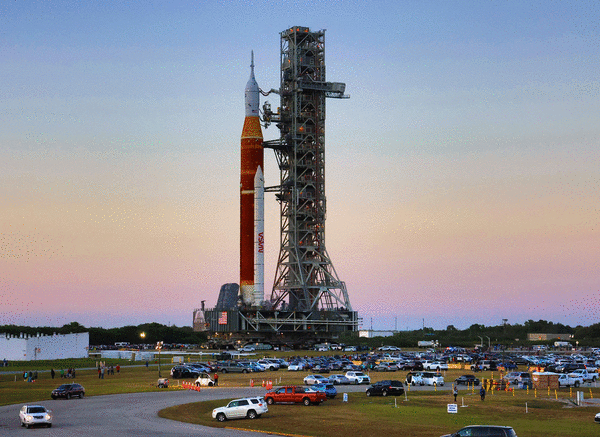
ORLANDO, Fla. — NASA could be sending a crew on the Orion spacecraft out past the moon in less than a month if everything falls into place. But first the agency has to get its rocket to the launch pad.
That could as early as next Saturday when the mobile launcher topped with the Space Launch System rocket and Orion could make the 4-mile slow roll atop the crawler-transporter 2 from the Vehicle Assembly Building to Launch Pad 39-B at Kennedy Space Center, NASA announced in a press release late Friday.
“We are moving closer to Artemis II, with rollout just around the corner,” said Lori Glaze, acting associate administrator for NASA’s Exploration Systems Development Mission Directorate. “We have important steps remaining on our path to launch and crew safety will remain our top priority at every turn, as we near humanity’s return to the moon.”
The crawler was last used on Artemis I in 2022, and had to make several trips to the pad and back as teams worked through hardware issues and even the threat of Hurricane Ian.
Once at the pad, more testing must be done before signing off on any launch attempt target date.
The first potential launch date, though, is Feb. 6 with opportunities falling on Feb. 7, 8, 10 and 11. The next launch window would give options on March 6, 7, 8, 9 and 11. The last of the planned launch windows announced so far has options to fly on April 1, 3, 4, 5 and 6.
Artemis II will be the first time humans fly on Orion, which had two previous uncrewed trips to space. The 10-day mission looks to send its crew out past the moon without landing, flying the farthest from Earth any human has ever flown, and venturing out of low-Earth orbit for the first time since the Apollo 17 mission in 1972.
The crew is made up of NASA astronauts, commander Reid Wiseman, pilot Victor Glover, mission specialist Christina Koch and Canadian Space Agency astronaut and mission specialist Jeremy Hansen. The crew announced this version of Orion has been named Integrity.
The goal of the mission is to prove Orion can keep its crew safe, fly past the moon and return home. This could then set up Artemis III, which aims to return humans to the lunar surface for the first time in more than half a century.
The SLS and Orion were fully stacked in the VAB in late October. Getting to the rollout has not been without hurdles, though, with teams continuing to work around the clock. NASA noted the rollout could delay if more time is needed for technical preparations or for weather concerns.
Recent troubleshooting issues have included a cable bent out of specifications that was connected to the flight termination system that needed replacement. Testing of that is occurring this weekend. Also, a valve connected to Orion’s hatch pressurization had issues during last month’s countdown demonstration in the VAB. That valve was replaced and tested earlier this month. In addition, teams had to fix leaky ground support hardware used to load gaseous oxygen into Orion for its crew to breathe.
Once at the pad, the mobile launcher will have its electrical, environmental control system ducts and cryogenic propellant feeds hooked up and powered on to make sure the rocket is ready to fly.
The crew will then perform a final walkdown at the pad before NASA performs a wet dress rehearsal, which means filling the SLS and Orion with all the needed propellants but not igniting them. That will involve flowing in more than 700,000 gallons of liquid hydrogen and liquid oxygen, all filled during a practice countdown, and then removing the propellants while the astronauts are safely away from the pad.
The closeout crew that would during launch day secure the astronauts onboard Orion will be on site to practice their procedures, though.
If issues arise, it’s possible NASA will need to roll the SLS back to the VAB. But if all goes well, the next step would be getting ready for launch.
Wet dress rehearsal testing will be carved up into runs, with the first occurring 49 hours ahead of the target test T-0 time with teams getting called to their launch support stations running down to T-90 seconds. Then a planned three-minute hold will move onto a countdown resumption to T-33 seconds. This is the point when the SLS’s automatic launch sequencer takes control. The rehearsal will then recycle the clock to T-10 minutes and hold, and then resume countdown down to T-30 seconds.
“While NASA has integrated lessons learned from Artemis I into the launch countdown procedures, the agency will pause to address any issues during the test or at any other point should technical challenges arise,” NASA posted on its website. “Engineers will have a close eye on propellant loading of liquid hydrogen and liquid oxygen into the rocket, after challenges encountered with liquid hydrogen loading during Artemis I wet dress rehearsals.”
Changes in the propellant load procedures made after the issues seen on Artemis I will be of particular interest, as well as recently updated procedures that will attempt to limit how much inert gaseous nitrogen accumulates in the space between Orion’s crew module and launch abort system hatches, something that could potentially cause problems for the closeout crew.
NASA said it may need to perform more than one wet dress rehearsal depending on the initial run’s results.
But if all boxes get checked, NASA could move onto a flight readiness review to choose a target launch date.
While each month’s launch window is about two weeks, the specific days carved out as launch options were based on keeping the crew safe.
When it does launch, Orion won’t be headed to the moon right away. Instead it will orbit Earth to let the crew and ground teams ensure the spacecraft’s life support systems are good to go. Then it will align for a trans-lunar injection burn to set up the spacecraft’s flyby and return trajectory. Some launch day options were taken off the board because they would cast Orion into the moon’s shadow for more than 90 minutes, which would limit the effectiveness of the spacecraft’s solar array wings.
Other issues with launch dates include Florida’s tempestuous weather and the availability of the propellants, so if there’s a scrub on one day, it’s hard to do a 24-hour turnaround.
“As a general rule, up to four launch attempts may be attempted within the approximate week of opportunities that exist within a launch period,” NASA sated.
©2026 Orlando Sentinel. Visit orlandosentinel.com. Distributed by Tribune Content Agency, LLC.






Comments