'Sell America' trade is revived by Trump's latest Fed attack
Published in News & Features
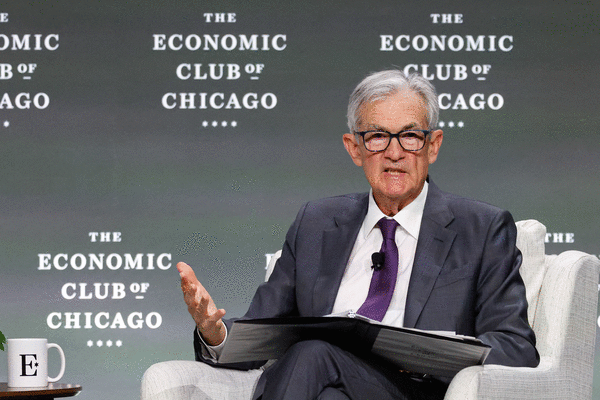
“Sell America” sentiment rippled through markets on Monday after the Trump administration escalated its attacks on the Federal Reserve, fanning concerns over the central bank’s autonomy in setting interest rates.
The dollar, Treasuries and U.S. equities futures slid after Chair Jerome Powell said the threat of a U.S. criminal indictment was a consequence of a disagreement over monetary policy. While the declines were relatively small, the hot-button issue of the Fed’s independence and the implications for U.S. markets resurfaced in investor debates.
“Any development that raises questions about the Fed’s independence adds uncertainty around U.S. monetary policy,” said Gary Tan, portfolio manager at Allspring Global Investments, which oversees more than $600 billion. “This is likely to reinforce existing trends of diversification away from the dollar and increase interest in traditional hedges such as gold.”
On Sunday evening, Powell said the U.S. central bank had been served grand jury subpoenas from the Justice Department that were related to his congressional testimony on ongoing renovations of the Fed’s headquarters. It’s the latest in a series of confrontations, which include efforts to fire Governor Lisa Cook and repeated calls for aggressive interest rate cuts.
“To characterize the events as putting the Fed independence discussion into uncharted waters would be an understatement,” Ian Lyngen, head of U.S. rates strategy at BMO Capital Markets, wrote in a note. “We remain skewed toward higher yields in the near-term.”
Bloomberg’s dollar gauge fell 0.2%, the most since Dec. 24. The S&P 500 fell as much as 0.5% in early trading, before paring its loss to trade little changed at 9:55 a.m. in New York. Ten-year U.S. Treasury yields advanced two basis points to 4.19% while yields on the 30-year bond rose three basis points to 4.84%.
Some strategists warned that the selloff may deepen if tensions continue to escalate. JPMorgan Asset Management flagged the risk of a steeper Treasury yield curve, meaning long-term rates would rise more than shorter ones, on expectations of more aggressive rate cuts. Lombard Odier sees the dollar and Treasuries coming under more pressure. Invesco Asset Management said non-U.S. assets like European and Asian equities look more favorable.
At the center of the debate is how far the U.S. president can and should influence the nation’s rate stance, which in recent decades have been insulated from political interference. Investors have also questioned whether they should reduce exposure to U.S. assets and the dollar — a theme that dominated global markets last April when President Donald Trump announced universal tariffs.
“This is a bad time to be worrying about Fed independence for the market,” said Bhanu Baweja, chief strategist at UBS Investment Bank, adding that U.S. inflation is likely to rise in the coming months. “The one common theme for this year seems to be not just a weaker dollar, but equity vol going higher.”
The president has long pressed the Fed to cut rates quicker to boost the economy and ease government borrowing costs, whereas Fed governors who set rates have been wary of rising inflation. Paul Volcker, who became Fed chair in 1979, is remembered for waging a dogged fight to quell an inflation problem that many believe went unchecked because the Fed gave in to pressure from then President Richard Nixon.
In an interview with NBC News on Sunday, Trump denied having any knowledge of the Department of Justice’s investigation into the central bank.
“The news could once again propagate the ‘Sell America’ narrative as we approach the opening bell,” said Gerald Gan, chief investment officer at Singapore-based Reed Capital Partners. The dynamics reflect an administration “focused on regaining public approval ahead of the midterm elections, even at the expense of institutional credibility.”
U.S. assets came under strain last year when Trump’s sudden global tariff announcement sent markets into a tailspin. Treasury yields had spiked when the levies were announced in April, with 30-year yields soaring more than 80 basis points on an intraday basis between the so-called Liberation Day to late May. The dollar tumbled more than 8% in 2025, its steepest annual decline since 2017.
“The Fed subpoena is another example of how U.S. assets are becoming less attractive,” said David Chao, global market strategist at Invesco Asset Management, which oversees more than $2 trillion. “Not only is the U.S. retrenching behind its Fortress America borders, the country is also becoming more predatory.”
Some are taking a more cautious view, saying that given the strong positioning of the dollar as a reserve currency, the deep liquidity in Treasuries and the artificial intelligence boom powering stocks, any pullback could be an opportunity to buy. “While we are always concerned with independence, it is something we will watch and make decisions when there is a more definable economic outcome,” said Marvin Loh, senior macro strategist at State Street in Boston.
Still, ‘Sell America’ pressures are unlikely to go away as trading gets underway for 2026.
Powell’s investigation looks “more like smoke than fire” right now, said Hebe Chen, senior market analyst at Vantage Global Prime Pty., but how long that lasts is up for debate. “Its longer-term and more deep-rooted implications are far more profound,” she added.
(With assistance from Richard Henderson, Matthew Burgess, Alice Atkins, James Hirai and David Watkins.)
©2026 Bloomberg L.P. Visit bloomberg.com. Distributed by Tribune Content Agency, LLC.






Comments