Catholic Church to start delivering US aid for victims of Hurricane Melissa in Cuba
Published in News & Features
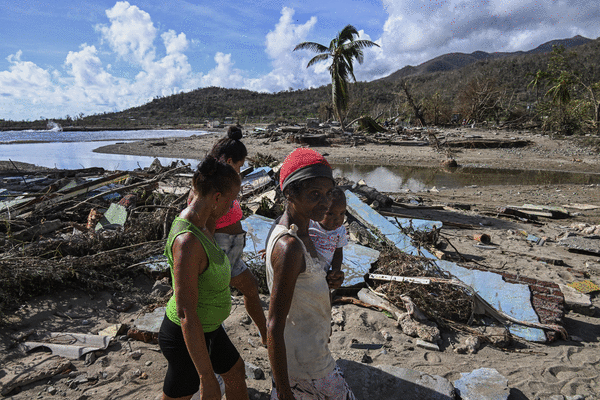
Secretary of State Marco Rubio announced Wednesday that the Catholic Church will start delivering U.S. aid directly to people affected by Hurricane Melissa in Cuba.
“Today, we are announcing the first in a series of direct humanitarian shipments to Cuba as part of the $3 million of disaster assistance committed by the Trump Administration following Hurricane Melissa,” Rubio said in a statement obtained by the Miami Herald. “These shipments reflect our sustained commitment to the Cuban people as they continue to recover from the devastation. While the storm has passed, humanitarian needs remain acute, and recovery efforts are ongoing.”
Melissa ravaged eastern Cuba as a Category 3 hurricane in October, leaving thousands of people without homes and destroying crops, telecommunications, electricity and water-pumping infrastructure.
One charter flight carrying supplies will depart from Miami on Wednesday and arrive in the eastern city of Holguín. A second one, bound for Santiago de Cuba, will leave from Miami on Friday. The State Department said each flight will deliver more than 525 food kits and 650 hygiene and water-treatment kits.
A ship carrying the rest of the assistance will dock in Santiago de Cuba in a few weeks. The State Department estimates the aid could reach up to 24,000 people in the hardest-hit provinces of Santiago de Cuba, Holguín, Granma and Guantánamo.
The food kits include rice, beans, oil and sugar to help families meet basic nutritional needs. The church will also distribute water purification tablets and storage containers, pots and cooking utensils, sheets and blankets, solar lanterns for lighting during outages and other essentials.
“Consistent with our longstanding policy, we have taken extraordinary measures to ensure that this assistance reaches the Cuban people directly, without interference or diversion by the illegitimate regime,” Rubio said. “We are working in close partnership with the Catholic Church in Cuba to deliver aid transparently and effectively.”
Shortly after the hurricane left Cuba, the State Department announced it would send $3 million in aid to Cuba for direct distribution through the Catholic Church and Caritas, the church’s charitable organization, as part of a broader effort to assist people affected across the Caribbean. Although Cuban officials had previously denied similar gestures, this time Cuba’s Ministry of Foreign Investment said it “greatly appreciated” the U.S. help.
“Our humanitarian assistance is a tangible manifestation of U.S. direct support for the Cuban people — los cubanos de a pie” — ordinary citizens — said Mike Hammer, the chargé d’ affaires at the U.S. embassy in Havana. “We expect it will be delivered without interference to those most in need.”
The U.S. embargo on Cuba includes provisions to allow sending humanitarian aid, food and medicines.
The aid would reach the island at a time of heightened tensions, following the capture by U.S. forces of the island’s close ally Nicolás Maduro in Venezuela and remarks by president Donald Trump and Rubio calling Cuba a “failing” nation run by “incompetent” people.
“As Secretary Rubio has said, the incompetent and illegitimate regime has for too long failed to care for the brave Cuban people,” said Jeremy P. Lewin, acting under-secretary of State for foreign assistance, humanitarian affairs and religious freedom.
“As this week’s charter flights demonstrate, the Trump Administration is committed to supporting the Cuban people, even if their corrupt rulers will not,” he added. “Working with the Catholic Church, we are proud to be able to deliver critical life-saving assistance directly to the people. If the regime gets out of the way, we are eager to provide even more support in the coming days and months.”
Cuba was already in dire need before the hurricane: 2025 ended as one of the worst years in the country’s recent history. Shortages are widespread, and most Cubans get only a few hours of electricity per day. Videos published by Cubans after the hurricane showed the desperate conditions in eastern Cuba’s rural areas, where many of the people most affected by the storm live.
The United Nations estimates that more than 1.7 million people were affected by the hurricane and that more than 160,000 homes sustained damage. In Santiago de Cuba alone, over 22,000 homes were destroyed, Cuban state media reported.
The Cuban government’s response has mainly relied on donations from several countries in Latin America, Europe and Asia. The U.N. released $4 million in emergency funding to support the government’s disaster response, but said it needed a total of $74 million to meet the needs of the people severely affected by the storm.
©2026 Miami Herald. Visit at miamiherald.com. Distributed by Tribune Content Agency, LLC.






Comments