Supreme Court appears likely to strike down laws banning guns in stores and restaurants
Published in News & Features
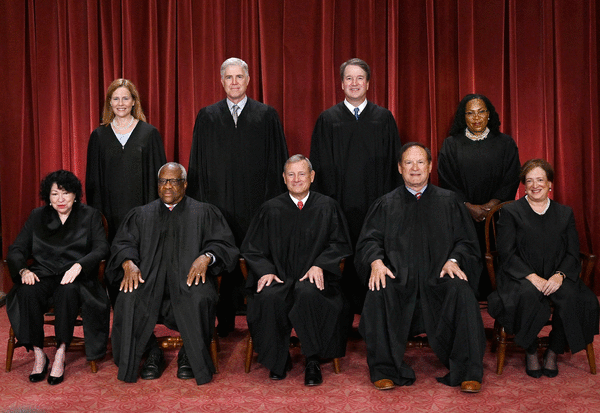
WASHINGTON — Do licensed gun owners have a right to carry a loaded weapon into stores, restaurants and other private places that are open to the public?
California and Hawaii are among five states with new laws that forbid carrying firearms onto private property without the consent of an owner or manager. But the Trump administration joined gun-rights advocates on Tuesday in urging the Supreme Court to strike down the laws as unconstitutional under the Second Amendment.
Such a law “effectively nullifies licenses to carry arms in public,” Trump’s lawyers said.
If you stop at a gasoline station, “you’re committing a crime” if you do not have the owner’s consent, Deputy Solicitor General Sarah Harris told the court.
An attorney representing Hawaii said the issue is one of property rights, not gun rights.
“An invitation to shop is not an invitation to bring your Glock,” Washington attorney Neal Katyal told the court. “There is no constitutional right to assume that every invitation to enter private property includes an invitation to bring a gun.”
The justices sounded split along the usual ideological lines, with the court’s conservatives signaling they are likely to strike down the new laws in five Democratic-led states.
“You are just relegating the Second Amendment to second-class status,” Justice Samuel A. Alito Jr. told Katyal.
He said the court had ruled law-abiding persons have a right to carry a firearm for self-defense when they leave home. That would include going to stores or businesses that are open to the public.
“Could Hawaii enact a statute that says that if you are wearing attire expressing approval of a particular political candidate, you can’t come in unless you get express consent from the owner of the restaurant?” Alito asked.
Both sides agreed that business owners are generally free to allow or prohibit guns on their property. However, state officials said, the laws are important because business owners rarely post signs that either welcome or forbid the carrying of guns.
“Why is this a big deal? If they want people carrying guns to stay out, just put up a sign,” Alito said.
At times, Chief Justice John G. Roberts Jr. has been wary of extending gun rights under the 2nd Amendment, but not on Tuesday. He said he was concerned the Second Amendment and the right to bear arms has been treated as a “disfavored right.”
A candidate for office has “a very clear constitutional right under the First Amendment to walk up to your door on private property and knock on the door and say, give me your vote,” he said. “You say it’s different when it comes to the Second Amendment. When a candidate is carrying a gun, what exactly is the basis for the distinction?”
Justices Clarence Thomas, Neil M. Gorsuch and Brett M. Kavanaugh said they too believed the “right to keep and bear arms” included the right to carry weapons, including into stores.
Justice Sonia Sotomayor and Ketanji Brown Jackson said property rights should prevail over gun rights.
“Is there a constitutional right to enter private property with a gun without an owner’s express or implicit consent? The answer has to be simply no,” Sotomayor said. “You can’t enter an owner’s property without their consent.”
But with the possible exception of Justice Amy Coney Barrett, none of the conservatives agreed.
Four years ago, the court ruled law-abiding gun owners had a right to carry a concealed weapon for self-defense when they left home. They also said then that guns may be prohibited in “sensitive places,” but they did not decide what that meant.
In the wake of that decision, California, Hawaii, New York, New Jersey and Maryland adopted new laws that restricted carrying guns in public places, including parks and beaches.
The laws also said gun owners may not take a gun into a privately owned business without the “express authorization” of an owner or manager. California’s law went a step further and said the owner must post a clear sign allowing guns.
The 9th Circuit Court of Appeals upheld the laws from Hawaii and California in a single opinion, except for the required posting of a sign in California.
Three Hawaii residents with concealed carry permits appealed to the Supreme Court and won the backing of the Trump administration. The case is Wolford vs. Lopez.
In recent weeks, the justices have been considering whether to hear a Second Amendment challenge to the laws in California and Illinois that forbid semiautomatic “assault weapons” and large-capacity magazines.
Four of the conservative justices have already issued dissents asserting these laws are unconstitutional.
On Friday, when the court meets for its private conference, the justices will consider the California case for the fifth time.
If the court votes to hear the appeal in Duncan vs. Bonta, the arguments would likely be held over until the fall.
_____
©2026 Los Angeles Times. Visit at latimes.com. Distributed by Tribune Content Agency, LLC.




Comments