2 bills aimed to rein in ICE heard by Maryland senate committee
Published in News & Features
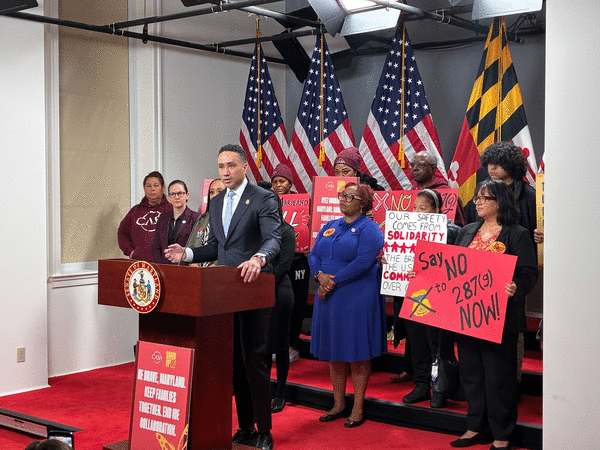
Maryland Democrats are pushing legislation that would bar local cooperation with federal immigration enforcement and prohibit law enforcement officers from wearing face coverings, drawing objections from sheriffs who warned the measures could undermine their work and Republicans who downplayed concerns about ICE in the state.
Both bills, which have support from Senate President Bill Ferguson and House Speaker Joseline Peña-Melnyk, were heard Thursday during a packed meeting of the Senate Judicial Proceedings Committee.
“Of course we should enforce the law, but we don’t need to do it in a way that disrespects humanity,” Ferguson, who listed the two bills as priorities this session, said on Jan. 14. “Until there is a major shift, until there is a major restructuring of how that organization functions, Maryland should not be partnering in furthering an organization that does not follow Maryland values.”
Local immigration agreements bill
Senate Bill 245 would prohibit the state and local governments from entering into immigration enforcement agreements with the federal government and would end any existing agreements. In Maryland, those agreements allow correctional officers in several counties to question detainees about their immigration status, notify U.S. Immigration and Customs Enforcement of people believed to be in the country illegally, and hold individuals for up to 48 hours after they would otherwise be released so ICE can take custody.
Eight Maryland counties participate in the contracts, known as 287(g) agreements: Allegany, Carroll, Cecil, Frederick, Garrett, Harford, St. Mary’s and Washington counties. Three operate under the jail model, which allows correctional officers to screen all people entering detention facilities for immigration status and contact ICE if someone is believed to be in the country illegally. The remaining five use the warrant model, which limits cooperation to cases in which there is an outstanding warrant issued by the Department of Homeland Security.
“It doesn’t keep us safe, but what it does do is allow ICE to use our legal system as a force multiplier, freeing up their agents, their detention space and their resources to make even more arrests on our streets,” Judicial Proceedings Committee Chair Sen. Will Smith, a Montgomery County Democrat and sponsor of the bill, said in a Thursday news conference.
Supporters of the legislation argue the agreements erode trust between communities and law enforcement, funnel people who have not been convicted of crimes into deportation proceedings, and are unnecessary because ICE conducts enforcement activity regardless. Advocates testifying at the hearing also said the agreements can lead to racial profiling and disproportionately affect people accused of minor offenses, such as traffic violations. Similar legislation to end the agreements failed to pass during last year’s General Assembly session.
Sheriffs in counties that participate in 287(g) agreements said the contracts enhance public safety by keeping ICE activity confined to local jails rather than neighborhoods. They also said the agreements apply only after individuals are arrested and that people who are in the country illegally and do not want to be referred to ICE should not commit crimes.
“You can pass this law and abolish our 287(g) agreement, but no politician or legislative body will tell me that I can’t communicate with another law enforcement agency when it comes to a matter of public safety in my community,” Carroll County Sheriff James DeWees told lawmakers during Thursday’s hearing.
Noreen Shah, director of immigration policy for the American Civil Liberties Union, said agencies that participate in 287(g) agreements are “embroiled in a reckless, dangerous enforcement spree spearheaded by the Trump administration.” Maryland Comptroller Brooke Lierman supported ending the agreements, noting immigrants make up about 21% of the state’s labor force and warning that immigration enforcement can discourage immigrant participation in the economy.
One CASA member, who only provided the name Angel, testified that her brother was detained by ICE in Frederick County last week after a routine traffic stop. She questioned during her testimony if Frederick officers are an extension of ICE.
“We lived with a constant fear that he couldn’t trust the police, not because he wanted to fear them, but because he saw them as ICE agents who could tear him from his family and his home,” Angel said through a translator. “Unfortunately, my brother’s worst fears came true … ICE is not targeting so called dangerous criminals. They are targeting hardworking people like my brother.”
Republican Senators William Folden and Chris West downplayed the agreements between local jurisdictions and the federal government. The state lawmakers argued that the policies of these agreements do not allow officers to assist in raids or other on-the-street enforcement.
“There’s no mass roundups in Maryland … our local sheriff’s offices are not out enforcing immigration laws,” Folden, a Frederick County Republican on the committee, said.
Face coverings bill
The face coverings legislation would prohibit law enforcement officers, including federal immigration agents, from wearing face coverings while working in Maryland, except when officers are undercover. The proposed bill would not apply to religious garments or safety devices. If found guilty, officers would face up to two years in jail and a $2,000 fine. A specific model policy would be made by the Maryland Police Training and Standards Commission.
The bill comes after nationwide outcry over ICE agents wearing faces covering while detaining people, which advocates have said hinder efforts to hold individual officers accountable.
“Masked law enforcement apprehending people is familiar in repressive totalitarian countries. It’s done to intimidate and to terrorize,” Sen. Malcolm Augustine, a bill sponsor and Prince George’s County Democrat, said. “That practice undermines community trust and makes us all less safe.”
Augustine argued in his Thursday testimony that law enforcement officers have to follow other state laws, masks are not needed for law enforcement activity, and officers wearing masks can lead to fear and anxiety in already tense situations. He emphasized that the bill is meant to increase transparency.
Critics of the legislation have argued that law enforcement agents, including ICE, and their families can be put at risk when their photos are posted online. This includes Folden, who pressed the bill's sponsors during the hearing on what he said is an increase in doxing faced by law enforcement officers.
ICE is the only agency in the country that is routinely masking out of a fear of doxing said Noreen Shah, the American Civil Liberties Union’s director of immigration policy, during the hearing.
_____
©2026 Baltimore Sun. Visit baltimoresun.com. Distributed by Tribune Content Agency, LLC.






Comments