Detained by ICE, 2 women became first responders during agent's seizure
Published in News & Features
MINNEAPOLIS — The ICE vehicle had barely made it two blocks when something went wrong.
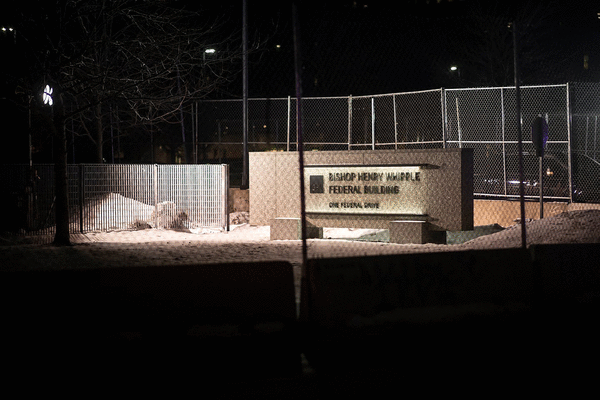
Tippy Amundson, 39, and Heather Zemien, 55, were sitting handcuffed in the back seat of a three-row SUV on the afternoon of Jan. 22 in Brooklyn Park, detained by federal immigration agents and heading toward the Whipple Federal Building. The third row had been folded down. One agent sat behind them without a seat belt. Two others were in front.
They were stopped at a light when the agent in the front passenger seat said out loud that he wasn’t feeling well.
Then his body began to tilt. His arms flailed. His words dissolved into sounds that didn’t make sense.
“To us, it was obvious,” Amundson said. “It wasn’t obvious to them.”
Amundson and Zemien were the only ones who recognized that the man was having a seizure. They spoke up immediately, telling the driver to pull over and telling the agents to call 911. When nothing happened, they repeated it, louder and more urgently.
The SUV lurched over a curb and came to rest at an angle on the sidewalk near Welcome Avenue, just off a busy stretch by an Aldi. Amundson could hear the agent’s tongue and fluids blocking his airway. She asked to be uncuffed.
“He’s going to stop breathing,” she told them.
Amundson, a kindergarten teacher who has received CPR and first-aid training through school emergency planning, moved without hesitation once the cuffs came off. The agents stepped out of the vehicle, leaving the driver’s door open, the engine running and the keys inside. Weapons were still in reach.
Amundson ran around the car and knelt beside the agent, trying to turn him onto his side. She spoke to him calmly, telling him he was safe and that help was coming. She said she was aware that people having seizures can often hear what’s being said around them.
When he began to lose consciousness, she moved his gun from its holster so she could position him properly. She cradled his head as another seizure came.
Zemien, a personal care attendant, grabbed one of the agents’ tactical vests from the ground, rolled it up and slid it under his head to keep his airway open. She told the agents to shut the car doors so he wouldn’t lose body heat.
“He had two more seizures after that,” Zemien said. “We had to tell them every step of the way what to do.”
By the time emergency medical responders arrived, the women had been holding the agent steady for several minutes. They were detained but acting as first responders to the man who had detained them.
Once the agent was transferred to medical care, Amundson and Zemien were placed into another vehicle and driven to Whipple anyway.
“I asked if we could just go home,” Amundson said. “I said, ‘We just saved his life. Is that cool with you?’ And they said no.”
On the drive, Amundson asked when they would be allowed to call a lawyer. An agent told her they “should” be able to at Whipple but said he didn’t really know the policy. After a pause, he added that because they had helped one of the agents, they could call one person.
Zemien called her attorney. By then, their support network was already mobilizing. Using a voice command to text a message during the detention, Amundson had managed to alert her husband, who contacted their state representative. Legal paperwork was already being gathered. A meeting at Whipple was already being arranged.
A commanding officer eventually approached them.
“We’re releasing you to your counsel and to your state representative,” the officer said, according to Amundson. “But you need to tell everybody that we treated you kindly.”
They were driven to the front of the Whipple Federal Building and released into their representative’s car.
What stayed with Amundson most, she said, was not the adrenaline of the moment but the realization that came while she was holding the agent’s head in her hands and keeping his airway open.
“I was hit so hard with the fact that this man would not do this for me,” she said.
Her mind went immediately to Renee Good.
Earlier this month, Good, a citizen observer and U.S. citizen, was shot three times by an ICE agent during an enforcement action in Minneapolis. According to witnesses and officials, a person who identified themselves as a medic was not permitted to provide care after the shooting. Agents said ICE had its own medical personnel. Several minutes passed before aid was rendered. Good died at the scene.
ICE has said its agents followed protocol. The agency did not immediately respond to requests for comment about the Brooklyn Park incident involving Amundson and Zemien.
For the two women, the contrast between the incidents was difficult to ignore.
“We were willing to do for this man, this human, what they were not willing to do for Renee Good,” Zemien said.
“It’s important for people to know how ill-prepared they are,” Amundson said. “And how untrained.”
©2026 The Minnesota Star Tribune. Visit at startribune.com. Distributed by Tribune Content Agency, LLC.




Comments