Why was the slavery exhibit removed from Philly's President's House Site? A historian gives context
Published in News & Features
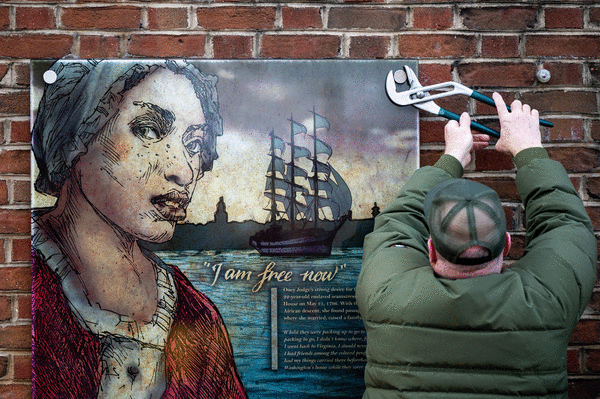
PHILADELPHIA — For some, the removal of exhibits about slavery at the President’s House Site at Independence National Historical Park on Thursday came as a shock.
For John Garrison Marks, a historian and author who writes and researches about America’s early years, it looked like history repeating itself.
In April, Marks will publish his book "Thy Will Be Done: George Washington’s Legacy of Slavery and the Fight for American Memory." The book delves into George Washington’s life, his relationship with slavery, and how that relationship has been manipulated by politicians and activists over the last 21/2 centuries to serve various narratives.
Marks talked to The Philadelphia Inquirer about how the removal of the slavery exhibits at the President’s House will become another chapter in the nation’s struggle to reconcile how a man renowned for fighting for freedom forced so many into bondage.
The following interview has been edited for clarity and brevity.
Question: Can you tell me a little about the specific history of this site?
Answer: While (Washington) was there, he enslaved at least nine people. He had enslaved people for the entirety of his adult life. He had grown accustomed to being served by enslaved people at his home in Virginia.
So he brought these people from Mount Vernon to the President’s House in Philadelphia while he was serving as president there, and the major complication that came up with this, and this is one of the things that the historic site did a great job of explaining, is that the state of Pennsylvania passed a law to gradually abolish the institution of slavery in 1780.
As part of that law, any enslaved person who remained in residence in Pennsylvania for more than six months would be entitled to their freedom. George Washington discovered this soon after assuming the presidency and relocating to Philadelphia, and he also learned, as many future presidents would learn, that the law also would apply to him. He wanted to keep the labor of these people that he enslaved, and so he devised a scheme he very much wanted to be kept secret to rotate enslaved people in and out of Pennsylvania before they had arrived at that six-month mark and would be entitled to their freedom.
Sometimes he would send people back to Virginia. Sometimes he would just take them across the river to New Jersey for a little while, but he was very aware of this gradual abolition law and worked very hard to make sure that it wouldn’t apply to the people he personally enslaved.
The tragic irony in that is, at the very same time, George Washington was expressing in letters to people, in private correspondence, how much he supported these Northern gradual abolition laws.
Q: Was there some sort of moral struggle that we have evidence of that he was experiencing? How was he reconciling these things?
A: He writes to people in private, talking about how he recognizes the hypocrisy inherent in him leading a revolution to found a nation dedicated to liberty and equality and his own involvement with slavery.
There were these statements that he made limiting the nature of his involvement, of trying to establish some limits for himself of how he would and would not engage with the institution of slavery, but he also proved flexible on that point.
Hercules Posey, the chef that he enslaved in Philadelphia, escapes from slavery and escapes from the Washingtons.
After that happens, Washington writes in a letter that he’s disappointed because he vowed never to gain another enslaved person by purchase but then says, “Now this is a vow I must break.” So it seems he never even considered the possibility of hiring and paying a free chef.
Q: How has Washington’s experience with slaves, in general but particularly there, been sort of warped over time?
A: In the months after Washington’s death, almost every American would have known that he freed the people he enslaved in his last will and testament, and yet almost no one talked about it.
There are dozens of biographies of Washington that get published in the decade after his death, and almost none of them acknowledge slavery in any way.
But there have always been people in America who are dedicated to lifting up that history, to resurfacing Washington’s involvement in slavery. So during the 1932 bicentennial (of Washington’s birth) you have Black educators and activists, Black newspapers who say, if this is going to be about getting back to the real George Washington, now is the time that we have to reckon with his involvement in slavery.
It happens again, to varying extents, during the Civil Rights Movement as there’s a greater scholarly attention to the histories of slavery and Black Americans. You’ve seen it over the course of the last couple decades about what kinds of things can and can’t be taught in American schools.
Always, the conversation is about Washington, but it’s never just about Washington. It is always about America and what America stands for, and depending on people’s assessment of what the nation is and what it means, that often dictates how they think the story of George Washington and slavery should be treated.
Q: Why do you think it’s important we have the President’s House as a memorial with the plaques that have been removed? What do you make of the removal of them?
A: Trying to hide the nation’s history of slavery has never worked. We’ve been trying it over and over again throughout American history, but there have always been other people who insist that we reckon with this past, that we face it head on, that we include the full story so we can learn from it.
As we approach the nation’s 250th anniversary, I can’t help but think how many people are going to be visiting Independence Hall, are going to be visiting Independence National Historical Park, who would have had the opportunity to encounter this history of slavery that is so closely tied to our history of the founding and maybe learned it for the first time.
Eliminating the ability for people to learn from that history, to have conversations about that history, to reckon with what that history should mean for us today is only going to set us farther back. It is going to make much more challenging any effort to move the United States to becoming a more just society.
©2026 The Philadelphia Inquirer. Visit inquirer.com. Distributed by Tribune Content Agency, LLC.





Comments