Rubio calls Haiti's prime minister after stern US warning against ousting him
Published in News & Features
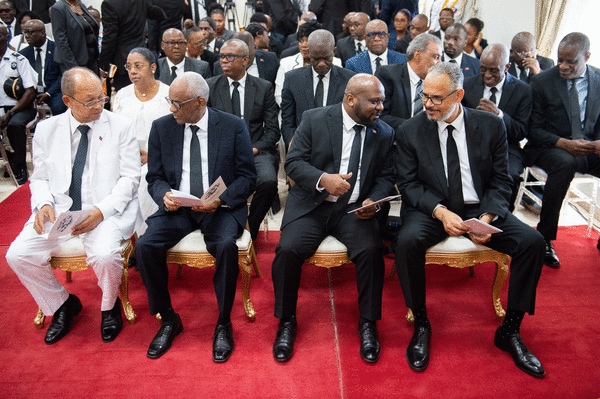
Secretary of State Marco Rubio spoke to Haiti Prime Minister Alix Didier Fils-Aimé on Friday, giving him his support amid efforts by the transitional presidential council to oust him.
“Secretary Rubio emphasized the importance of his continued tenure as Haiti’s prime minister to combat terrorist gangs,” State Department spokesperson Tommy Pigott said in a statement. “The current violence caused by gangs can only be stopped with consistent, strong leadership, with the full support of the Haitian people.”
Rubio also added that the Transitional Presidential Council “must be dissolved by February 7 without corrupt actors seeking to interfere in Haiti’s path to elected governance for their own gains.”
Under the terms of the creation of the presidential council in April 2024, it would be dissolved on Feb. 7.
“Haiti’s leader must choose Haiti’s stability,” Pigott added. “The United States will ensure there is a steep cost for corrupt politicians who support vicious gangs and wreak terrorism on Haiti.”
Rubio’s outreach came a day after the Trump administration openly backed Fils-Aimé, warning members of the country’s beleaguered nine-member transition council that their effort to oust the businessman and head of government is “illegal.”
A late-night Thursday post on X by the State Department made the U.S. position bluntly clear after a marathon day of social media warnings and political turmoil in Port-au-Prince, during which Fils-Aimé’s pending dismissal dominated the political landscape. After five of the seven voting members of the presidential council signed a resolution to oust Fils-Aimé, Haitians were waiting to see if it would be published in the country’s official gazette, Le Moniteur, to have legal force.
“The United States maintains its unwavering support for Haiti’s stability and security,” the State Department said in its post. “We view the recent announcement by the (council) as illegal. Haitian Prime Minister Alix Fils-Aimé’s tenure remains integral to advancing efforts to combat terrorist gangs and stabilize the country.”
The statement followed a series of unusually blunt warnings issued throughout Wednesday and Thursday by the U.S. Embassy in Haiti, the State Department’s Bureau of Western Hemisphere Affairs and Deputy Assistant Secretary of State Christopher Landau. U.S. officials cautioned council members that removing Fils-Aimé would carry grave consequences and could create a dangerous political vacuum.
In a joint statement, the ambassadors of the European Union, Germany, Spain and France called on “Haitian transitional authorities to act with responsibility and a sense of the general interest.” The group had paid Fils-Aimé a visit the day before, and posted a photo where he appeared “quite confident.”
The United Nations, Canada and the Organization of American States have also issued similar statements. But the sharpest language has come from the U.S. In another post, the State Department’s Bureau of Western Hemisphere labeled the members of the presidential council as “corrupt and gang allies.”
“Real stability will come when political leaders get their power from the support of voters rather than their ability to sow chaos,” the bureau said. “The members of the (council) who have followed this path are not Haitian patriots. They are criminals like the gangs they conspire with.”
Members of the council have been accused of targeting the prime minister in order to keep their grip on power and remain in the transitional posts after Feb. 7. On Friday, council members Leslie Voltaire, who has been accused of leading the push, and Edgard Leblanc Fils spoke at a joint press conference declaring they have the right to replace the prime minister and want to ensure the country doesn’t fall into chaos after Feb. 7.
The two men, however, also gave contradictory messages about the process, with Voltaire talking about “a pause to allow political parties and civil society groups to meet” and seek what he described as an acceptable governance arrangement, and Leblanc saying that the resolution firing Fils-Aimé “is ready” to be sent to the National Press for printing.
Where they were clear, is in their rejection of the pressure from the U.S. and others, whom they said had overstepped their authority and undermined efforts to find a Haitian-led solution to the crisis.
“We are accustomed to pressure,” Voltaire said. “We are the ones who appointed Didier Fils-Aimé in November 2024. We are the ones who worked with him for a year, and it is up to us to issue a new decree naming a new prime minister, a new government and a new presidency.”
Leblanc, adopting a more defiant tone, said had seen the international community’s messages on social media and they “lacked respect for the Haitian people.” He said he was especially “surprised” that certain members of the international community are accusing council members of aligning themselves with gangs.
“It’s not the first time we’ve seen where international organizations or friendly countries give a position on a situation... and then tomorrow or the day after it’s revealed that the position was for the public, and not really their position,” said Leblanc, a former president of the Haitian Senate. “We are used to this in Haiti.... It’s happened and could be the case here too.”
On Friday, as the impasse continued security was tightened around Villa d’Accueil — the former prime minister’s office that now houses the council’s offices. Haiti National Police Chief André Jonas Vladimir Paraison deployed armored vehicles to the area. He also removed his controversial head of the Villa d’Accueil and National Palace security units, who had fallen under suspicion of working for council members after he tried to order hundreds of assault rifles and millions of high-caliber ammunition.
Political analysts and those familiar with the Haitian government’s administrative procedures are questioning the legality around the council’s decision, which is increasingly being described as an attempted coup.
Guichard Doré, a former official in the National Palace under President Jovenel Moïse, said that under governing rules, Fils-Aimé remains in office as head of the government until the council member and lead coordinator, Laurent Saint-Cyr, signs the resolution and submits it for publication in Le Moniteur.
Until that happens, the resolution is just “a working document,” Doré said. “It does not yet engage the state.”
From the onset, the idea of putting a multi-member council in charge of Haiti’s presidency was deemed problematic. But it was seen as the only way to get some measure of stability to be able to hold elections, which are scheduled for this summer. Haitians themselves are divided. While some groups invited to a “national dialogue” held by the council reportedly asked for Fils-Aimé’s firing, others have denounced the gathering as a ploy and distanced themselves from the decision.
Fanmi Lavalas and Compromis Historique, two organizations who have representatives on the council, issued statements disavowing their council members’ support for removing the prime minister just as police have intensified efforts to reclaim territory from gangs, and with less than two weeks remaining in the council’s mandate.
“The (council) is the problem today, and it cannot present itself as the solution,” said Jodson Dirogene, a spokesman for Fanmi Lavalas, which was once Haiti’s biggest political party. Dirogene described the move as “treason” and accused council members, including his group’s own representative, Voltaire, of “betraying the people.”
Voltaire, a former government minister, had previously dismissed Prime Minister Garry Conille in November 2024 during his tenure as head of the council’s rotating presidency. The act opened the door for Fils-Aimé’s appointment. A month later, Fanmi Lavalas publicly reprimanded the council, accusing it of failing to improve security or political stability. In a statement shared Friday, the party said its position remains unchanged.
“The scandal and tragicomedy that is taking place... is a maneuver to maintain power because power is sweet in their mouths while life is bitter and galling in the mouths of the people,” the party said in a statement. “The Lavalas Family asks the police not to let the games of politicians fighting for power divert it from the road to security. Continue to chase all gangs, bandits and criminals who refuse to return to peace in the four corners of the country.”
In its statement, Compromis Historique called the effort to dismiss Fils-Aimé “irresponsible, dangerous and politically inopportune.” One of three groups in a coalition that designated member Smith Augustin to serve on the transitional entity, the group asked Augustin to withdraw his signature from the decision to dismiss Fils-Aimé.
Haiti has now seen three prime ministers forced from office since the July 2021 assassination of Moïse plunged the country deeper into uncertainty. Ariel Henry was ousted in March 2024 after the U.S. withdrew its support amid a coordinated assault by gangs on Port-au-Prince. He was followed by Conille, a longtime U.N. official who previously served as prime minister under President Michel Martelly.
Although in both cases U.S. authorities were inclined to let Haiti’s political actors have their way, this time around is different. After four years of political instability, the U.S. is pressing for elections and working to get funding for a new U.N.-authorized Gang Suppression Force of more than 5,000 foreign soldiers deployed to Haiti.
Despite the mounting criticism and warnings, the council appeared poised to proceed with removing Fils-Aimé as its mandate nears expiration.
By pressing ahead, council members are testing the Trump administration, which has intensified the use of sanctions against Haitian politicians and businessmen, and last May designated the country’s powerful gang coalition, Viv Ansanm, as a global terrorist organization. The designation exposes anyone who collaborates with armed groups to terrorism-related penalties.
After four years of political instability, the U.S. is pressing for elections and urging government leaders to put the country first in order to create the conditions necessary to hold them. That effort includes combating gang violence and preparing to receive a the Gang Suppression Force.
“To the corrupt politicians supporting vicious gangs and who are wreaking terrorism on the country, the United States will ensure there is a steep cost,” the State Department said in a socia media posting.
_____
©2026 Miami Herald. Visit miamiherald.com. Distributed by Tribune Content Agency, LLC.


Comments