Mexico, Cuba's last oil lifeline, weighs cutting shipments as US pressure intensifies
Published in News & Features
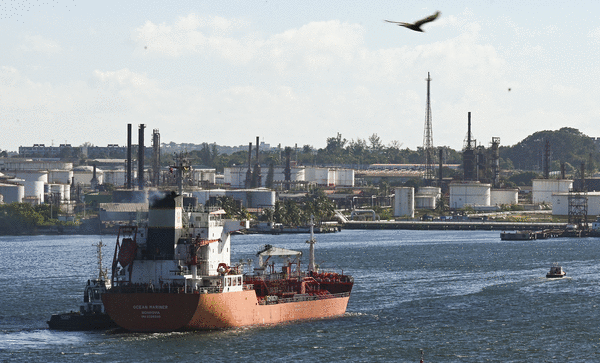
Mexico is quietly reviewing whether to continue shipping oil to Cuba, amid rising concern inside President Claudia Sheinbaum’s administration that the policy could provoke retaliation from the United States at a moment of intense geopolitical strain in the hemisphere, according to a Reuters report citing three people familiar with the discussions.
The internal review — which has not previously been reported — comes as President Donald Trump’s administration considers more aggressive steps to force regime change in Cuba. Among the options under discussion, reported by the media outlet Politico, is a total blockade on oil imports to the Communist-run island. Three people familiar with the U.S. deliberations told Politico that the idea has been pushed by hardliners and backed by Secretary of State Marco Rubio, though no final decision has been made.
The stakes for Havana are unusually high. After U.S. forces blocked Venezuelan oil tankers in December and dramatically captured Venezuelan President Nicolás Maduro earlier this month, shipments of crude from Caracas to Cuba have effectively stopped. Mexico has since emerged as Cuba’s single largest external oil supplier, making its role critical for an island already crippled by chronic energy shortages, rolling blackouts and deepening economic stagnation.
Trump has made little secret of his desire to tighten the screws. “Cuba is ready to fall,” he wrote on Truth Social on Jan. 11, adding in capital letters: “THERE WILL BE NO MORE OIL OR MONEY GOING TO CUBA – ZERO!” While the message was aimed primarily at Venezuela, it has cast a long shadow over Mexico’s continued shipments.
Publicly, Sheinbaum has defended the policy, saying oil deliveries to Cuba are governed by long-term contracts and constitute a form of humanitarian aid. Privately, however, senior officials acknowledge growing anxiety within her cabinet that continuing the shipments could antagonize Trump at a delicate moment in U.S.-Mexico relations, Reuters reported.
Mexico is simultaneously trying to renegotiate elements of the U.S.-Mexico-Canada Agreement and persuade Washington that it is doing enough to confront powerful drug cartels — while firmly rejecting any unilateral U.S. military action on Mexican soil. Trump has recently escalated his rhetoric, claiming Mexico is “run by the cartels” and suggesting U.S. ground attacks could be imminent, comments Sheinbaum has described as a grave threat to national sovereignty.
“There is a growing fear that the United States could take unilateral action on our territory,” one of the sources told Reuters.
Those tensions came into sharper focus during a phone call last week between Trump and Sheinbaum. According to two sources familiar with the conversation, Trump questioned her directly about Mexico’s oil shipments to Cuba and the presence of thousands of Cuban doctors working in Mexico. Sheinbaum responded that the oil deliveries are humanitarian in nature and that the medical program complies fully with Mexican law. Trump did not explicitly demand an end to the shipments, the sources said, but the exchange was pointed enough to intensify debate inside Mexico City.
Adding to the unease is what Mexican officials see as a growing U.S. military footprint nearby. Since December, U.S. Navy Northrop Grumman MQ-4C Triton surveillance drones have flown repeatedly over the Gulf of Mexico and the Bay of Campeche, roughly tracing maritime routes used by tankers carrying Mexican fuel to Cuba, according to local media citing flight-tracking data. Similar aircraft were observed off Venezuela’s coast shortly before U.S. action there.
Inside the Trump administration, discussions about Cuba reflect a belief that the island is at its most vulnerable point in decades. Cuba imports about 60% of its oil, according to the International Energy Agency, and until recently relied heavily on subsidized Venezuelan crude. The loss of those supplies — and the hard currency Havana earned by reselling part of them — has further squeezed an already fragile economy.
Some U.S. officials argue that a complete oil blockade could be decisive. “Energy is the chokehold to kill the regime,” said one person familiar with internal planning, adding that toppling Cuba’s Communist government is viewed as a near-term goal, potentially justified under the 1994 Helms-Burton Act that codifies the U.S. embargo.
Others have pushed back, warning that a total cutoff could trigger a severe humanitarian crisis, destabilize the Caribbean and fuel a new wave of migration. Cuba’s government has survived decades of U.S. sanctions, the collapse of the Soviet Union and prolonged economic hardship, but conditions on the island have deteriorated sharply in recent years.
For Mexico, all options remain on the table. According to the sources, officials are weighing a complete halt to oil shipments, a partial reduction or maintaining current levels. In a statement to Reuters, the Mexican presidency said the country “has always been in solidarity with the people of Cuba,” calling both oil shipments and a separate agreement to pay for Cuban medical services “sovereign decisions.”
If Washington moves ahead with harsher measures, Mexico may be forced to choose between its long-standing policy of non-intervention and solidarity with Havana, and shielding itself from economic or political reprisals from its most powerful neighbor — a dilemma that underscores how quickly the balance of power in the Americas is shifting as the Trump administration turns its focus from Venezuela to Cuba.
©2026 Miami Herald. Visit miamiherald.com. Distributed by Tribune Content Agency, LLC.





Comments