'Like we're starting all over again'; Chicago man acquitted on Bovino murder-for-hire charges now in ICE custody
Published in News & Features
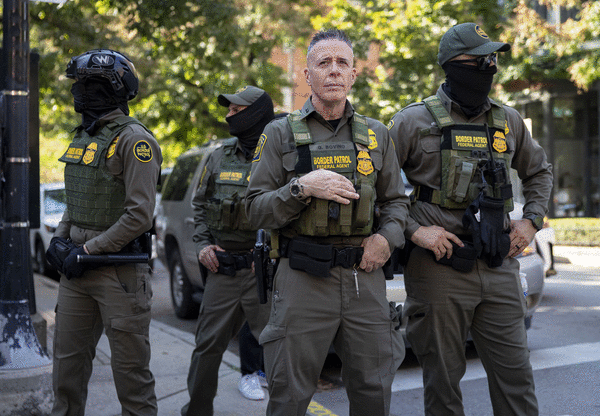
CHICAGO — A day after a Chicago construction worker was acquitted by a federal jury of charges he offered money to kill Border Patrol Cmdr. Gregory Bovino, the Department of Homeland Security was hardly in a conciliatory mood.
“This verdict does not change the facts: (Juan) Espinoza Martinez targeted federal law enforcement with violence via Snapchat,” DHS spokeswoman Tricia McLaughlin said in an emailed statement, which went on to strike some other familiar themes about the media, sanctuary politicians and “terrorists” bent on harming immigration agents.
The government’s response to yet another high-profile case stemming from Operation Midway Blitz going down in flames illustrates just how much emphasis the Trump administration has placed on the public relations battle, rather than legal outcomes.
By quickly labeling arrestees as “domestic terrorists” or, in Espinoza Martinez’s case, a “high-ranking gang member,” DHS has tried to paint a picture of Chicago as a city out of control, with citizens willing to do anything to inflict physical harm on immigration agents simply trying to do their job.
Over and over again, however, criminal charges have dissolved once put under judicial scrutiny.
Out of the roughly 30 cases charged since September, 14 never made it to a trial — including many where a grand jury refused to return an indictment and others where prosecutors moved to dismiss them when more evidence came out.
Last month, prosecutors dropped assault charges against Marimar Martinez after questions arose about the official version of an agent who shot her in traffic in Brighton Park, purportedly in self-defense, then bragged later about his marksmanship in text messages with his buddies.
Several other cases remain pending — most notably the high-profile conspiracy charges against six protesters, including several Democratic political candidates, accused of impeding immigration officers and damaging a vehicle outside the Broadview ICE facility in September.
Espinoza Martinez’s case, meanwhile, was the first to make it to a jury, which acquitted him after only three hours of deliberation.
Some Chicago defense attorneys who have handled Midway Blitz-related cases told the Tribune they were encouraged by the outcome because the jury process worked as intended.
But they also expressed concern over so many cases being brought in seemingly hasty fashion, particularly in a courthouse where prosecutors, working with federal law enforcement agencies, have long been known as thorough and methodical.
“You don’t blitz in federal criminal prosecutions,” said attorney Christopher Parente, a former federal prosecutor who represented Marimar Martinez. “You take your time. You make sure your case is rock solid and that you’re going to win.”
Parente said he saw many parallels between his client’s case and the allegations surrounding Espinoza Martinez. In both instances, he said, DHS trashed the defendants as violent thugs in news releases and put out information about their supposed gang membership that later turned out to be completely fictitious, he said.
“They almost don’t care what happens when it gets to court,” Parente said.
Attorneys Jonathan Bedi and Dena Singer, who represent Espinoza Martinez, also said Friday his acquittal is “an example of the power of the jury trial.”
“Twelve ordinary citizens stood between an overreaching government and an innocent man. They demanded proof, not politics,” the attorneys said in a statement. “This verdict is a reminder that juries see through political prosecutions. They demand real evidence, not speculation and character assassination. The government didn’t have it. They never did.”
A spokesman for the U.S. attorney’s office in Chicago declined to comment.
Despite his acquittal, Espinoza Martinez, who is not a U.S. citizen, was taken into custody directly from the Metropolitan Correctional Center on Friday pursuant to a detainer by Immigration and Customs Enforcement.
Bedi said despite the uncertainty where he’d go next, Espinoza Martinez was in good spirits after the trial ended.
“He’s relieved,” he said. “A lot of happy tears.”
Espinoza Martinez’s wife, Bianca Hernandez, told the Tribune the relief she and her family felt when her husband was found not guilty was real — but fleeting.
“We were very, very happy because we knew that he didn’t do anything,” Hernandez said. “But at the same time, it is a very bittersweet victory because he doesn’t actually get to come home.”
With her husband now in ICE custody, she and their three children, ages 14, 12, and 3, are now facing a new and frightening uncertainty.
The family does not know where Espinoza Martinez is being held or when he will be deported to his native Guerrero, Mexico, where he has not been since he was 5 years old, she said.
He previously held DACA status until 2020, when financial hardship during the COVID-19 pandemic prevented him from renewing.
“To me this is like we’re starting all over again,” Hernandez said.
When the charges against Espinoza Martinez were announced Oct. 7, the language DHS used to describe him could not have been more inflammatory. It was just days after Marimar Martinez had been shot in Brighton Park, and tensions in Chicago were already elevated.
“Depraved individuals like Juan Espinoza Martinez — who do not value human life and threaten law enforcement — do NOT belong in this country,” McLaughlin blasted in a news release. “We will not allow criminal gangs to put hits on U.S. government officials and our law enforcement officers.”
Federal leaders also tried to use Espinoza Martinez’s case to allege that it is part of a coordinated effort by criminal gangs to go after immigration officials, though they’ve offered no further evidence.
In an interview on Fox News shortly after the arrest, McLaughlin said it was proof of a “coordinated, highly organized waging of war against our law enforcement and a terror campaign against them.”
”They’re now handing intelligence over to these cartels, these criminal gangs, to go after our law enforcement, harass them, dox them, kidnap them and, god forbid, kill them,” she said.
But questions began to arise the minute Espinoza Martinez was led into a magistrate judge’s courtroom for his initial appearance.
Arrested a day earlier at his construction job site, Espinoza Martinez, still dressed in his green work T-shirt, certainly didn’t fit the profile of a hard-core gang member. He had never been arrested in almost 30 years living in Chicago, had no tattoos of any kind, a steady job and devoted family.
When the criminal complaint was unsealed against him, it showed a Homeland Security Investigations special agent had sworn out the affidavit before a magistrate at 1:09 p.m. Oct. 5, the day before his arrest.
“Based on my training and experience and knowledge of this investigation, I believe that Espinoza Martinez is a high-ranking member of the Latin Kings and has authority to order other members to carry out violent acts, including murder,” Agent Christopher Perugini wrote in the affidavit.
But that knowledge, it turned out, came mostly — if not entirely — from a “source of information” in the complaint, later identified as 44-year-old construction company owner Adrian Jimenez, a longtime government informant who had known Espinoza Martinez for only about a year.
Jimenez, who has an armed robbery conviction in his background, testified at trial that he notified Homeland Security Investigations immediately after Espinoza Martinez sent him a Snapchat message with Bovino’s photo and the words “2k cuando lo aggaren,” which means “when they catch him” and “10K if u take him down.”
But Jimenez acknowledged at trial he never pressed Espinoza Martinez on the seriousness of the offer. Jimenez also was not allowed to testify about his belief that Espinoza Martinez was in the Latin Kings.
That’s because by the time the case got to trial, U.S. District Judge Joan Lefkow had barred references to any gang ties due to the lack of evidence.
The centerpiece of the trial was Espinoza Martinez’s videotaped interview with agents on the day of his arrest, which was played for the jury on Wednesday.
Over the course of the interview, the agents pressed Espinoza Martinez repeatedly on how he thought the messages looked. While he acknowledged that he’d made references to the Latin Kings, he also said over and over he meant nothing by it, that they were nothing more than social media chatter, and that he had no intention of making any actual offer for Bovino’s killing.
“I’m really confused about this,” Espinoza said at one point in the interview. “I’m not nowhere around there. I work for a living every day. I’m a union worker. I work concrete, so I don’t know.”
On Friday, Espinoza Martinez’s wife said the past three-and-a-half months have already taken a heavy emotional toll on the family. Now, with her husband facing possible deportation, Hernandez is currently the sole provider for the household, taking on caregiving and catering work to make ends meet.
Hernandez said her kids, who are U.S. citizens, never doubted their father’s innocence, but they still felt the weight of public judgment.
“They are devastated. They went from being happy and lively kids to now completely isolating themselves,” she said.
Hernandez last spoke to her husband after he was picked up by ICE on Friday morning.
“He just told me to keep my head up, talk to the kids and let them know that he’s fine.”
As they wait for answers, Hernandez said her husband is grateful for the support of the community and still holds onto hope.
“Hopefully we can just find a way to get him back home,” she said.
©2026 Chicago Tribune. Visit chicagotribune.com. Distributed by Tribune Content Agency, LLC.





Comments