As big snowfall hits, delayed state climate policy in Minnesota could pose future issues with snow plows
Published in News & Features
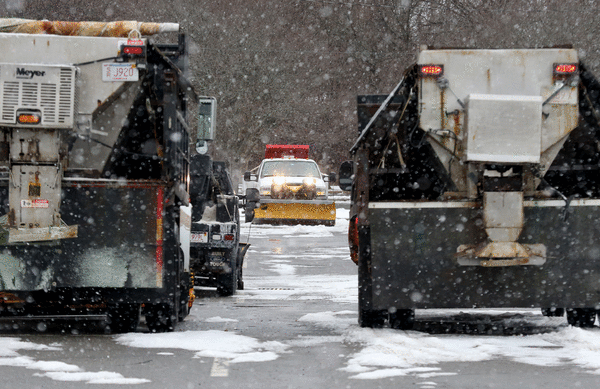
BOSTON — With the biggest snow storm of the season hitting Massachusetts, a two-year delay on a climate policy that will reduce the amount of diesel and gas powered trucks sold in the state sets up potentially challenging winters ahead.
The Massachusetts Department of Environmental Protection announced in April that it would not be enforcing a requirement on truck manufacturers to sell a minimum percentage of electric medium and heavy-duty, or MHD, trucks for model years 2025 and 2026. It’s all part of the Advanced Clean Trucks, or ACT, program, which is rolled into the state’s NetZero Emissions by 2050 climate mandate.
According to critics and experts in the trucking industry, the state is only setting itself up for challenges in snow removal by switching to an ever-increasing electric fleet. They say a current lack of EV charging infrastructure combined with the current reliability of EV trucks could present challenges for snow removal operations.
“Especially for snow operations but for virtually every other application, where battery systems and charging infrastructure still have significant limitations,” Executive Director of the Trucking Association of Massachusetts Kevin Weeks told the Herald. “ACT and electrification of the medium and heavy-duty (MHD) vehicle sector in general, while a well intentioned idea, really is unreasonable on so many fronts.”
ACT is based off of California’s emissions rules, for which the Golden State had received a federal waiver of preemption from the EPA for under the Clean Air Act. Massachusetts was able to adopt California’s vehicle standards — including ACT — under the EPA waiver. But, In 2025, Congress passed and President Trump signed into law resolutions under the Congressional Review Act intended to rescind EPA waivers for California’s emissions rules.
Those actions are now the subject of litigation playing out in federal court over whether an EPA waiver can be rescinded in this manner. Until a decision is reached on the issue, Massachusetts plans on moving forward with ACT.
Weeks says when the ACT requirements resume in 2027, and if manufacturers are able to meet state EV sales compliance, it could affect winter readiness by making it more difficult for municipalities and private fleets to obtain diesel and gas powered trucks.
“Readiness for winter storms is not just a matter of numbers but of policy. The interplay between federal waiver authority, state enforcement discretion, infrastructure and manufacturer behavior will shape truck availability for fleets and municipalities,” Weeks said.
The state has committed to transitioning its public fleet to 100% zero-emissions vehicles by 2050, according to Executive Order 594, signed in 2021 by Republican former Gov. Charlie Baker.
For 2030, the order set a goal for electric vehicles to make up 20% of the state’s fleet. It also requires that any new vehicles purchased or leased by state agencies must be a zero-emissions vehicle. Dubbed “Leading By Example,” the executive order, requires the Commonwealth to have 200,000 registered EVs by 2025 and a whopping 900,000 by 2030.
According to the Massachusetts Vehicle Census, last updated in October, there are 2,237 trucks in the state-owned fleet. In order to meet the state’s goal of electrifying 20% of its fleet by 2030, that would mean it would need to have 455 electric trucks for plowing during the winter months. In 2040, the state has set a goal of electrifying 75% of its fleet. The census did not differentiate between trucks used for snow removal and trucks that are not.
“The rule is essential to reducing harmful air pollution, like particulate matter and nitrogen oxides, which is linked to heart and lung diseases and other harmful health impacts. Frequent vehicle traffic through communities worsens health outcomes for our most vulnerable populations, including children and seniors,” MassDEP said in a press release on the ACT rule. “Medium- and heavy-duty vehicles account for approximately 25 percent of all transportation-related greenhouse gas pollution.”
Due to pushback on the stringent requirements from the trucking industry, MassDEP said it would hold off the enforcement for two years as long as dealers supply their gas-powered trucks to dealerships in Massachusetts without restrictions.
In a letter sent to Gov. Maura Healey in Sept. 2024 opposing the ACT rule, Weeks said the average cost of a new commercial heavy-duty diesel truck is between $180,000 and $200,000, while the average heavy-duty electric truck sells for nearly $500,000 – a financial mountain for private and public truck fleets alike to overcome if making a switch to electric.
“Please note that this does not just affect private fleets; state agencies, like the Massachusetts Department of Transportation (MassDOT), and municipalities face the same impediment to buying these needed medium and heavy-duty trucks,” Weeks wrote. “No responsible fleet manager – public or private – will buy an electric medium- or heavy-duty truck when there is no infrastructure to support the same, not enough personnel to fix the technology-laden motor vehicle, or the cost is significantly more than a diesel-powered truck, even with incentives.”
MassDEP has not delayed another requirement of the program, however, which took effect in July, for truck manufacturers to provide quarterly reports detailing their marketing efforts for Zero Emissions Vehicles (ZEVs), increase their ZEV fleets, educate and train dealerships on ZEV maintenance, sales and service, and deploy an increasing number of EV charging stations.
_____
©2026 MediaNews Group, Inc. Visit at bostonherald.com. Distributed by Tribune Content Agency, LLC.






Comments