Gov. Moore's energy plan aims to cut costs; slashes clean energy fund to pay for it
Published in News & Features
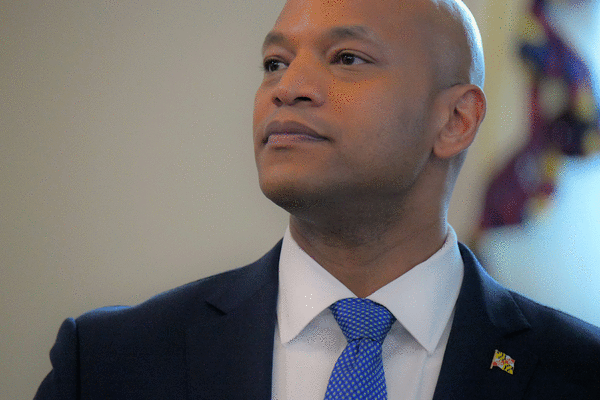
Marylanders could see lower electric bills this year under Gov. Wes Moore’s latest energy measure, which seeks to lower costs by funding clean energy projects, upgrading the state electric grid, and giving residents one-time $40 refunds on their utility bills.
Funding for the bill is slated to come from the remainder of Maryland’s Strategic Energy Investment Fund (SEIF), which Moore cut by $292 million to close the state’s budget deficit. The SEIF funds renewable energy projects and also programs that decrease energy demand and increase supply.
Moore announced Tuesday his plans to introduce the Lower Bills and Local Power Act, which will replace funds for shovel-ready clean energy projects stalled by federal funding cuts, require utility companies to prioritize technologies that increase the amount of electricity delivered through Maryland’s power grids and provide $40 per household in electricity bill rebates to Maryland residents.
The rebates, according to a senior official in Moore’s administration, are a continuation of a policy from the Next Generation Energy Act of 2025 that gave Maryland residents refunds on their electric bills. The rebates prescribed in Moore’s new legislation will come from money collected when the state charges electricity suppliers penalties for failing to meet state-mandated renewable energy targets, the administration official added.
Moore’s legislation comes as gas bills unexpectedly skyrocketed ahead of Baltimore Gas and Electric rate hikes and also after Moore, 12 mid-Atlantic governors, and the Trump administration recently urged Maryland’s electric grid operator, PJM Interconnection, to cut its energy costs.
“Energy policy is about more than megawatts and transmission corridors — it is about whether Maryland families can afford to live in their homes,” Moore said in a press release. “That’s why our administration is stepping up to deliver real relief, focusing on driving down the cost of utility bills for Marylanders, and investing in local projects that make energy more reliable and affordable.”
Republicans argue the proposed bill is a less than satisfactory solution to lowering costs because it invests too much in renewable energy and ignores other energy sources like natural gas that they have said are more cost-effective. Democrats argue natural gas energy sources pollute the environment at alarming rates.
Senate Minority Leader Steve Hershey said Tuesday that Moore’s energy amounts to an invisible added fee for Marylanders.
“At the end of the day, this is a hidden energy tax: Marylanders are overpaying because of Democratic mandates, and instead of giving that money back or fixing the policies that caused the problem, the Governor is using it to fund government operations,” Hershey said in a statement. “That is not energy relief — it’s a shell game.”
But as far as energy advocates are concerned, the proposal is a good starting point — even if $40 refunds don’t do much to make up for electricity bills Maryland residents have said are soaring well into hundreds of dollars.
“It’s taken us over a decade to get ourselves into this mess of unaffordable delivery rates, and it’s going to take us a while to get ourselves out of it. So we need a combination of direct relief and systematic fixes so to make sure customers are getting value from their utilities,” Emily Scarr, senior adviser at Maryland PIRG, told The Sun. Maryland PIRG is an advocacy group focused on environmental protection and consumer health.
“If you asked any Marylander who has these outrageous gas bills if they’d rather have $40 or not, I assume everyone would say, ‘I’ll take it,'” Scarr added.
________
©2026 The Baltimore Sun. Visit at baltimoresun.com. Distributed by Tribune Content Agency, LLC.





Comments