Drones, heavy guns and fragile gains: Inside Haiti's latest push against gangs
Published in News & Features
When specialized Haitian police units and a drone task force broke through barricades and entered the home of one of Haiti’s most notorious gang warlords earlier this month, their mission was simple, but highly symbolic.
They would occupy the house for several hours — then destroy it.
The target was a residence linked to gang leader and spokesman of the powerful Viv Ansanm gang coalition, Jimmy “Barbecue” Chérizier, in the Delmas 6 neighborhood of Port-au-Prince.
The two hours security forces spent inside his house and an adjoining property before blowing them up came to underscore a shift now quietly being acknowledged even by Haiti’s deeply divided political class: despite ongoing political turmoil and the absence of any major gang leader being killed or captured, security forces, using drones, are beginning to make tangible gains against the armed groups that dominate much of the capital.
“It was definitely done as a sign to the rest of the gangs that the task force can go where it wants, when it wants,” a source close to the operation told the Miami Herald.
After months of struggling to establish itself in gang-controlled Port-au-Prince, the specialized drone task force supporting the Haiti National Police is changing the battlefield.
Earlier this month, one of Haiti’s most well-known thoroughfares, Rue Jean-Jacques Dessalines, briefly became something almost unrecognizable in recent years: a functioning road through the capital.
A video clip shared with the Miami Herald show an armored bulldozer pushing aside burned-out vehicles and debris that had long served as gang barricades, trapping residents inside downtown neighborhoods and keeping police out. Behind it, a line of 20 civilian cars waited patiently for the last obstacle to be cleared before driving through.
For more than a year, merchants and motorists had avoided the area amid gang gunfire and kidnappings. The return of traffic, even if not what it once was, was a small but a meaningful victory.
“We’re far from being done with this operation,” said the task force operative who spoke to the Herald. “But I would say we’re at least at the end of the beginning. And what we’ve seen of [the Haitian national police] is now the ability to go and clear these neighborhoods, overmatch the gangs that tend to not want to fight as much because the gangs lose those fights.”
Hired by Prime Minister Alix Didier Fils-Aimé with the approval of Washington, the task force operates under the supervision of U.S.-based private security firm Vectus Global. The firm was founded by Erik Prince, the former CEO of private military contractor Blackwater whose entry into Haiti has met with mixed reactions.
After an initial slow start with its explosive drone operations in March of last year, Vectus Global began stepping up, achieving success with a police raid to take back a key telecommunications tower in September from gangs in the hills above Port-au-Prince. But its missed drone strikes triggered anger in the population after several children were killed when a drone missed its intended target at a gang leader’s birthday party, and weeks later when it barely missed individuals waiting at a bus stop in front of a hospital as it targeted a moving vehicle.
During the raid at Chérizier’s home, “none of his team came to fight that day,” said the security operative. The panicked gang leader later took to social media to appeal to cops from a new hiding place.
With gang members now panicked and a stash of at least 100 retrieved weapons recovered by police, the source said task force believes the team is now “showing great and measurable success in the model that we predicted” would work.
“Reporting is indicating probably half the gangs are just abandoning their positions completely,” the source said, adding that the model will now be accelerated.
Drone task force security model
Haiti National Police Director Andre Jonas Vladimir Paraison said gang leaders are running and hiding while deploying their foot soldiers to the front lines. “I’ve yet to encounter a general on the battlefield,” he told journalists last week as he held a two-hour press conference to discuss the recent successes and the challenges the Haiti National Police forces continue to face.
Even without any top gang leaders in custody, the shift in security operations is fueling confidence and hope in Haiti, where the gang violence has shuttered schools and hospitals, forced more than 1.4 million people to flee their homes and placed much of the country at the mercy of armed groups.
Currently, there are 129 personnel deployed as part of the task force’s one-year deal to tackle gang violence. Working alongside the Haiti National Police, the Armed Forces of Haiti and the Kenya-led international police mission — now operating as the newly authorized Gang Suppression Forc — they are relying on both weaponized and surveillance drones. The coordination is also being done with the help of .50-cal machine guns mounted on armored vehicles.
“The tools and the tactics that have been gathered to this mission are working. [Gangs] really don’t like to fight against drones. They don’t like to fight against the .50-caliber on top of the vehicles, because the .50-caliber will eat through those buildings,” the task force operative said of the higher caliber weapons Haiti has finally been authorized to use under U.S. arms rules.
In the months before the surge in operations, police lost 25 armored vehicles to ambushes involving barricades, trenches and Molotov cocktail attacks, authorities said. Since the new tactics were introduced, officials say police vehicle losses have dropped to zero.
Still, the gains remain fragile.
“We just need the Gang Suppression Force and other elements of the [Haitian National Police] to step up and to just occupy these newly cleared areas,” the source said.
The Gang Suppression Force was conceived by the United States and authorized by the United Nations in late September. Its first troops aren’t expected to arrive before April. Leaning more towards military than policing, the new force is expected to be five times the size of the Kenya-led operation currently in Haiti, and more heavily armed.
Gang expansion continues
In a report to the Security Council this month, U.N. Secretary-General António Guterres acknowledged that the intensified anti-gang operations in Port-au-Prince and parts of the neighboring Artibonite region have resulted in the reopening of several key roads. But he also noted that gangs’ expansion beyond metropolitan Port-au-Prince continue to undermine government authority, disrupting humanitarian and commercial routes in the region.
The U.N. also noted that the controversial drone strikes resulted in at least 973 people killed between March and December. This includes 934 alleged gang members and 39 residents, among them 16 children. Another 674 people were injured, including 41 residents and 18 children.
The civilian casualties have drawn sharp criticism from human-rights groups, which argue not enough care is being taken to prevent the deaths. The task force says warnings are issued ahead of strikes and extensive surveillance precedes operations.
“They are extremely judicious,” the source said. “I would encourage civilians to not be in those prepared gang defensive positions if they don’t want to get killed. Other than that, I think the collateral damage has been extremely, extremely minimal.”
The operations, Paraison said, reflect coordinated efforts, and the task force is an extension of the current security framework.
During the press conference, he acknowledged the heavy casualties on the side of gang members. But he also described the challenge of fighting armed men who are sometimes paid as little as $1.15 a day to carry out attacks.
“If 20 die today, we know that 100 will be ready tomorrow,” said Paraison, who previously oversaw the task force before he was tapped in August to head the national police. “A lot of people are asking, where did they come from?”
The Haiti National Police, he said, “are determined to respond. We are not pretending we can do everything,” Paraison added. “But if we can limit it, we will limit it, what we can do we will do.”
Expanding role of private security
The expanding role of private security firms in Haiti has fueled controversy, particularly after it was revealed last summer that in addition to the $50 million the government was paying for the drone operations, they were seeking private companies to collect taxes at the land border with the Dominican Republic.
After months on hold, a 10-year deal was signed this month, according to the daily Le Nouvelliste. Under the deal, the companies Evergreen, Alex Stewart International, Ense Group and SecuriPort would help fortify land borders, seaports and airports in exchange for a share of the increased revenue from the improved security. Paraison did not address the contract, which is currently under review by Haiti’s Superior Court of Auditors.
But he told reporters that control of the border is among the police’s most pressing challenges. Haiti, he said, only controls four of its 110 border crossings along its 242-mile frontier with the Dominican Republic.
“Everything else has been tried in Haiti: The all-government all-the-time approached has not worked,” the source close to the task force said, pushing back against criticism the government is privatizing core state functions. “Give the private sector a chance to show what’s been done.”
New Haiti police recruits
Haiti has fewer than one police officer per 1,000 residents, Paraison said, and the force face severe personnel shortage.
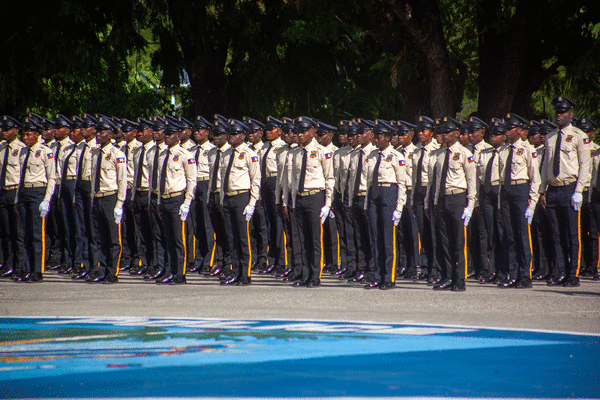
Last week, 877 new recruits graduated from an accelerated, U.S.-supported program aimed at adding 4,000 officers within 12 months.
“The Haitian National Police has been in combat mode,” Paraison said at the ceremony. “Battles have been fought in key strategic locations, particularly in the city’s center and its surrounding areas. We are on all fronts simultaneously until the terrorist gangs have been neutralized and the well-being of our fellow citizens has been ensured.”
Henry Wooster, the chargé d’affaires at the U.S. Embassy, said Haiti’s stability and security were top priorities for Washington and required “monitoring and accountability.”
“Haitians have suffered enough from gang violence,” he said during the police graduation ceremony. Wooster also used his time at the podium to address the country’s politicians and a looming political crisis in which a majority of the country’s Transitional Presidential Council members voted to oust the prime minister ahead of the end of its mandate on Feb. 7.
“Maintaining Alix Didier Fils-Aimé at the head of the Haitian government remains essential to advancing efforts to combat terrorist gangs and stabilize the country,” Wooster said, before issuing a warning to political figures whom he accused of being “corrupt” and banking their political survival on the support of violent gangs.
“The United States is watching closely. We will ensure that anyone who supports the terrorism responsible for the chaos in Haiti and the insecurity in the region faces severe consequences. The era of impunity is over,” he said.
For now, success remains modest — and uncertain.
“I think there’s an initial glimpse of hope,” said the task-force source. “It’s my goal that by late summer we can drive from Cap-Haïtien unbothered by gangs, or from Port-au-Prince out to the DR border unbothered. That’s the measure of success for what the task force is doing: Can you move around the country without anybody robbing, raping or assaulting you?”
©2026 Miami Herald. Visit at miamiherald.com. Distributed by Tribune Content Agency, LLC.



Comments