Backlash from Minnesota immigration actions sets back federal fraud cases
Published in News & Features
MINNEAPOLIS — The Trump administration dispatched thousands of federal agents to Minnesota under the stated goal of beefing up the response to the state’s fraud crisis following viral claims of wrongdoing by Somali immigrants.
Two months later, Trump administration officials have said little about what those newly arrived federal agents are doing to root out and prosecute fraud in Minnesota’s social service programs. Deportations and violent clashes with protesters, including the killing of two Minnesotans who were U.S. citizens, have been the most notable features of Operation Metro Surge.
Ongoing fraud investigations, meanwhile, experienced a massive setback this month when six of the state’s top federal prosecutors resigned in protest of the Justice Department’s investigation into 37-year-old Renee Good’s killing. Prominent state leaders, including Gov. Tim Walz, quickly recognized their departures as a major loss for fraud-fighting efforts.
Vic Hartman, a former FBI special agent and forensic accountant in Atlanta, said the DOJ’s white collar investigation divisions have been decimated under Donald Trump. Skilled professionals are leaving in droves, and federal crime-fighting agencies are under-resourced.
“If the government wants to deport their way out of this fraud problem, they may be on a path and [Department of Homeland Security] can do that,” Hartman said. But if the end goal is prosecuting the offenders, “they’re doing all the wrong things.”
The Department of Homeland Security and the U.S. Attorney’s Office in Minnesota did not respond to requests for comment about the direction of the fraud investigation. The FBI declined to comment.
The Minnesota Department of Human Services said in a statement that the agency has conducted more than 3,000 investigations since 2020 and referred more than 500 cases to law enforcement.
“We have seen no correlation between Operation Metro Surge and the fight against fraud in Minnesota,” the department said. “The work the Minnesota Department of Human Services has done to identify fraudulent providers and implement strong program integrity measures is being used to sow doubt in public social programs and as an excuse to defund services.”
FBI agents and federal prosecutors have been investigating fraud in social services programs in Minnesota for years, kicking off a huge investigation into meal programs in the Feeding Our Future case in 2021.
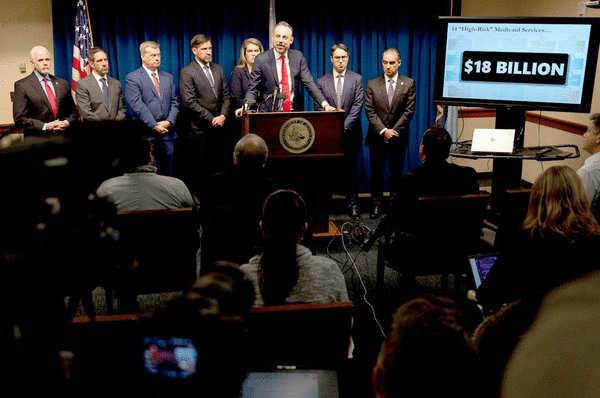
Then last year, officials announced a widespread investigation into Medicaid programs that help vulnerable Minnesotans — work that has led to charges against 15 people so far. Serious concerns led Minnesota officials on Jan. 8 to freeze new applications to 13 high-risk programs, after shuttering another one last year.
But after a viral video from a conservative YouTuber about Somali-run day cares, Trump administration officials froze child care funds to the state and launched the Department of Homeland Security investigation.
The viral video’s largely unsubstantiated — or outright disproven — claims have still fueled the Trump administration’s push to justify the surge in federal immigration officials.
One social media post earlier this month by the DHS claimed federal officials are collecting “mountains” of evidence of fraud, showing masked agents helping carry boxes out of an office for a St. Paul provider of Medicaid funded services.
The provider, Cradle of Love, had a state-issued license that was revoked by the Minnesota Department of Human Services last year. The Minnesota Star Tribune’s attempts to reach the 44-year-old woman who owns the business were unsuccessful. Public records show she was born in Illinois and has no criminal history in Minnesota besides traffic tickets.
In other social media posts, the DHS has pointed to other operations — a $14,135 undeclared cash seizure at Minneapolis-St. Paul International Airport, and businesses audited for compliance with standard employee verification requirements — as part of what it says are efforts to combat fraud.
Publicly available federal court filings reveal no major developments on those fraud-fighting efforts as a direct result of the new deployments. Trump and DHS Secretary Kristi Noem have said, without offering details or evidence, that fraud in the state now amounts to more than $19 billion, though state leaders have disputed those figures.
At the same time, the courts have been flooded with legal challenges to immigration detainers brought by immigrants arrested since the DHS increased its presence. Many of those operations are apparently supported with agents from Homeland Security Investigations, its chief investigative arm, including some who have been spotted surveilling day cares and schools.
The Minnesota Department of Human Services added in a statement that it’s unaware of any federal arrests or charges related to Medicaid fraud in Minnesota since six charges in December that the agency’s Office of Inspector assisted on.
“There has been no measurable impact by the federal government on the prevention or detection of fraud in state social service programs as a result of the surge of federal law enforcement in Minnesota,” the department added.
Critics of the Trump administration’s surge in immigration enforcement have cast doubt on the idea that fraud is the true goal of the campaign.
Though the stated goal of Operation Metro Surge is stopping the abuse of social services program by Somalis, only 23 of DHS’ “Worst of the Worst” arrestees in Minnesota were from Somalia, according to a recent Star Tribune analysis of immigration enforcement actions. None of those arrestees had criminal records connecting them to the state’s major social service frauds.
In the state’s lawsuit against the Department of Homeland Security, Attorney General Keith Ellison’s office argued that the deployment “bears no connection to that stated objective.”
Skeptics of Trump’s motivations also point to the wave of resignations of assistant U.S. attorneys, including lead prosecutor Joe Thompson. Since then, a seventh attorney has resigned in protest over at the federal government’s actions during the surge.
Minneapolis Police Chief Brian O’Hara said in a statement that the loss of Thompson, the face of the Feeding Our Future case, “tells you this isn’t really about prosecuting fraud.”
All the prosecutors on the sprawling Feeding Our Future case are “walking away from coveted positions” rather than obey “orders from D.C. that violated their integrity,” former U.S. Attorney Andrew Luger wrote in a Jan. 26 opinion column.
Fraud investigations are painstaking efforts that take years, according to experts on white-collar crime.
Former DOJ employees told the Star Tribune that a deployment of DHS agents could augment the investigation of Somali fraudsters specifically, though complex financial fraud is most often led by the FBI. Frequent partners include members of the criminal investigation division of the IRS and, in cases of health care fraud, the federal Department of Health and Human Services.
The federal government’s ability to prosecute and investigate these complex fraud cases will be further hampered by the loss of institutional knowledge after top prosecutors resigned.
According to CBS News, the Pentagon is asking military attorneys to travel to Minnesota to assist with the fraud investigation in March after the Justice Department asked for additional attorneys.
But simply adding more attorneys will not fix those problems, said Mark Osler, a former federal prosecutor and law professor at St. Thomas University.
“To lose the veteran members of a trial team is a very big blow to a prosecution effort,” Osler said.
Those experienced members have relationships with investigators on the case, know the deep details of the cases and also know the communities in Minnesota, he said.
The talent pool of investigators who have the expertise to perform advanced tasks like forensic accounting is limited, he added.
“If the focus right now really was on catching fraud, stopping fraud, getting the money back, then it would be a priority to keep the most talented people doing that work,” Osler said. “And that clearly hasn’t been done.”
Strains on Minnesota’s remaining federal prosecutors are starting to show up in court.
Citing new responsibilities because of “changes in office staffing,” Assistant U.S. Attorney Katharine Buzicky on Jan. 20 requested an extension in the case of convicted Feeding Our Future defendant Sharon Ross, 55, who is seeking early release from her 43-month sentence at the federal prison in Waseca, Minn. A judge granted the extension.
In another case, Assistant U.S. Attorney Daniel Bobier spent 80 minutes in court on Jan. 14, the day after the Minnesota U.S. Attorney’s Office exodus, fighting a change of venue requested by seven other Feeding Our Future defendants.
Their defense lawyers want the trial moved to Illinois, highlighting Trump calling Somali Americans “garbage” and the flood of federal immigration agents as evidence that an impartial jury would be impossible to assemble in Minnesota.
A Star Tribune email request seeking comment from Minnesota’s U.S. Attorney’s Office was met with an auto-reply saying the office is without a public information officer.
On Jan. 25, Trump signaled that deportation agents would leave the Twin Cities “at some point,” without further clarity, the Wall Street Journal reported following an exclusive interview with the president. He added that the administration would “leave a different group of people there for the financial fraud.”
------------
—The Minnesota Star Tribune’s Jeff Meitrodt contributed to this report.
©2026 The Minnesota Star Tribune. Visit at startribune.com. Distributed by Tribune Content Agency, LLC.





Comments