Sworn court testimony reveals conditions at hastily assembled Alligator Alcatraz
Published in News & Features
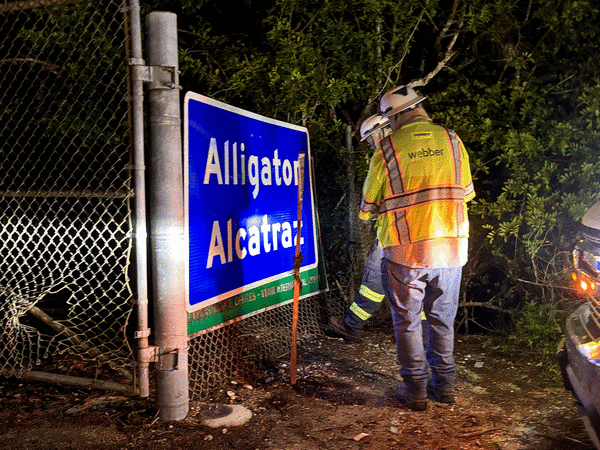
FORT MYERS, Fla. — Two people detained at Florida’s Alligator Alcatraz immigration detention facility testified in federal court Wednesday to having to write lawyers’ phone numbers on their bunks and walls using bars of soap after being refused pens and paper — and then having the available phones glitch and fail when they tried to call legal counsel.
“The call would immediately drop,” said one formerly detained man, who was identified only by his initials, H.C.R. “We didn’t have any information and neither did our relatives,” he said in a video call to the court from Bogotá, Colombia, where he was deported in October.
Another former detainee — a Haitian man identified as J.E. — described “horrible” treatment in the facility, fear of punishment from guards and being forced to sign deportation papers he was led to believe would send him to Mexico. It wasn’t until he boarded the plane on Jan. 7 that he found out he was instead being flown to Haiti, where he’s now living in hiding, he told the court by video.
Their sworn testimonies came during a federal court hearing in Fort Myers Wednesday in a lawsuit against federal and state immigration enforcement agencies and officials, including Department of Homeland Security Secretary Kristi Noem and Florida Gov. Ron DeSantis.
Their stories, as well as testimony from a state contractor, provided new insight into the conditions for the hundreds of immigrants held in cages and industrial tents at the first-of-its-kind detention camp, erected by the DeSantis administration in a matter of days last June on a seized airport in the Big Cypress National Preserve.
The case, brought by former detainees and legal providers, accuses the defendants of violating detainees’ First Amendment right to legal counsel and free speech at Florida’s state-run detention facility. U.S. Middle District of Florida Judge Sheri Polster Chappell is ruling on the case.
‘Massaging’ policies
An outside contractor overseeing legal scheduling also testified Wednesday to “massaging” policies to try to comply with federal immigration standards, describing the facility’s early policy drafts as being “written rather quickly” and including outright falsehoods — like referencing a Nakamoto Group legal team that didn’t exist.
“There was no formula if you will,” said Mark Saunders, the vice president of The Nakamoto Group, to the court, about the unprecedented nature of the Everglades site being run by a state emergency management agency. “Policies were written rather quickly.”
His company manages an email inbox for scheduling legal visits that the plaintiffs say is obstructing access to clients in dire legal situations. The Nakamoto Group has been previously chided by the Department of Homeland Security’s Office of Inspector General for inconsistent and ineffective inspections of Immigration and Customs Enforcement facilities. Saunders told the court Wednesday these findings were inaccurate and that attorneys can make same-day visit requests.
Those suing have argued the separate visitation request system is unnecessary and has acted as a barrier to constitutional access to legal counsel.
One of the other newly implemented policies Saunders described to the court: a mandate to staff “five to six weeks ago” that they can’t turn away attorneys who show up at the facility in person. But the change was not advertised anywhere online, according to the evidence provided in the testimony.
Another recent change in practice not reflected in any publicly available policy, according to his testimony, is that detainees can now ask guards to use cell phones at the facility to make confidential calls to legal counsel, Saunders told the court.
When the plaintiffs’ attorneys questioned how a detainee would know about this new policy, Saunders confirmed none of the known signs in the facility provide information about how to make confidential outgoing calls to legal counsel.
“That is really a peculiar thing to do,” Dora Schriro, an expert witness hired by the plaintiffs, told the court of the new practice of asking staffers for facility cell phones for unmonitored legal calls.
Schriro said Immigrations and Customs Enforcement as well as the state agencies and contractors running the facility have made it “very difficult” for those who are detained in the facility to “access what they are entitled to” under the U.S. Constitution.
A ‘humiliating experience’
Judge Polster Chappell signed off on a subpoena forcing the deputy director for ICE’s Miami field office, Juan Lopez Vega, to testify, after the federal government tried to block it by arguing he has been on leave since November and isn’t expected to return until April.
During his sworn testimony, Vega said his role includes oversight of ICE operations within the Miami area, including Alligator Alcatraz. He insisted the facility is in compliance with all relevant standards, based on reports he’s reviewed, but acknowledged he hasn’t visited the site himself since last summer when it first opened.
Those formerly detained at the site presented a bleak picture of their time inside.
“It was a rather humiliating experience,” said H.C.R through an interpreter. “They did not remove handcuffs for meals, so it was very difficult to eat. They restricted access to my medications.”
He added that “when we first went in I signed some documents. I didn’t know what they said because they were in English. The officer told me to sign quickly.”
Plaintiffs’ attorneys intended to bring a third person formerly detained at Alligator Alcatraz to the stand. But attorney Eunice Cho with the American Civil Liberties Union told the court the witness had recently gone missing after being deported, despite a judge previously granting him a “Convention against Torture” relief, which is supposed to prevent people from being deported if they show they’re likely to be tortured.
The second detainee who was able to testify to the court, J.E., said of his experience at Alligator Alcatraz: “They don’t treat people fairly there, they abuse people there.”
©2026 Miami Herald. Visit at miamiherald.com. Distributed by Tribune Content Agency, LLC.






Comments