White House plans federal agent drawdown, if Minnesota cooperates with Operation Metro Surge
Published in News & Features
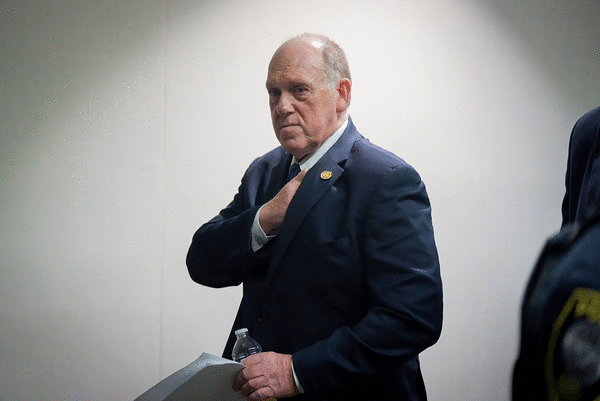
MINNEAPOLIS — White House border czar Tom Homan said Thursday that, after conversations with numerous political and law enforcement leaders in Minnesota, a plan is in the works to reduce the number of federal agents in the area.
That drawdown, Homan added, will require the cooperation of Minnesota law enforcement and political leaders with ICE and Customs and Border Protection.
“As we see that cooperation happen,” Homan said at a news conference at the Whipple Federal Building, “the redeployment will happen.”
President Donald Trump sent Homan to Minnesota earlier this week to manage immigration enforcement on the ground after a second fatal shooting involving federal law enforcement in Minneapolis. The killing of Alex Pretti by federal agents on Saturday, two weeks after the killing of Renee Good by an ICE officer, ignited new criticism over the federal government’s heavy-handed approach. Homan’s arrival coincided with the departure of Border Patrol Cmdr. Greg Bovino.
Homan struck a diplomatic posture in his first address to the press since arriving in Minnesota on Monday. He wore a dark suit and spoke of the need for effective communication between state and federal leaders to carry out immigration enforcement. It offered a stark contrast to the green uniform and pointed criticisms of local officials that Bovino deployed while leading the immigration efforts in Minnesota.
While Homan’s request of Minnesota was the same as others in the Trump administration — if you want Operation Metro Surge to recede, cooperate with Operation Metro Surge — his tenor was different. He didn’t criticize federal agents for their tactics during the operation, which have been widely denounced in political and law enforcement circles in Minnesota, but said the federal government had a role to play in improving public safety at this time.
“I don’t want to hear that everything we’ve been doing here has been perfect,” Homan said. “Nothing is ever perfect. Anything can be improved on, and what we have been working on is making this operation safer and more official. The mission is going to improve because of the changes we’re making.”
He said President Donald Trump sent him here “to regain law and order in a city beloved by many.”
In response to Homan’s news conference, a spokesman for Gov. Tim Walz said, “As the governor has said, we need a drawdown in federal forces, impartial BCA investigations, and an end to the campaign of retribution against Minnesota.”
Homan, who was first appointed to a leadership position in ICE in 2013 by then-President Barack Obama, has worked in customs enforcement since 2003, when he became a border patrol agent in the wake of 9/11.
He said he’s not leaving Minnesota until the “problem is gone.”
Homan did take time to praise the Minnesota Department of Corrections for “honoring our detainers” of immigrants.
A detainer is a two-part request made by the federal government. ICE wants local law enforcement to notify federal authorities as early as possible before releasing a person who could be deported. ICE also asks that jails or prisons hold that person for up to 48 hours after their release date until they can be taken into federal custody.
Earlier this month, Minnesota Corrections Commissioner Paul Schnell said state law requires his department to notify ICE when a noncitizen enters prison, and the prisons fully comply. He said the state has always worked with ICE to transfer prisoners with immigration detainers to ICE upon their release.
Immigration in county jails
Homan returned several times to the argument that ICE agents needed to have access to county jails.
Homan said he spoke to Minnesota Attorney General Keith Ellison and that Ellison told him that jails would notify immigration enforcement “of the release dates of criminal public safety risks, so ICE can take custody upon their release.”
“Let me tell you why that’s important,” Homan said. “People are concerned about the law enforcement manpower. I’ve said this many times before. I’ve said it for several years — give us access to the illegal alien and public safety threat in the safety and security of the jail. It’s common sense. It’s safer for the community. It’s safer for the agent. And it’s safer for the alien.”
Ellison issued an advisory opinion in December that sheriffs could not unilaterally enter into agreements to be deputized by ICE to perform immigration enforcement, which are known as 287(g) agreements. Those agreements, instead, had to be approved by county boards. In February, he issued another advisory opinion that “Minnesota law prohibits state and local law enforcement agencies from holding someone based on an immigration detainer if the person would otherwise be released from custody.”
Whether that opinion was changing was not clear, and the Minnesota attorney general’s office did not immediately respond to a request comment.
Sheriffs throughout Minnesota responded to Homan’s intimation that they hadn’t been cooperating with immigration enforcement.
“Carver County continues to cooperate with federal partners. That has not changed,” said Patrick Barry, chief deputy with the Carver County Sheriff’s Office. “We also have to remain in compliance with state laws and court rulings as it relates to immigration detainers.”
Barry said the Carver County Sheriff’s Office notifies ICE when they have a detainer request and the inmate is getting ready to be released. He said federal immigration enforcement agencies have access to the county jail, but the Sheriff’s Office cannot legally hold a person beyond their release date without criminal charges.
“This is a matter that has been dealt with in court several times at the federal level and state level,” Barry said. “Until that gets resolved, I’m not sure how they think we can do that. That’s going to involve the state of Minnesota, legislators and the courts to be involved.”
“Barring some statute change, I don’t know how that’s going to help us right now,” Barry said.
Barry said the county would risk a lawsuit if it were to hold someone without criminal charges, “because we would be in violation of their Fourth Amendment rights.”
“The federal government has a unique job, one that they have to do. We’ll be as cooperative as we possibly can be,” Barry said. “But there are some challenges here. We want to bring the temperature down, and we recognize the federal government has a job to do. But this issue has to get resolved in order for us to understand what we can legally do and be supported in doing in the state.”
Dakota County Sheriff Joe Leko said he’s worked closely with federal partners in the past, but when the surge came, that communication seemed to break down when thousands of new officers arrived. He said there was no pre-surge meeting with the federal government to cooperate and plan on the front end.
Leko said he understands if immigration authorities fear their plans will leak and endanger operations or safety, but he said it has caused problems.
“It was just like a big tidal wave that came through and there was not much communication with the local agencies as far as where they’re at, what they’re doing, involving us if things get out of control,” Leko said. “There just was not a good structure set up when this came.”
Leko said communication has gotten better after federal agents fatally shot Pretti. Homan’s arrival has led to “some headway,” he said. Leko said the first thing to work on should be “our structure and communication lanes.
Common-sense cooperation
Homan said his conversations with police chiefs, county sheriffs and politicians have created a plan that will allow federal agents to have better access to illegal immigrants who have been arrested or convicted of a crime and are targets of immigration enforcement. Homan said that access should allow for less enforcement activity in public.
He referred to it as “common-sense cooperation that lets us draw down on the number of people here.”
State Sen. Erin Maye Quade, DFL-Apple Valley, said in a Minnesota Senate committee hearing Thursday morning that she was hopeful about a potential drawdown in federal immigration agents but that she has not seen that in her community.
“Bus stops are being terrorized,” Maye Quade said. “Schools are being terrorized.”
Maye Quade said she wakes up to stories of parents afraid to leave home and spends late nights trying to find people legal help.
“My composure is wafer-thin,” she said.
State Sen. Jordan Rasmusson, R-Fergus Falls, said he was glad to see Homan come to Minnesota and that Gov. Tim Walz, Minneapolis Mayor Jacob Frey and other state leaders need to “work in good faith to de-escalate the situation.” He criticized “sanctuary policies” that he argues make the state less safe.
_____
(Allison Kite, Sarah Ritter and Walker Orenstein of the Minnesota Star Tribune contributed to this story.)
_____
©2026 The Minnesota Star Tribune. Visit at startribune.com. Distributed by Tribune Content Agency, LLC.






Comments