Central Florida advocates demand TPS be restored for Haitians as deadline looms
Published in News & Features
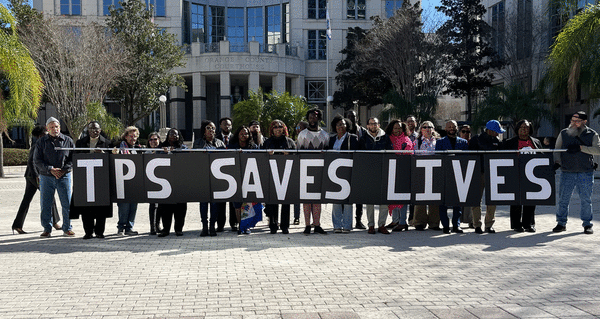
ORLANDO, Fla. — More than 300,000 Haitians across the U.S. will lose their temporary protected status on Tuesday, thrusting the community into uncertainty and potential arrest and detention by Immigration and Customs Enforcement.
More than 100,000 of those Haitians live in Florida, the largest such population in the country. And many work in Central Florida’s biggest industry, tourism and hospitality.
“Removing TPS protections will force thousands into the shadows, disrupting local economies and weakening the fabric that binds us together,” said Larry Colleton, president of the Florida Voters League.
On Thursday in front of the Orange County Courthouse in Orlando, advocates and former elected officials asked for President Donald Trump to create a pathway to permanent residency for Haitians, many of whom face life-threatening danger if they are forced to return to their home country as it grapples with ongoing gang violence.
“We call upon our leaders, not as Democrats, not at Republicans, but as people of consciousness to protect and resonate for Haiti,” said Regina Hill, former Orlando commissioner. “This is not simply an immigration issue, this is a humanitarian issue.”
The group read letters from Haitians who expressed their fear of returning. Seven Charlestin, with the organization Las Semillas based in Pine Hills, read a letter from a 44-year-old Haitian professor with TPS who went only by his first name, Reggie.
“In 2010, after the earthquake, I barely climbed out of the rubble of the university where I was teaching,” Charlestin said. “In 2019, two armed gang members broke into another school where I taught and stabbed me and left me for dead. If I am forced to return to my country I fear I may not live for too long.”
Haitians are the latest group to lose temporary protection, joining Venezuelans and immigrants from Afghanistan, Burma, Cameroon, Haiti, Honduras, Nepal, Nicaragua and Syria. Last year, Homeland Security Secretary Kristi Noem revoked TPS from at least nine countries, impacting over 1.5 million immigrants in the U.S. and leaving them vulnerable to deportation.
One Venezuela man whose protected status had been stripped was arrested during his first-ever hearing before an immigration judge in June and spent nearly four months in six immigration detention centers across the country. He was released following a temporary judge’s order.
Wesny Theophin, a Haitian immigrant and U.S. citizen, said the Haitian workers he represents as part of the Unite Here Local 737 union who work at restaurants in Walt Disney World “don’t know what to do.”
“TPS is not just an immigration policy for Haitians in the United States, it’s a lifeline,” Theophin said. “Unions depend on workers who feel protected and empowered but when some workers have the threat of deportation it weakens everybody.”
Theophin said the entire Haitian community is living in fear and its impact is far reaching, including U.S. citizens.
“I am an organizer and in one of my restaurants, of my five top leaders in the dishwashers, three of them will be gone in five days because TPS is ending,” Theophin said. “That means it is harder for us to win a good contract for every single worker in that restaurant. That hurts everyone, including workers who are born in America.”
_____
©2026 Orlando Sentinel. Visit orlandosentinel.com. Distributed by Tribune Content Agency, LLC.





Comments