Minneapolis shootings spark wave of anti-ICE bills. How far can California lawmakers go?
Published in News & Features
SACRAMENTO, Calif. — Even before two U.S. Immigration and Customs Enforcement agents shot and killed protester and nurse Alex Pretti in Minneapolis on Saturday, California lawmakers were lining up bills to push back on the agency for the second year in a row.
With Pretti’s death, however, and the earlier killing of protester Renee Good by an ICE agent in the same city, those efforts have reached a new pitch. Democrat Assembly lawmakers announced Thursday there are now 16 bills under consideration, with about a dozen introduced this week.
Efforts range from the preventive, such as bills to block ICE from using state property or renting cars for its operations, to the responsive, such as a bill to require the California attorney general to investigate any shootings by federal agents, to the retaliatory — two new proposals would make anyone who joined ICE ineligible for a teaching or law enforcement job in the state.
“The valve is off,” Sonoma State University Political Science Professor David McCuan said in an interview, “the flood, the fire hose of legislation is released.”
If the political momentum is undeniable, the more overarching question may be: How far can the California Legislature legally go to regulate the actions of federal agents in the state?
If passed into law, many if not all of those bills are likely to be challenged by the Trump administration. Last year’s bill from Sen. Scott Wiener, D-San Francisco, to ban law enforcement, including federal agents, from wearing masks remains tied up in court. A federal judge heard arguments in that case earlier this month, and the Los Angeles Times reported he appeared skeptical of the federal government’s arguments. Some court watchers say the law will survive that stage of legal scrutiny.
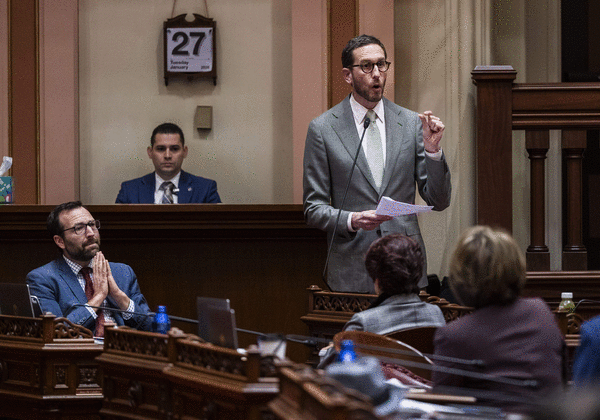
Meanwhile the California Senate voted Tuesday to advance Wiener’s latest ICE measure, Senate Bill 747, the No Kings Act. That bill would strengthen Californians’ ability to pursue civil lawsuits against federal agents over misconduct or excessive force, and has been in the works since last year. Ahead of the vote, Wiener had removed a clause that would have made the bill law immediately once it was signed by the governor. Such a clause meant the bill required a two-thirds vote to clear the chamber, and Wiener told reporters ahead of the vote he didn’t want to run the risk of not hitting that threshold.
He needn’t have worried. Though the chamber’s 10 Republicans voted “no,” every Democrat senator voted in favor. Many of them made impassioned speeches in its favor across two hours of lopsided debate. Now, Wiener is calling on legislative leadership to fast-track his bill so the Assembly can vote on it quickly, and he plans to add back in the urgency clause so that Californians can then immediately sue ICE officers who may have harmed them.
“We need the Legislature and the governor to pass this into law immediately,” he said in a video posted to Instagram after the vote.
Wiener is campaigning to replace U.S. Rep. Nancy Pelosi next year and has joined some Democrats’ calls to “abolish ICE.” Republican critics in the Legislature have said Wiener and other Democrats are bringing bills unconstitutionally targeting the federal agency for attention.
“They don’t have the authority to do it, and they know they don’t have the authority to do it,” state Sen. Tony Strickland, R-Huntington Beach, told The Sacramento Bee.
“They’re just trying to get headlines,” he said.
Some anti-ICE bills may be on questionable legal ground
Recent polling by The New York Times indicates voters, particularly registered Democrats, are increasingly opposed to ICE’s aggressive enforcement tactics. At a moment when many of California’s elected offices are in flux, there is a political imperative to bringing anti-ICE bills, McCuan said, and being “able to say that you are the tip of the spear to respond to Minnesota.”
But some of the keystone efforts also appear to be on solid legal ground, University of California Berkeley School of Law Dean Erwin Chemerinsky said in an interview Wednesday. “California can apply its general laws to federal law enforcement unless it unduly burdens the federal government,” he said.
Whether laws will pass judicial scrutiny will depend on how they’re written and to what extent judges could find them discriminatory against a certain class of employee, he said. Some of the other legislation now emerging may run afoul of that test, Chemerinsky warned.
That includes bills that could bar current or former ICE agents from certain freedoms.
Concord Assemblymember Anamarie Ávila Farías announced the MELT ICE Act, or the Misconduct Ends Law-Enforcement Trust Act of 2026, on Monday. It would disqualify former ICE agents, as well as former prison guards in Alabama and Georgia — where the U.S. Department of Justice has uncovered major constitutional violations — from becoming police officers or teachers at any level.
“California’s peace officers and teachers must be guardians of constitutional rights, not participants in their erosion,” Farías wrote in an emailed statement. “Public service requires integrity, restraint, and respect for due process. When those values are abandoned, public trust is broken, and communities are put at risk.”
What some of the proposed anti-ICE bills would do
On Thursday morning, Assembly Speaker Robert Rivas told Politico he would give his powerful endorsement to a similar bill coming from Assemblymember Mark Gonzalez, D-Los Angeles. The bill would prevent people who participated in immigration enforcement during the second Trump administration from applying to state, county and local government jobs, Politico wrote.
Another bill in the same vein is the ‘Slam the Breaks on ICE Act’ from Assemblymember Jessica Caloza, D-Los Angeles, which would prohibit rental car agencies in California from renting a vehicle to ICE agents.
Chemerinsky said bills like those could have “real constitutional problems,” due to violations of the equal protection clause of the 14th Amendment.
“You’re discriminating against them,” he said. “I think it’s hard to come up with a rational basis for why you’re forever disadvantaging people by virtue of the work they’ve done.”
Farías plans to work with legal and policy experts to shape the legislation as it advances, she said in a statement to The Bee, but said she believed she had legal room to move the measure. “It is within the Legislature’s authority to determine what criteria disqualifies someone from holding a public position,” she said.
During a news conference Thursday morning, Assemblymember Jesse Gabriel, D-Encino, stood up for his colleagues’ bills.
“If we decline to act because of the possibility or the threat of a legal challenge, we wouldn’t be doing our jobs,” he said. “We don’t have a choice. So we have to push forward.”
Gabriel has put forward two of his own bills, one of which Chemerinsky said seems to be on solid legal footing. The bill, which hasn’t been given a number yet, would require the California attorney general to conduct an investigation into any shooting by a federal immigration enforcement agent in the state. That bill would build on a 2020 law that requires a state prosecutor to investigate incidents of officer-involved shootings that result in the death of an unarmed civilian.
Another Gabriel bill, coauthored with California Legislative Latino Caucus vice chair Assemblymember Juan Carillo, D-Palmdale, would prevent federal agents from using state resources for their operations, including use of state properties as staging areas for federal actions.
Assemblymember Maggy Krell, D-Sacramento, said she kept the supremacy clause — which dictates that federal policy supersedes state policy — in mind when she drafted Assembly Bill 1544, which ensures members of the press can always access public courts with a mind toward immigration courts.
“What I’ve done is created a state law that applies across the board to state courthouses and federal courthouses,” the veteran prosecutor told The Bee. Krell brought the bill in response to the closure of the John E. Moss Federal Building to journalists and observers last summer, which came as immigration authorities were detaining people in the building.
Other legislative efforts stick to the state’s jurisdiction. Sen. Susan Rubio, D-Baldwin Park, introduced Senate Bill 288 earlier this month. The bill allows any party or witness to appear remotely to any state court hearing, trial, or conference — a measure designed to allow people to keep court dates but avoid the risk of arrest by immigration agents who have targeted judicial buildings.
“We are responding to real fear in our communities — fear fueled by incidents like the deadly Minnesota shooting,” Rubio said in a news release.
If it passed, that bill would sunset two weeks after President Donald Trump is scheduled to leave office.
_____
©2026 The Sacramento Bee. Visit sacbee.com. Distributed by Tribune Content Agency, LLC.





Comments