Can Florida's cold snap kill invasive pythons and iguanas? Here's what experts say
Published in News & Features
MIAMI — With the arrival of cold weather, some people in South Florida see low temperatures as a possible solution to the region’s invasive reptile problem. But that hope cools quickly: species like giant invasive pythons have mechanisms that help them survive cold snaps — as long as they don’t last too long.
Meteorologists forecast that temperatures in Miami could drop into the 30s on Sunday, with wind chills possibly reaching the 20s — below freezing.
These temperatures affect reptiles because they are ectothermic, meaning they rely on external sources of heat, such as the sun, to regulate their body temperature.
Melissa Miller, a research assistant scientist in invasive species ecology at the University of Florida’s Institute of Food and Agricultural Sciences (UF/IFAS), told el Nuevo Herald that when temperatures drop, these animals can experience hypothermia or cold shock, which makes them slow down and become unresponsive.
If temperatures continue to fall below a tolerable threshold, other experts warn that they could die.
Cold snap lessons from 2010
When temperatures dropped to around 30 degrees during the 2010 cold snap, many pythons died in the Everglades wetlands.
The deaths were linked to the fact that the low temperatures persisted for several days, from Jan. 2 through Jan. 11 of that year.
The combination of duration and extreme cold during that historic event caused widespread mortality among native and exotic wildlife, including manatees, sea turtles, crocodiles, iguanas, pythons and numerous fish species, according to a U.S. Geological Survey study.
Miller said that “fortunately, many reptiles are adapted to cold temperatures to some extent, and even cold shock and hypothermia act as mechanisms to help reptiles survive cold periods by allowing them to lower their metabolism and conserve energy until temperatures rise.”
“We’ve all heard the South Florida tradition about iguanas that look dead and then come back to life,” she added.
Iguanas in a cold-stunned state
The Florida Fish and Wildlife Conservation Commission (FWC) noted that when temperatures drop near freezing or below, nonnative green iguanas and other nonnative reptiles can enter a cold-stunned state in which they temporarily lose all muscle control.
That can cause green iguanas to fall from trees or other vegetation. FWC reminds the public not to bring iguanas inside homes or vehicles to warm up, because they can recover quickly and become defensive, using their sharp teeth, claws and long tails, which they whip with force.
However, prolonged periods of very low temperatures can be harmful to reptiles — particularly those from more tropical climates — as happened in 2010, when the cold killed numerous reptiles, including invasive iguanas and pythons, “but also many of our native fish and wildlife species,” Miller said.
Alligators and freezing temperatures
In addition to physiological mechanisms for cold tolerance, reptiles can also display behavioral adaptations to withstand low temperatures, such as seeking shelter in underground burrows, basking in the sun, or staying submerged underwater.
This last behavior, Miller explained, is commonly seen in alligators because water temperatures are usually warmer than land temperatures during a cold snap, allowing them to avoid extremely cold air.
According to FWC, alligators enter a state of inactivity when temperatures drop below 55 degrees and stop feeding when temperatures fall below 70 degrees.
“This is good news for native reptiles, but not so much for those who hoped that cold snaps could solve our invasive reptile problems in South Florida,” the UF/IFAS expert said.
Cold weather also affects manatees
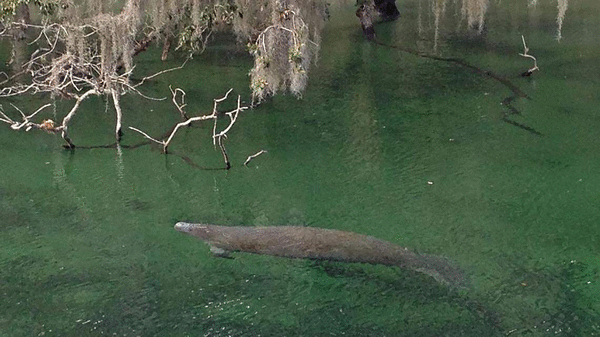
Manatees need access to water temperatures above 68 degrees to survive prolonged cold weather.
As temperatures drop, Florida manatees move toward springs, power plant discharge areas and other warm-water sites, FWC said.
Prolonged exposure to colder water can cause manatees to lose body heat and digest food improperly, which can lead to a condition known as cold stress — and over time, it can be fatal.
“When observing manatees as they gather at warm-water sites, it’s important to give them space,” FWC warned. “Disturbing manatees at these sites can cause them to swim out of protected areas and into cold water that could endanger their lives. Manatees are a protected species and it is illegal to harass, feed, disturb or harm them.”
If you see an injured, distressed, sick or dead manatee, report it to the FWC Wildlife Alert Hotline at 888-404-FWCC (3922) so trained responders can assist the animal in a timely manner.
©2026 Miami Herald. Visit at miamiherald.com. Distributed by Tribune Content Agency, LLC.






Comments