Mayor Brandon Johnson directs police to investigate federal immigration agents for possible felony charges
Published in News & Features
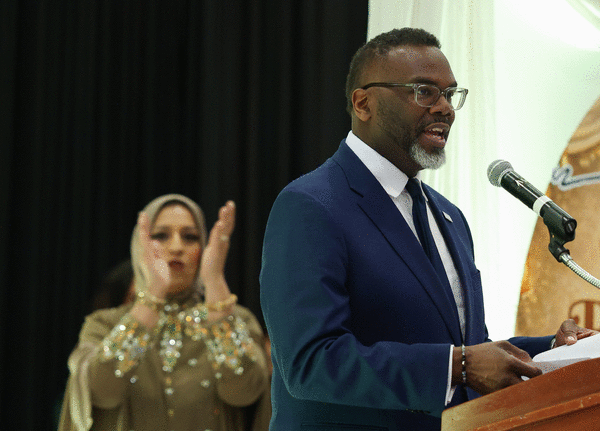
CHICAGO — Mayor Brandon Johnson signed an executive order Saturday directing Chicago police to collect evidence, investigate and potentially refer for felony prosecution criminal charges against federal immigration agents accused of misconduct.
Johnson’s decree — dubbed the “ICE on Notice” order — also states that any Chicago Police Department recommendations for felony charges against agents will be made through his office.
The announcement comes days after Johnson, during a speech at the National Press Club in Washington, said he would prepare the city for the future prosecution of federal agents and marks what the mayor says is a major escalation in the city’s response to President Donald Trump’s controversial, aggressive deportation efforts. The mayor touted the order as a first-of-its-kind effort to “set the groundwork to prosecute ICE and Border Patrol agents.”
“These rogue federal agents are taking us backwards as a city,” Johnson said as he signed the order in his wood-paneled ceremonial office. “The people of Chicago asked me to do more, so I’ve done more.”
But Johnson’s celebration was quickly complicated by pushback from Cook County State’s Attorney Eileen O’Neill Burke, whose office would actually be responsible for filing any charges against federal immigration agents. Johnson told reporters Burke was in “complete support” of the measure, but she wrote in a statement that her office had not reviewed it and called Johnson’s description “not true.”
“The CCSAO did not receive the Executive Order until it was released to the public. We do not provide legal approval of any matter until we’ve reviewed it,” she wrote in a post on X, the social media site. “On such a critical issue, it’s important we get it right.”
The order is one of several efforts by Johnson in recent months to push back against Trump via executive decree. Past orders have made it illegal for immigration agents to stage on city property and directed city agencies, including the police department, not to cooperate on immigration enforcement with Trump’s administration.
The mayor has defended those efforts as major acts of resistance, even as some appeared largely symbolic steps by a city government that has little, if any, ability to counter the federal agencies’ actions.
Even as Johnson has punched back at Trump with forceful rhetoric and calls for agents who break laws to be prosecuted, he has largely danced around questions about how such legal action would unfold.
But he argued his order Saturday — issued months after major federal deportation raids hit Chicago and the suburbs but in the wake of two recent fatal shootings by federal agents of protesters in Minneapolis — gave an answer.
The order also notably places the power to at least spark these prosecutions squarely in his own hands. It directs police to recommend felony charges against agents to Burke “at the direction of the Mayor’s Office.” The clause means Johnson would get a final sign-off before any felony referral is made.
Johnson said his team worked on the order alongside Burke’s office, one of the claims Burke later said on X was not true. Neither Burke nor police Superintendent Larry Snelling attended the news conference, though roughly three dozen supporters — aldermen, activists and staffers — crowded behind Johnson’s desk as he signed the order Saturday morning.
“Her office has said repeatedly, the reason why she has not moved forward with prosecution is because no evidence has been provided to her,” Johnson said of Burke.
Before Burke on X more directly challenged Johnson’s account, Burke’s office had issued a tempered response in a statement Saturday that did not express clear support for the measure.
“We look forward to reviewing the Mayor’s Executive Order now that we have received it,” the statement said.
Burke’s stance will ultimately prove critical in any efforts to prosecute federal agents since only her office, and not Johnson’s, has the power to file charges, even if police and the mayor’s team recommend them.
Asked if he would pressure Burke to file charges should a disagreement arise, Johnson said he would “use the pulpit of the community.”
“It’s not just on the mayor of Chicago. This is a nationwide effort to hold an authoritarian effort, to hold an authoritarian regime,” he said before directing his comments directly about Trump, who has repeatedly insulted Johnson.
“Listen,” the mayor said, “if this was just about me, I would have beat him a long time ago.”
The order would apply to all federal immigration agents, including those from U.S. Immigration and Customs Enforcement as well as Border Patrol.
Johnson defended his decision to implement the new order only now, months after the Trump administration’s Operation Midway Blitz wound down following more than two months of intense raids and deportation sweeps. His office is “constantly evolving” in “this unprecedented moment,” he said.
He also echoed many at City Hall who have warned that a flood of federal agents is likely to return to Chicago in the near future, making it critical to bolster the city’s response.
“We have learned, and now, as we have learned, we are putting forth this executive order at the very time as we prepare for what could be a surge in the spring,” he said.
In addition to its felony referral process, the executive order directs police to verify the names and badge numbers of immigration agents in leadership roles when responding to the scene of immigration enforcement actions. If federal agents do not comply, police should capture that denial with their body cameras, the order states.
It also orders police to preserve and document body-camera footage, notify supervisors if people on site allege immigration agents broke the law and complete more reports that Johnson’s team says would build a foundation for prosecution.
The order would apply to past cases, meaning it could clear the way for prosecution of alleged misconduct that occurred during Operation Midway Blitz, Johnson said. Asked if there was a specific case he wanted to see prosecuted, the mayor said, “there are too many to count.”
“The evidence, I believe, is very clear, not just in Chicago, but across this country,” he said. “The expectation is that this is one more step closer to justice for families.”
Johnson’s strategy chief, Sheila Bedi, shot back at the Trump administration’s claim that federal agents have broad immunity to prosecution for their actions.
“That’s not the law,” said Bedi, a civil rights attorney. “What the law says is that federal agents can be held accountable for state and local crimes if their actions were not necessary to further their federal obligations.”
Bedi said the mayor’s final say on felony charge referrals would not be influenced by politics, but “based on the facts.” The mayor’s administration will begin meeting on Sunday to discuss implementing the policy, she added.
“There’s all this evidence that CPD has,” Bedi said. “There’s going to be somewhat of a process to pull that all together, but we don’t anticipate it being, you know, a six-month process.”
©2026 Chicago Tribune. Visit chicagotribune.com. Distributed by Tribune Content Agency, LLC.





Comments