Thousands decry ICE in rallies led by Seattle nurses, cyclists, teachers
Published in News & Features
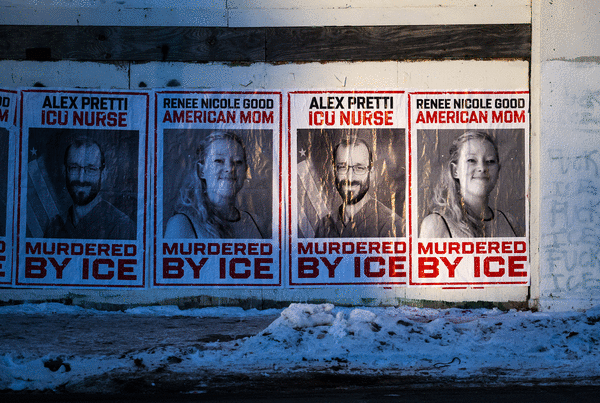
While Swedish Hospital preoperative nurse Joanie Paskert didn't know Alex Pretti, she feels connected to the 37-year-old intensive care nurse federal agents killed in Minneapolis last Saturday.
"I might not have worked at the same facility as (Pretti), but that's my co-worker," she said. "That's my brother. He's one of us. So to hear that not only are the patients not safe, but we, who are called to take care of them, aren't safe, it's just enraging."
From a memorial bike ride in West Seattle, to a rally of health care workers at Harborview Medical Center, to another rally led by educators at Seattle Central College, to yet another led by tech workers at Cal Anderson Park, thousands took to the streets on Saturday to continue protesting President Donald Trump’s federal immigration crackdown.
The demonstrations came on the heels of a tense week for the country, headlined by the killing of Pretti, who was shot by U.S. Customs and Border Protection officers multiple times while he was recording them with his phone. Pretti had a gun in his waistband, though he never drew the weapon.
Pretti’s killing last Saturday came two and a half weeks after Renee Good was shot to death by ICE agent Jonathan Ross, also in Minneapolis. Both deaths have led to outrage and national protests.
Activists planned at least 30 events in Western Washington on Saturday, according to a Seattle Area Protest List compiled by volunteers.
On Saturday morning, about 100 cyclists gathered in front of Alki Bike and Board in West Seattle for a 5-mile memorial bike ride in honor of Pretti, an avid cyclist. The Alki group's ride was one of more than 100 memorial rides planned across the U.S.
Stu Hennessey, 71, led the Seattle cyclists.
"We think a lot like Alex Pretti, a person who was always trying to do something for others," Hennessey said.
An hour later, medical professionals in scrubs held signs and chanted in front of Harborview on Saturday afternoon.
"Doctors against ICE," one sign read.
"We treat trauma, ICE creates it," another read.
"Code Blue!" attendees chanted, a reference to the hospital intercom alert signaling a life-threatening situation.
Nurse practitioner Heather Gates helped organize the march at Harborview's Ninth and Jefferson building. She said Pretti's death resonated with her and many others in health care.
"As health care workers, we can recognize an emergency," said Gates, a nurse for 22 years. "And unfortunately, right now, it's imperative to act with urgency."
Kristin Jahrig, a registered nurse, moved from Minnesota to Seattle in 2003. She's worked at Harborview for 16 years.
"It hits really close to home that if someone who I feel so similar to, and have had so many common experiences with, can get killed by the government with no consequence, then any of us are also vulnerable," Jahrig said.
After a slate of speakers, the group marched down Jefferson up toward Swedish Hospital. A group protesting in front of Swedish Hospital joined the march. The crowd continued north up Broadway until they reached Seattle Central College in Capitol Hill, where educators were holding an anti-ICE rally.
"Educators stand with Immigrants," a banner read.
Many educators wore red, a nod to the national Red for Ed campaign associated with teacher unions. The protesters marched through downtown Seattle to the Henry M. Jackson Federal Building.
Bryan Pule is a physical education teacher at Whittier Elementary School in North Seattle. The recent aggression of immigration enforcement in the region has him, and many other educators, worried about the future.
"It's just frightening," he said.
Sigrun Payne, a third-year teacher in the Tukwila School District, attended the rally at Seattle Central with a cardboard sign that read, "stay the (expletive) away from our students." She, like Pule, said the current situation is scary for educators, but scarier for the students.
"Students can't learn if they don't feel safe," Payne said. "This is the basic principle of education. Students cannot learn if they don't feel safe, and they do not feel safe right now.
_____
© 2026 The Seattle Times. Visit www.seattletimes.com. Distributed by Tribune Content Agency, LLC.






Comments