Still reeling from Operation Midway Blitz, Chicago casts wary eye toward Minneapolis
Published in News & Features
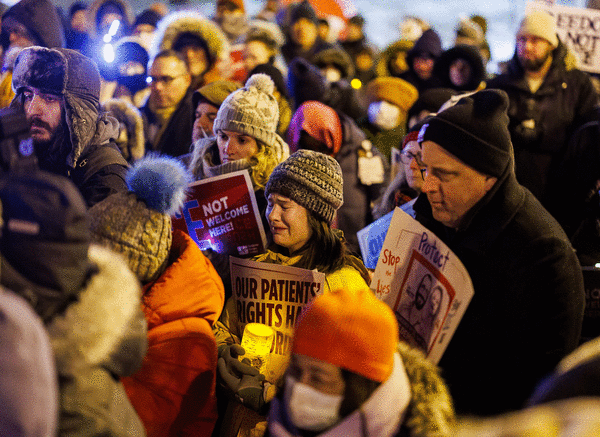
Like many Chicago-area residents, Katie Bunt watched in horror as federal agents conducted Operation Midway Blitz in Chicago, and did what she could to push back on the immigration raids as they swept through the city and suburbs.
She hadn’t anticipated that immigration enforcement eventually would escalate further than it did here.
“Every big action ICE and DHS are taking is a clue to the next place that it could be worse,” Bunt said. “I did not expect it to be worse in another city.”
But on a frigid Tuesday night in Albany Park, Bunt was dropping off bundles of hand warmers at a last-minute supply drive for protesters in Minneapolis, which along with St. Paul has found itself in the crosshairs of the federal government as it carries out its latest, stepped-up enforcement surge against immigrants without legal status, wreaking much of the same chaos there as agents did here in the fall during Operation Midway Blitz.
Though federal operations in Minnesota have taken place on a different scale than they did here, with thousands more agents overtaking much smaller cities in pursuit of different immigrant populations, the raids there in many ways parallel the blitz in Chicago. There are sights familiar to so many Chicagoans: parents in reflective vests outside schools, cars left abandoned with their doors open and drivers missing, dark SUVs screaming through red lights, locked restaurant doors and miniature recessions in the hardest-hit neighborhoods.
Both places have seen lethal and near-lethal violence against both citizens and immigrants at the hands of agents, and responded. People in both states have pointed out how protest tactics developed and scaled up in Chicago have made their way to the Twin Cities as federal forces bore down.
As the Trump administration shakes up leadership of the roving raids, replacing U.S. Border Patrol Cmdr. Gregory Bovino with “border czar” Tom Homan amid public backlash to the killings of two U.S. citizens in Minneapolis, there’s no indication if the feds will return to Chicago. Nor is there much information about how such an operation might mirror or depart from what’s taken place in the Twin Cities, where Homan recently spoke of a “drawdown.”
Many citizens, immigrants and advocates in Chicago now find themselves casting around for ways to support Minnesota residents — and wondering what events there might mean for the city come spring, even as a smaller number of agents continue to make arrests in the city and suburbs and Department of Homeland Security officials declare that they “never left.”
Bunt, 38, knew a couple of sets of hand warmers wasn’t much. But it was something small she could do.
She still carries her black whistle with her keys everywhere she goes, and plans to keep following the news out of Minnesota and other cities where the feds may train their focus next. She’ll keep looking for ways to help protesters. And she said she would try to spread reliable information about what to do if federal agents return in greater numbers to Chicago and its suburbs.
“It feels like there’s not a lot we can do other than prepare for something a little bit worse,” said Bunt, who works in industrial sewing.
Kevin Fee, legal director of the Illinois chapter of the ACLU, said that unless there was a “major change” in federal enforcement strategy, he feared events like the killing of Silverio Villegas-Gonzalez just outside Chicago, or Renee Good and Alex Pretti in Minneapolis, would occur “over and over again.”
“We hope that the feds are serious about de-escalating the situation in Minnesota, given the tragic events that have unfolded there,” he said. “But if they continue along the current path and reappear in Chicago, we expect that their actions will continue to be abusive and excessive and unconstitutional.”
Chicago and Minneapolis
If Chicago’s blitz was characterized by floods of agents in one neighborhood or suburb at a time, Operation Metro Surge in Minnesota has been more of a saturation.
“It’s kind of everywhere all the time,” Minneapolis resident Doug Mack said. “My understanding is that they have even more agents here, and it’s a smaller place (than Chicago).”
The federal government says it sent about 3,000 agents to Minnesota for Operation Metro Surge. Minneapolis, the larger of the Twin Cities, is home to just under 430,000 people, according to 2024 U.S. census numbers. About 307,000 more reside in St. Paul.
The number of agents in the region dwarfs the two cities’ police departments combined. And it’s about 10 times the number of agents that were sent to metro Chicago, with its population of roughly 9 million.
Those differences in scale have led to what Mack, 44, described as a “more dispersed but more widespread presence” of agents around the metro area. Some have reported that more agents are wearing plainclothes like jeans, parkas and baseball hats in an apparent effort to blend in more on city streets, rather than the fatigues that were so often seen on the streets of Chicago and its suburbs.
Amanda Kimber said there had been plenty of news about raids striking different big-box stores or commercial strips, but that she and her neighbors had also witnessed agents casing streets without arresting anyone, apparently scoping out future targets.
“It feels like they have a lot of people who are doing day-to-day enforcement — just targeting a COSTCO parking lot — but then they are also doing, like, reconnaissance on people,” said Kimber, 40. “Because they have enough bodies, they can do both.”
All of that has led to her sense that “no neighborhood is really free of them.”
Besides the scale of the raids, who the victims were also made a difference in the broader reception of their deadliest moments, experts said. Advocates and activists have pointed out that while the killing of Villegas-Gonzalez, a Mexican immigrant and father of two, in Franklin Park, got significant attention, it didn’t garner the same national backlash as the deaths of two white citizens in Minnesota.
Rey Wences, co-founder of Organized Communities Against Deportations, saw the Minneapolis killings as an escalation of a trend that began in Chicago with the shooting of Marimar Martinez, the citizen who survived being shot five times in Brighton Park while protesting Midway Blitz — where people who aren’t candidates for arrest and deportation need to think about serious risks when interacting with immigration agents.
“What I saw being inflicted on (Villegas-Gonzalez) was consistent with the type of violence that I have seen being inflicted on other undocumented immigrants that are caught in the system,” Wences said. “Now … it feels like anyone is a target if you do not agree with the way that immigration enforcement is being carried out in this country.”
The availability of video footage has also been a significant contributing factor in the resulting public backlash against the two killings in Minnesota, experts said.
Nail salon surveillance video offers the most complete look at the shooting of Villegas-Gonzalez, and Martinez’s attorneys are still fighting to get Border Patrol Agent Charles Exum’s body-worn camera footage released to the public.
But closer-range video of the shootings that killed Good and Pretti has reverberated through social media feeds and news outlets around the country, creating what Northwestern University professor Kevin Boyle referred to as a new “Kent State moment.”
“You saw it, you watched it happen,” Boyle said. “That’s one of the most powerful things in terms of the responses people can have.”
A similar response
While there are factors that set Chicago’s “blitz” and the Twin Cities’ “surge” apart, Boyle said, “the similarities are stronger than the differences.” Both places have strong traditions of activism, he noted: “networks in place that can mobilize protests that not every city has.”
Mack, of Minneapolis, noted that everyone he sees carries a whistle to alert others of agents’ presence — ”we are very grateful to Chicago for the whistles,” he said. And while every city seems to react to federal presence in its own way, he said, “in broad strokes, it’s all the same.”
“If somebody can’t go to work, you do what you can to help them make rent, buy groceries, buy diapers,” he said. “I think that’s kind of universal.”
On the federal side, former Customs and Border Patrol Commissioner Gil Kerlikowske saw almost no difference between agents’ strategies in Minnesota versus Chicago, where their use of force in both places has prompted federal judges to issue restraining orders.
“The tactics, walking down the street, going to a car wash or a Home Depot lot, are kind of the same,” he said. “I saw them pick up people and throw them to the ground. I’ve seen this widespread use of pepper spray. I don’t see a great deal of distinction.”
Fee, of the ACLU, said the feds have taken a mostly consistent approach across every city they’ve raided: “An escalation of conflict rather than de-escalation, agents seeming to sort of delight in conflict with protesters and crowds and crucially, for fairly high-ranking officials, misrepresenting facts relating to those conflicts.”
“It all got its start even before Chicago,” he said. “We’ve seen very similar tactics used in each of the cities with an expansion in scope and volume of agents.”
As for the way in which the raids’ outcomes in Minnesota seem to now be diverging from Chicago on the national stage, Fee chalked it up to a “nearly inevitable” consequence of a greater number of “largely untrained, highly unprofessional, seemingly conflict-driven bands of federal law enforcement roaming cities with near-impunity.”
“The increase in volume itself … is going to increase the opportunities for tragic violence,” he said. “You just have more flash points.”
Future for Chicago?
When Tom Homan spoke to reporters Thursday, he seemed to be signaling at least a superficial retreat from the hyper-militarized, freewheeling approach that Bovino and his men relied on throughout their time in Chicago, the Twin Cities and elsewhere.
Dressed in a civilian suit instead of the green fatigues that Bovino favored throughout his time leading the raids, Homan’s talk of “targeted strategic enforcement operations” seemed to mark a turn away from the roving, go-fish style of arrests that Bovino and his men were carrying out for much of the fall as they circled neighborhoods, jumping out of their convoys to question people they encountered on the street
“We’re going to hit the street and we’re going to know exactly who we’re looking for,” Homan said.
He did not address the shootings of Good or Pretti, only saying that he did “not want to hear that everything that’s been done here has been perfect,” and hinted that the feds may pull some of their agents out of the state. But even that prospect was murky, tied to cooperation of state and local officials, and Chicago was not specifically mentioned.
“If ICE comes back in the spring, of course, they’re carrying with them the weight of what happened in Minneapolis,” said Boyle, the Northwestern professor.
Immigrants, advocates and civic leaders have looked at the escalations in Minneapolis as a possible bellwether.
Marty Castro, a former chair of the U.S. Commission on Civil Rights during President Barack Obama’s era, described Minnesota as “a preview of what could come here” at a news conference Thursday.
The fear and uncertainty remain widespread among Chicago’s immigrant communities, both undocumented residents and those with legal status, saying their concern has deepened after witnessing what unfolded in Minnesota.
But Castro, whose group Allies United has been in close contact with civic leaders and advocates in Minnesota, said that despite that alarm, people would keep opposing the raids.
“A lot of us are going to get hurt and some of us may even get killed but we will continue the fight and win,” he said.
Rosemarie Dominguez is worried that people who choose to be on the scene during immigration raids and their aftermath will be putting themselves in “life-and-death situations” if the feds step their activity back up around the city.
At the same time, Dominguez, an activist and member of the Ogden District Police Council who was briefly detained last fall while protesting the crackdown, said she was channeling those emotions into trying to prepare for what could come next.
“We’re still going to continue to show up,” she said. “I’m angry and I’m frustrated, but channeling that (into) ‘how much more prepared can I be come March?’”
For some in Chicago, there has been a measure of relief in the removal of Bovino. But that relief is tempered by uncertainty over what his departure actually means.
“Bovino may be gone, but people are still wondering what comes next,” said Dolores Castañeda, a lifelong resident of Little Village. ”Trump is still president.”
She said concerns had been building long before agents left Chicago, but escalated sharply after the scale and severity of the Minnesota operations became clear.
“We didn’t think they would kill someone so blatantly, so openly. They don’t care about humanity,” she said. “So if that’s what they do to citizens, people recording them or standing up for their rights, what do they do to the immigrants they detain?”
Castañeda, who has become a community leader by helping street vendors and connecting residents with resources, said the fear has had real consequences.
Some people were able to survive for a time without working, she said. Many are still hiding. Others were taken during enforcement actions, and those losses continue to ripple through families and neighborhoods.
Mel Trujillo has witnessed some of that loss and disruption up close: she has co-workers who have spent the last several months afraid to leave their homes, she said.
Seeing their fear was part of what brought Trujillo, 25, to gather around a worktable inside the Pilsen Arts & Community House on a freezing weekday night, where about 30 people were cutting and folding sheet after sheet of paper printed with information about how to use whistles in the face of a federal immigration raid. Grimes blasted over the rustling as people moved in and out, clutching rubber-banded stacks of whistle manuals in pink and green.
Trujillo and Gabe Rivera, 24, saw the raids, protests and killings in Minnesota as a “call to action.” They’d come to put their rage and hopelessness to some use.
And while Rivera said that they, like many others, had been taken by surprise during the first round of raids, “we’re just going to be more prepared when they do come back.”
“It’s one more reason why we’re here now,” Trujillo said, slipping another zine into her table’s box. “To make sure our presence is loud and we’re not small.”
Mostly stuffed boxes, each holding about 3,000 “zines,” sat in the middle of every table, waiting to be shipped. Almost all of that week’s set was headed to Minneapolis.
_____
©2026 Chicago Tribune. Visit chicagotribune.com. Distributed by Tribune Content Agency, LLC.




Comments