Over 300 groups ask Trump administration to reverse course on ending Haitian TPS
Published in News & Features
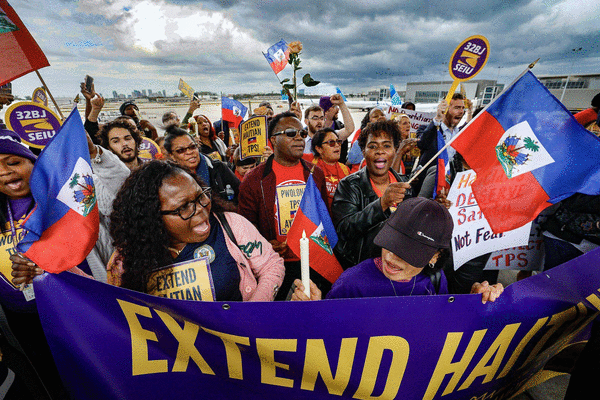
Hundreds of organizations, including civil rights groups, labor unions, immigrant rights advocates and faith leaders nationwide are urging President Donald Trump and leaders of the departments of State and Homeland Security to preserve temporary immigration protections for Haitians.
The calls come amid growing fear and anxiety over the fate of more than 300,000 Haitians who could lose temporary protected status benefits at 11:59 p.m. Eastern time Tuesday if a federal judge does not intervene.
Nine plaintiffs, including Haitians with TPS, a labor union and an association of Haitian Protestant clergy have filed one of several suits on the administration’s decision to terminate Haiti’s TPS designation. They are arguing that DHS not only failed to properly follow the law when they made the decision, but that the move was based on the fact that Haitians are Black. DHS has said the law doesn’t allow for Secretary Kristi Noem’s decision to be challenged in court, and the department has asked for the case to be dismissed. U.S. District Judge Ana C. Reyes in Washington, D.C., is expected to make a decision Monday or Tuesday.
Even if Reyes finds in favor of continuing Haitian TPS the reprieve could be short-lived. In a similar circumstance involving Venezuelans, the administration appealed directly to the Supreme Court, which allowed the TPS termination to remain in effect while a challenge proceeded in court.
The letter penned by the Haitian Bridge Alliance and American Federation of Labor and Congress of Industrial Organizations, AFL-CIO, and signed by some 300 organizations, urges the administration to not only reconsider Haiti’s termination but to also redesignate the status so people can continue to work and live in the U.S. legally.
“We believe extending and redesignating TPS for Haitians is in the clear national interest of the United States, from a labor, business and taxpayer perspective,” the letter said. “This is not an appeal to charity; it is an appeal to pragmatic self-interest, grounded in facts.”
Liz Shuler, president of the AFL-CIO, said ending TPS for Haitians is “essentially firing more than 300,000 experienced, tax-paying workers who are essential to our economy, including our care, construction, hospitality and manufacturing sectors.
“The AFL-CIO calls on the administration to extend and redesignate Haiti TPS, a common-sense step to protect workers, strengthen our economy, and avoid further destabilizing families and communities across the country,” she said.
The letter notes that Haitians are part of an estimated 1.3 million people nationwide with TPS, which has allowed them to live and work legally in the U.S. because conditions in their homeland don’t allow for a safe return.
Recent analyses estimate that about 570,000 TPS holders participate in the U.S. labor force, including roughly 95,000 in leisure and hospitality, 90,000 in construction and 85,000 in business services, the letter said.
“According to official records, roughly 330,000-353,000 Haitians currently benefit from TPS,” advocates wrote. “Removing their work authorization will not magically create other workers to replace them,” but would also create a loss to the economy of billions of dollars.
“From an economic perspective, it is counter-productive to deliberately shrink a legal, tax-paying workforce that is already filling critical gaps in the U.S. labor market,” the letter said.
In appealing to the administration, advocates also highlight the worsening humanitarian and security situation in Haiti, where armed groups continue to terrorize the population.
“A recent large-scale attack in Haiti’s Artibonite department saw homes burned, civilians killed, and hundreds forced to flee; local officials estimate that around half of that region is now under gang influence,” the letter said.
A report released last week by the United Nations political office in Haiti said gangs continue to expand into the Central Plateau and Artibonite regions, where they’ve “carried out indiscriminate attacks against several localities in order to consolidate and expand their territorial control."
“These raids particularly targeted farming communities and their agricultural assets, triggering new population movements, weakening the local economy and increasing humanitarian and protection needs,” the U.N. Integrated Office in Port-au-Prince said.
The report noted that over the last three months, security forces and self-defense groups have prevented gangs from expanding further into the capital, where armed groups already control up to 90% of metropolitan Port-au-Prince. Still, criminal gangs continue to commit abuses in areas under their control, including targeted killings, sexual violence and child trafficking.
U.N. Secretary-General Antonio Guterres told the Security Council recently that more than 8,100 killings were documented in Haiti — over 5,900 of them directly a result of gang violence — between January and November last year, and the figures are “likely underreported owing to limited access to gang-controlled” areas. More than 8,000 cases of sexual violence were also recorded, along with more than 1,400 kidnappings.
To address the crisis in Haiti, the United States, through the U.N., recently transformed the Kenya-led Multinational Security Support into a Gang Suppression Force. However, the first military contingents aren’t expected to deploy until April.
In the meantime, concerns are growing over possible violence as the mandate of Haiti’s ruling Transitional Presidential Council comes to a close on Saturday. Five of the panel’s seven voting members are under U.S. visa restrictions after attempting to oust Prime Minister Alix Didier Fils-Aimé, whom the U.S. supports as a stabilizing figure.
Returning hundreds of thousands of Haitians into that environment and in a compressed time frame would overwhelm Haiti’s already-fragile state institutions, hand more leverage to armed groups that prey on returnees and place them at grave risk, which would be life-threatening, the letter to the administration warned. It also cautioned that deportations could fuel an increase in irregular migration by sea and land toward the U.S. and neighboring countries.
From a security standpoint, “it is safer and cheaper to allow Haitian TPS holders to keep working legally in the United States than to fuel a new wave of instability and irregular migration in the Caribbean basin,” the letter said.
“Haitian TPS holders are nurses, construction workers, caregivers, hotel workers and manufacturers. They keep hospitals open, rebuild cities after disasters, care for our elders, and pay billions in taxes. To strip them of status is to deliberately harm U.S. workers, sabotage the economy, and push families into fear and precarity,” said Guerline Jozef, executive director of Haitian Bridge Alliance.
Large-scale deportations and interdictions at sea, she added, cost taxpayers billions, drain DHS resources and fuel instability across the Caribbean. “TPS holders are already vetted, documented, and self-supporting. Ending TPS will force the federal government to spend more money to make the country less safe — while empowering gangs and human traffickers abroad,” Jozef said.
In September, U.S. Sen. Elizabeth Warren led a separate letter signed by more than 60 members of Congress urging the Trump administration not to terminate TPS.
“By terminating TPS for immigrants from several countries, President Trump is destabilizing immigrant families who are here legally, while threatening to remove thousands of home health aides, nursing assistants, and other essential health care workers who provide essential care for our rapidly aging population,” Warren’s letter said.
At the time DHS had ripped away protections for nearly 1 million people including nationals of Afghanistan, Cameroon, Haiti, Honduras, Nepal, Nicaragua, Syria and Venezuela.
An estimated 570,000 TPS holders are in the labor force, contributing approximately $21 billion annually to the economy and paying $5.2 billion in taxes, the Warren letter said.
Haitians with TPS also play a key role in stabilizing Haiti’s collapsed economy, contributing toward the $4.4 billion in remittances the country’s Central Bank said flowed into the country last year.
“If TPS is ended and lawful work authorization disappears, remittance flows will decline sharply, accelerating state failure and driving more people to flee,” advocates for TPS said. “Maintaining TPS is therefore one of the most cost-effective stability tools available to the United States — requiring no foreign-aid appropriation, no troop deployments, and no new nation-building commitments.”
“Amid uncertainty about the outcome of DHS’s attempted TPS revocations the lives and employment status of thousands hang in the balance.”
_____
©2026 Miami Herald. Visit miamiherald.com. Distributed by Tribune Content Agency, LLC.






Comments